
The cryptocurrency industry has evolved far beyond its early adopter phase. Today, thousands of blockchain projects compete for investor attention, user adoption, and community engagement in an increasingly crowded market. While innovative technology remains important, even the most promising crypto project can struggle without a structured marketing strategy.
A crypto marketing plan serves as the blueprint that aligns branding, user acquisition, community growth, investor relations, and long-term ecosystem expansion. Instead of relying on isolated campaigns or viral moments, successful blockchain companies execute coordinated strategies that build trust, educate audiences, and create sustainable growth.
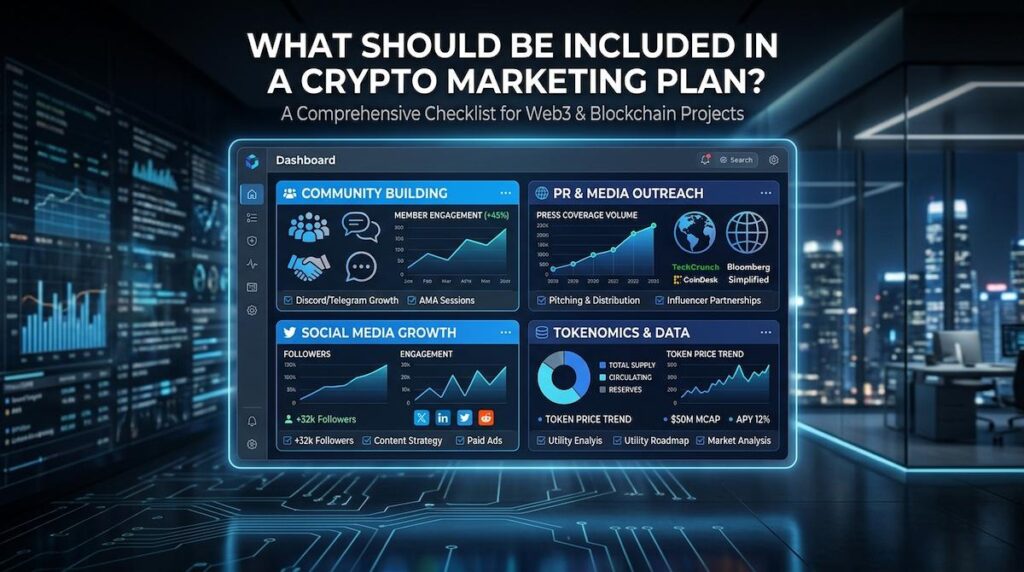
This article explores the essential components every crypto marketing plan should include and why each element plays a critical role in achieving measurable success.
Define Clear Business and Marketing Objectives
Every successful marketing strategy begins with a clearly defined destination.
Crypto startups often attempt to pursue multiple goals simultaneously—token sales, exchange listings, NFT launches, DeFi adoption, and community growth—without prioritization. This usually leads to fragmented campaigns and inefficient spending.
A strong marketing plan should establish objectives such as:
Increase Brand Awareness
Focus on introducing the project to new audiences through PR, social media, influencer collaborations, and educational content.
Drive User Acquisition
Generate wallet signups, platform registrations, or ecosystem participation through targeted campaigns.
Build Investor Confidence
Maintain transparent communication and consistent updates that encourage long-term investment.
Expand Community Engagement
Develop active communities across Telegram, Discord, X (Twitter), Reddit, and other crypto-native platforms.
Each objective should include measurable KPIs such as website traffic, wallet connections, social engagement, or token holder growth.
Understand the Target Audience
Crypto audiences are highly segmented, and messaging should reflect those differences.
Marketing to NFT collectors requires a completely different approach than marketing to institutional investors or Web3 developers.
An effective audience analysis should identify:
Investor Profiles
Retail investors seek growth opportunities, while venture funds focus on technology, scalability, and market potential.
User Personas
Determine whether the project targets gamers, traders, developers, creators, or enterprise users.
Geographic Markets
Crypto adoption varies significantly across regions due to regulations, language, and market maturity.
Pain Points
Understand the problems users face and position the project as a practical solution rather than another speculative asset.
Projects that deeply understand their audience consistently outperform those relying on generic messaging.
Build a Strong Brand Identity
Trust remains one of the biggest challenges in the crypto industry.
Given the number of scams and failed projects, branding plays a major role in establishing legitimacy and professionalism.
A comprehensive branding strategy should include:
Consistent Visual Identity
Maintain unified logos, typography, colors, and design language across every platform.
Clear Brand Voice
Educational, transparent, and community-focused communication builds stronger relationships.
Value Proposition
Explain in simple language why the project exists and how it solves real-world problems.
Storytelling
People connect with missions more than technology. The narrative behind a blockchain project often influences adoption as much as the product itself.
Strong branding transforms a token into a recognizable ecosystem.
Develop a Content Marketing Strategy
Crypto education drives adoption.
Many users remain unfamiliar with blockchain concepts, making educational content one of the most valuable marketing assets.
An effective content strategy should include:
Blog Articles
Publish market insights, technical explanations, and ecosystem updates that improve search visibility.
Educational Guides
Help beginners understand wallets, staking, governance, or token utility through easy-to-follow resources.
Video Content
Explainer videos, AMA sessions, and tutorials generate significantly higher engagement than text-only posts.
Newsletters
Regular email communication keeps investors and community members informed about milestones and upcoming developments.
According to multiple industry studies, companies that consistently publish educational content generate significantly more organic traffic and long-term customer engagement than those relying solely on paid advertising.
Create a Community Growth Strategy
Community is one of the defining characteristics of Web3 projects.
Unlike traditional startups, blockchain ecosystems thrive when users actively participate, advocate, and contribute to governance.
Community management should include:
Active Social Channels
Maintain consistent activity across Telegram, Discord, X, LinkedIn, and Reddit.
Regular AMA Sessions
Founders interacting directly with users create transparency and trust.
Incentive Programs
Rewards, contests, staking campaigns, and referral programs encourage participation.
Moderation and Support
Professional moderation reduces spam while ensuring new members receive timely assistance.
Many of the largest blockchain ecosystems grew through community-led advocacy rather than traditional advertising.
Incorporate SEO and Organic Growth
Paid campaigns can generate traffic quickly, but organic visibility creates sustainable growth.
Search engine optimization should become a long-term component of every crypto marketing plan.
Important SEO activities include:
Keyword Research
Identify search terms related to blockchain solutions, DeFi, NFTs, tokenization, or Web3 services.
Technical Optimization
Fast-loading websites, mobile responsiveness, and structured content improve rankings.
Content Clusters
Create interconnected articles around core blockchain topics to establish authority.
Backlink Development
High-quality media mentions and guest contributions strengthen domain credibility.
Organic traffic often becomes one of the highest-converting acquisition channels because users actively search for relevant solutions.
Plan Social Media and Influencer Campaigns
Crypto conversations happen in real time.
Social media provides direct access to traders, investors, developers, and enthusiasts worldwide.
An effective strategy should combine:
Daily Social Engagement
Regular updates maintain visibility during rapidly changing market cycles.
Influencer Partnerships
Collaborating with respected crypto creators increases credibility and expands reach.
Trend Participation
Reacting quickly to industry developments keeps projects relevant.
Live Spaces and Discussions
Interactive sessions encourage education and community participation.
The most successful campaigns prioritize authentic engagement over promotional messaging.
Allocate Budget Across Marketing Channels
Many crypto startups overspend on isolated campaigns without a clear allocation strategy.
A marketing budget should balance short-term visibility with long-term growth.
Investment areas often include:
- Public relations
- Paid advertising
- Influencer marketing
- SEO and content creation
- Community management
- Event sponsorships
- Exchange marketing campaigns
- Analytics and marketing automation
Diversification reduces dependency on a single acquisition channel.
Blockchain App Factory provides crypto marketing services that help blockchain startups strategically allocate marketing budgets across multiple channels while maximizing visibility, investor engagement, and community growth.
Monitor Analytics and Performance Metrics
A marketing plan should evolve continuously based on performance data.
Without measurement, optimization becomes impossible.
Key metrics include:
Website Performance
Monitor sessions, bounce rates, and user acquisition channels.
Community Growth
Track Discord, Telegram, and social media engagement trends.
Conversion Rates
Measure wallet registrations, staking participation, or token purchases.
PR Performance
Evaluate media mentions, referral traffic, and backlink quality.
Return on Investment
Compare marketing spend against customer acquisition and ecosystem growth.
Data-driven decision making allows blockchain projects to adjust campaigns before budgets are exhausted.
Prepare for Reputation and Crisis Management
Crypto markets move quickly, and negative news can spread within minutes.
Every marketing plan should include a reputation management framework that protects the project’s credibility.
Important preparations include:
Communication Protocols
Define how official statements will be released during market uncertainty.
Transparency Policies
Provide timely updates regarding technical issues or roadmap delays.
Security Communication
Clearly explain responses to exploits, vulnerabilities, or phishing attempts.
Media Response Strategy
Maintain relationships with industry publications to ensure accurate information reaches the public.
Projects that communicate openly during challenges often retain stronger community trust than those that remain silent.
Conclusion
An effective crypto marketing plan extends far beyond promotional campaigns. It integrates strategic objectives, audience analysis, branding, educational content, SEO, community management, influencer outreach, analytics, budgeting, and reputation management into a unified growth framework.
As blockchain adoption continues expanding across finance, gaming, AI, and enterprise technology, competition will only intensify. Projects that invest in comprehensive marketing strategies rather than isolated promotional efforts will be better positioned to build lasting communities, attract investors, and achieve sustainable ecosystem growth.
In the fast-moving world of Web3, marketing is no longer an optional support function—it has become a core driver of long-term success.