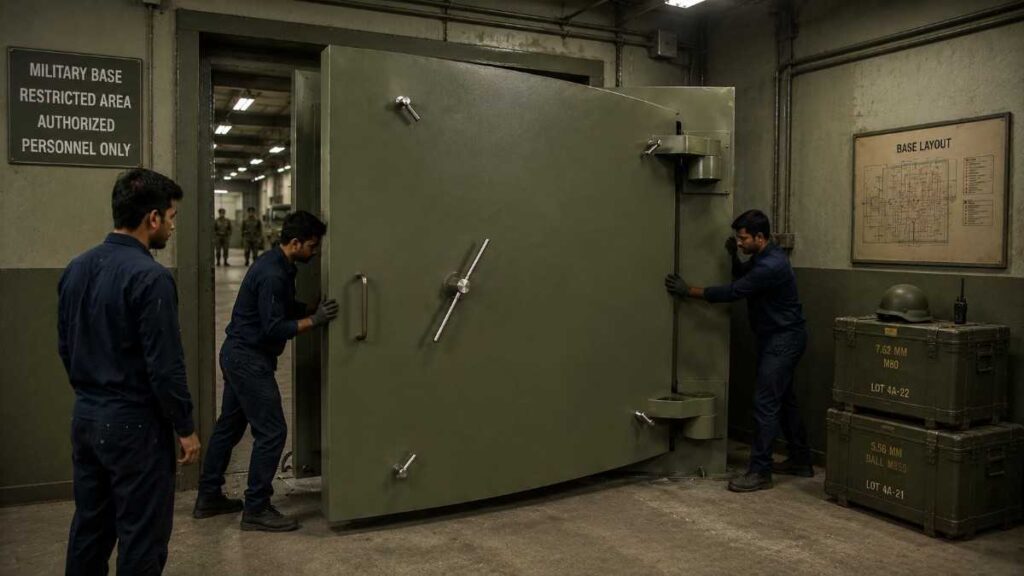

India’s defence sector invested ₹59,400 crore in protective infrastructure during 2024–25, with blast protection systems becoming mandatory for PSUs, refineries, and critical facilities under NBC 2016 and DRDO specifications. As threats evolve, facility managers and procurement officers increasingly search for blast proof door manufacturers in India who can deliver certified, high-performance solutions. This article explains what makes a door truly blast proof, which specs matter for Indian projects, and common specification errors that compromise safety.
Quick Answer: A blast proof door is a reinforced steel barrier engineered to withstand explosive pressure waves, typically rated for 0.5–26 bar peak reflected overpressure and certified to STANAG 2280 or ISO 16933. Indian manufacturers like Sigma Power Tech supply doors for DRDO, IITs, and refinery projects with compliance to NBC 2016 and DRDO specifications.
What is a Blast Proof Door and Why Indian Facilities Need It
A blast proof door is a reinforced steel barrier engineered to withstand pressure waves from explosions, typically rated to resist blast loads from 0.5 to 26 bar overpressure, and used in defence shelters, PSU facilities, and CBRN-protected buildings across India. These doors prevent blast waves and flying debris from entering protected zones, protecting personnel and critical infrastructure during explosions, terrorist attacks, or industrial accidents.
The Indian defence sector now mandates blast protection for military bases, DRDO facilities, and nuclear installations under MoD guidelines. PSU refineries (Indian Oil, BPCL, NTPC) require blast-resistant doors per OISD-117 safety standards for hazardous area classification. Smart building mandates under NBC 2016 also require blast-resistant glazing for high-rises in high-risk zones.
Sigma Power Tech Blast Door systems are engineered for industrial, defence, refinery, and critical infrastructure applications with heavy-duty construction. A certified blast door can withstand up to 40 bar peak reflected overpressure and offer up to 3 hours of fire resistance, depending on the configuration.
How to Select the Right Blast Proof Door for Your Facility
Selecting blast proof door manufacturers in India requires verifying four technical criteria: blast rating certification, frame anchoring system, sealing mechanism, and compliance with Indian or international standards.
- Verify blast resistance rating — Confirm the door is tested for your facility’s required overpressure level (0.5–26 bar typical for Indian defence/PSU projects); procurement teams often mistake fire rating for blast rating
- Check frame anchoring system — Ensure the frame uses hidden anchor bolts embedded 300–400mm into reinforced concrete; weak anchoring causes door failure even if the leaf is certified
- Confirm sealing mechanism specs — Look for hermetic seals that close within 2–5 milliseconds on pressure detection; poor sealing allows blast wave penetration around door edges
- Validate certification documentation — Demand test certificates from BIS-approved labs or DRDO-recognized facilities showing STANAG 2280, ISO 16933, or UFC 3-340-02 compliance
Pro Tip: For Indian defence installations, request DRDO specification CFEES/BD/HD 1.1 compliance documentation; this is the standard used for 2.5m × 2.5m above-ground blast doors in military structures.
Blast resistant doors differ from standard fire doors—they’re engineered for dynamic pressure loads, not just thermal exposure. A door rated FD120 (120-minute fire) may fail at 0.3 bar overpressure if not specifically blast-tested.
Common Mistakes When Specifying or Installing Blast Proof Door
The most common error when specifying blast proof door manufacturers in India is confusing fire rating with blast resistance, leading to procurement of doors that pass fire tests but collapse under 0.5 bar overpressure.
Mistake 1: Assuming all steel doors are blast-resistant
Standard mild steel doors lack I-beam reinforcement and homogenous steel plate construction required for blast loads. Only doors with solid homogeneous steel plates and I-beam stiffeners resist 15–26 bar peak overpressure.
Mistake 2: Ignoring frame anchoring depth requirements
Blast door frames require 300–400mm embedment in reinforced concrete with hidden anchor bolts. Shallow anchoring (150–200mm) causes frame pull-out during blast events, even if the door leaf is certified.
Mistake 3: Overlooking ballistic + blast dual certification
Critical facilities (embassies, defence HQs) need both ballistic resistance (EN 1063 FB7/BR7, NIJ Level IV) and blast rating. Many Indian suppliers offer only one certification, requiring separate systems.
For a complete technical guide on blast proof door manufacturers in India including DRDO specification CFEES/BD/HD 1.1 compliance and 2.5m × 2.5m above-ground structure details, the Blast Door Manufacturer page on SigmaPowerTech.com is worth bookmarking for reference.
Key Specifications and India-Specific Considerations
Key specs for blast proof door manufacturers in India include blast rating (bar overpressure), fire resistance (minutes), ballistic rating (EN/NIJ level), frame material, seal type, and certification standard.
- Standards: STANAG 2280 (NATO), ISO 16933, UFC 3-340-02 (US DoD), DRDO CFEES/BD/HD 1.1, NBC 2016 Part 4 (fire safety), OISD-117 (refineries)
- Typical project context: Defence shelters (DRDO, military bases), PSU refineries (Indian Oil, BPCL, NTPC), IIT research labs, high-risk commercial buildings (DLF, Lulu Mall), hospitals (AIIMS)
- Lead time: 6–10 weeks from Indian manufacturers for custom sizes; 12–16 weeks for STANAG-certified doors with ballistic rating
- Price range: ₹15,000–₹45,000 per square metre for 0.5–5 bar rating; ₹50,000–₹1,20,000/sqm for 10–26 bar rating with ballistic certification
- Climate consideration: Indian coastal facilities (Mumbai, Chennai, Vizag) require hot-dip galvanization or epoxy coating to prevent corrosion from humidity and salt spray; seismic Zone III–IV needs flexible frame anchors
Blast door price varies significantly based on overpressure rating, size, and dual certification requirements. A 2m × 2.2m single-leaf door at 5 bar rating costs roughly ₹1.8–2.5 lakh, while a 2.5m × 2.5m double-leaf door at 26 bar with NIJ Level IV ballistic rating exceeds ₹8–10 lakh.
FAQ
Q: What is a blast proof door and how does it work?
A: A blast proof door is a reinforced steel barrier engineered to withstand explosive pressure waves from 0.5–26 bar overpressure, using solid homogeneous steel plates with I-beam reinforcement to absorb and redistribute blast energy. The door seals hermetically within milliseconds to prevent blast wave penetration, protecting personnel in defence shelters, PSU facilities, and CBRN-protected buildings across India.
Q: What standard does a blast door need to meet in India?
A: Indian facilities require compliance with STANAG 2280 (NATO standard) for defence projects, ISO 16933 for commercial installations, DRDO CFEES/BD/HD 1.1 for military structures, and NBC 2016 Part 4 for fire safety. Refineries must follow OISD-117 for hazardous area blast protection. Always request test certificates from BIS-approved or DRDO-recognized labs.
Q: How much does a blast proof door cost in India?
A: Blast door price in India ranges from ₹15,000–₹45,000/sqm for 0.5–5 bar rating and ₹50,000–₹1,20,000/sqm for 10–26 bar rating with ballistic certification. A 2m × 2.2m single-leaf door at 5 bar costs ₹1.8–2.5 lakh; a 2.5m × 2.5m double-leaf at 26 bar with NIJ Level IV exceeds ₹8–10 lakh. Lead time is 6–16 weeks depending on certification.