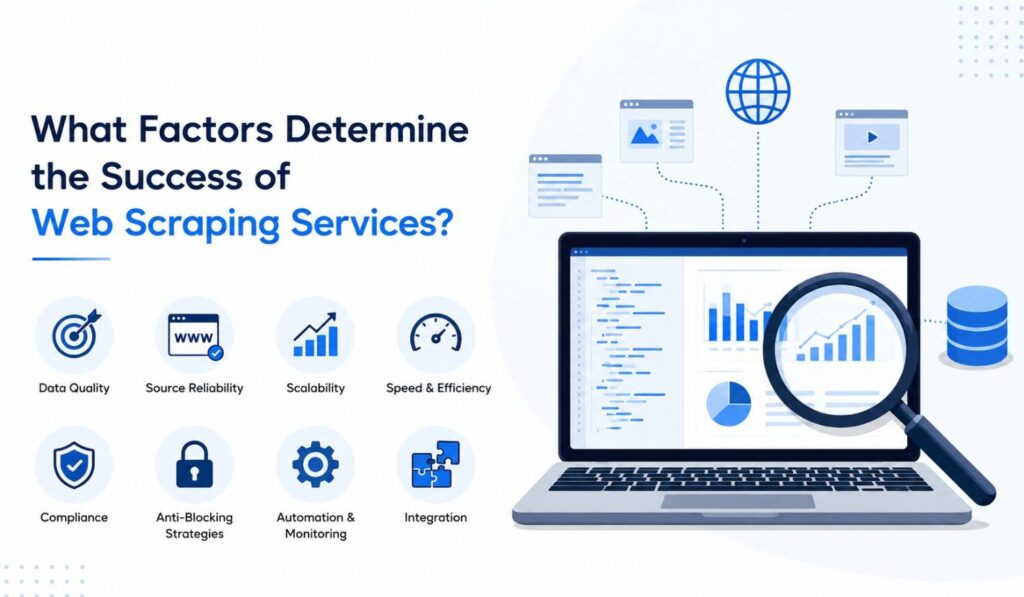

Data has become one of the most valuable business assets, but its value depends entirely on how effectively it is collected and used. Companies across industries rely on automated data extraction to gather market insights, monitor competitors, generate leads, and support strategic planning. However, successful outcomes do not happen simply because information is collected. The real challenge lies in obtaining accurate, timely, and actionable data consistently. At Kanhasoft, projects often reveal that success comes from a combination of technology, adaptability, and ongoing maintenance. After all, even the smartest system is only as good as the data it delivers.
Why Businesses Depend on Reliable Data Extraction
Modern businesses operate in environments where decisions must be made quickly and supported by facts rather than assumptions. Reliable data extraction helps organizations gather valuable information from multiple online sources without spending countless hours on manual research. Whether the goal is tracking competitor pricing, identifying new sales opportunities, or understanding market trends, access to dependable information creates a significant advantage. Over the years, one pattern has become remarkably clear—companies that make decisions using current, well-organized data tend to move faster and adapt more effectively than those relying on outdated spreadsheets and educated guesses.
Data Quality Is the Foundation of Success
Every successful data collection project begins with one essential requirement: quality. Large volumes of information may look impressive on a dashboard, but inaccurate, incomplete, or duplicated records can quickly create confusion. Clean and structured datasets help businesses identify opportunities, reduce errors, and improve operational efficiency. Regular validation processes are equally important because data quality naturally declines over time if left unchecked. A surprising number of business challenges can often be traced back to poor data rather than poor strategy. In many cases, better decisions simply start with better information.
Website Complexity and Source Selection
Not all websites are built the same, and that reality plays a major role in determining project success. Some platforms use simple structures that are easy to process, while others rely heavily on dynamic content, interactive elements, and advanced scripts. Choosing trustworthy data sources is just as important as understanding their technical architecture. A common observation from real-world projects is that seemingly simple websites can become unexpectedly complicated overnight after a redesign. For that reason, flexibility and careful source evaluation remain critical components of any effective data acquisition strategy.
Scalability Determines Long-Term Value
A solution that performs well today should also be capable of supporting future business growth. As organizations expand, data requirements often increase in both volume and complexity. Systems that cannot scale efficiently may create bottlenecks, slow performance, and increase operational costs. Proper infrastructure planning helps ensure that larger workloads can be managed without sacrificing accuracy or speed. One of the most common lessons in technology projects is that growth rarely arrives with advance notice. Building for scalability from the beginning helps businesses avoid costly upgrades and unexpected disruptions later.
Speed and Efficiency Play a Critical Role
In competitive markets, timing can be just as important as accuracy. Access to current information enables organizations to respond quickly to changing conditions, customer demands, and competitor activities. Efficient extraction processes reduce delays and help transform raw information into actionable insights faster. However, speed should never come at the expense of quality. Finding the right balance between performance and reliability is essential. A system that delivers accurate data consistently often creates far more value than one that collects information rapidly but introduces errors along the way.
Compliance and Ethical Data Collection
Successful data initiatives are built on more than technical expertise. Compliance and ethical practices play an equally important role in ensuring sustainable operations. Businesses must understand applicable regulations, respect website policies, and establish responsible data handling procedures. Ignoring these considerations can introduce legal risks and damage organizational reputation. Over time, compliance has evolved from a simple checklist into a strategic advantage. Companies that prioritize transparency and accountability often build stronger trust with customers and partners. In many ways, responsible data practices contribute directly to long-term business success.
The Importance of Anti-Blocking Strategies
One of the biggest challenges in data extraction is maintaining consistent access to information. Many websites implement security measures such as rate limits, IP restrictions, and verification systems to protect their platforms. Without effective anti-blocking strategies, data collection processes can become unreliable and inconsistent. Intelligent request management, session handling, and adaptive collection techniques help minimize disruptions while maintaining performance. A useful observation from past projects is that the most difficult obstacle is rarely gathering data itself—it is ensuring uninterrupted access when websites continuously change their defenses and security mechanisms.
Automation and Monitoring Make the Difference
Automation transforms data collection from a repetitive task into a dependable business process. Automated workflows reduce manual effort, improve consistency, and ensure information is gathered according to predefined schedules. Monitoring is equally important because even the most sophisticated systems require oversight. Real-time alerts can quickly identify changes, failures, or unexpected data issues before they affect business operations. Technology projects often perform best when automation and monitoring work together. One handles routine execution efficiently, while the other provides visibility into performance and helps maintain reliability over the long term.
Integration with Business Systems Increases ROI
Collecting information is only one part of the process. Real value emerges when data flows directly into the systems businesses already use every day. Integration with CRM platforms, ERP solutions, analytics tools, and reporting dashboards helps eliminate manual data transfers and reduces delays. Seamless connectivity allows teams to access insights where they need them most. Organizations frequently discover that data becomes significantly more useful once it is connected to existing workflows. Instead of sitting in isolated databases, information can actively support sales, operations, customer service, and strategic decision-making.
A Lesson We Learned from a Real-World Project
Several years ago, a project appeared surprisingly straightforward during the planning stage. The target website had a clean structure, predictable navigation, and accessible information. Everything seemed ready for a smooth implementation. Then, almost overnight, the website introduced major structural changes that affected the entire extraction process. Fortunately, continuous monitoring identified the issue quickly and allowed adjustments before business operations were impacted. Experiences like this reinforce an important reality—successful projects are rarely defined by perfect conditions. They are defined by preparation, adaptability, and the ability to respond when circumstances change unexpectedly.
How to Evaluate a Data Collection Partner
Choosing the right technology partner can significantly influence project outcomes. Technical expertise is certainly important, but long-term support, scalability, and problem-solving capabilities deserve equal attention. A reliable provider should understand complex website structures, implement quality assurance processes, and maintain systems as requirements evolve. Businesses should also evaluate security practices and compliance standards before making a decision. Experience has shown that successful partnerships are built on more than technical skills alone. Strong communication, proactive support, and a commitment to continuous improvement often make the greatest difference over time.
Emerging Trends Shaping the Future
The future of data extraction continues to evolve as technology advances. Artificial intelligence is improving data validation, pattern recognition, and automated adaptation to website changes. Real-time analytics integration is also becoming increasingly common, enabling organizations to act on information faster than ever before. At the same time, growing attention to compliance and data governance is influencing how systems are designed and maintained. Looking ahead, businesses will likely focus on creating smarter, more resilient solutions that combine automation, accuracy, and adaptability. The goal is no longer simply collecting data—it is transforming information into actionable intelligence.
Conclusion
The success of web scraping services depends on several interconnected factors, including data quality, scalability, speed, compliance, automation, and system adaptability. Focusing on only one of these elements rarely delivers lasting results. Sustainable success comes from building a balanced approach that supports both current requirements and future growth. Throughout many projects, one lesson consistently stands out: collecting information is the easy part; transforming that information into reliable buasiness value is where the real challenge begins. Organizations that invest in strong processes and flexible technology are often the ones that gain the greatest competitive advantage.
Frequently Asked Questions
What is the most important factor in successful data extraction?
Data quality is often considered the most important factor because accurate information supports better decision-making and reduces costly mistakes.
Why do extraction systems sometimes stop working?
Websites frequently update their structure, design, or security measures, which can affect existing extraction processes.
How does automation improve results?
Automation reduces manual effort, improves consistency, and ensures information is collected and delivered on schedule.
Can data collection systems scale with business growth?
Yes. Properly designed solutions can handle larger datasets, more sources, and increased collection frequency as business needs expand.
Why is compliance important?
Compliance helps reduce legal risks, protects business reputation, and supports sustainable long-term operations.
How can businesses maximize return on investment?
Organizations achieve better ROI by integrating collected data with business systems and using insights to support strategic decisions.