
Knee replacement surgery is often recommended when knee arthritis, joint damage, or severe pain affects daily life and non-surgical treatments no longer provide enough relief. While most patients know that an artificial joint is placed during surgery, they may not know what the implant is actually made of. This is where understanding Knee Replacement Material becomes important.
Patients searching for knee replacement surgery in Greater Noida often want clear, simple, and reliable information before taking the next step. Dr Bharat Goswami helps patients understand implant materials in a practical way so they can feel confident and prepared.
Why Artificial Knee Design Needs Multiple Materials
The human knee is a complex joint. It carries body weight, allows bending, supports balance, and absorbs pressure during movement. A knee implant must perform similar functions with artificial materials.
No single material can do everything perfectly. That is why knee implants use a combination of metals, plastic, and sometimes ceramic or coated surfaces. Each material has a different role.
Metal provides strength.
Polyethylene provides smooth movement.
Bone cement provides fixation.
Special coatings may support selected patient needs.
This combination helps create a joint that can function safely during daily activities.
Femoral Component: The Strong Upper Part
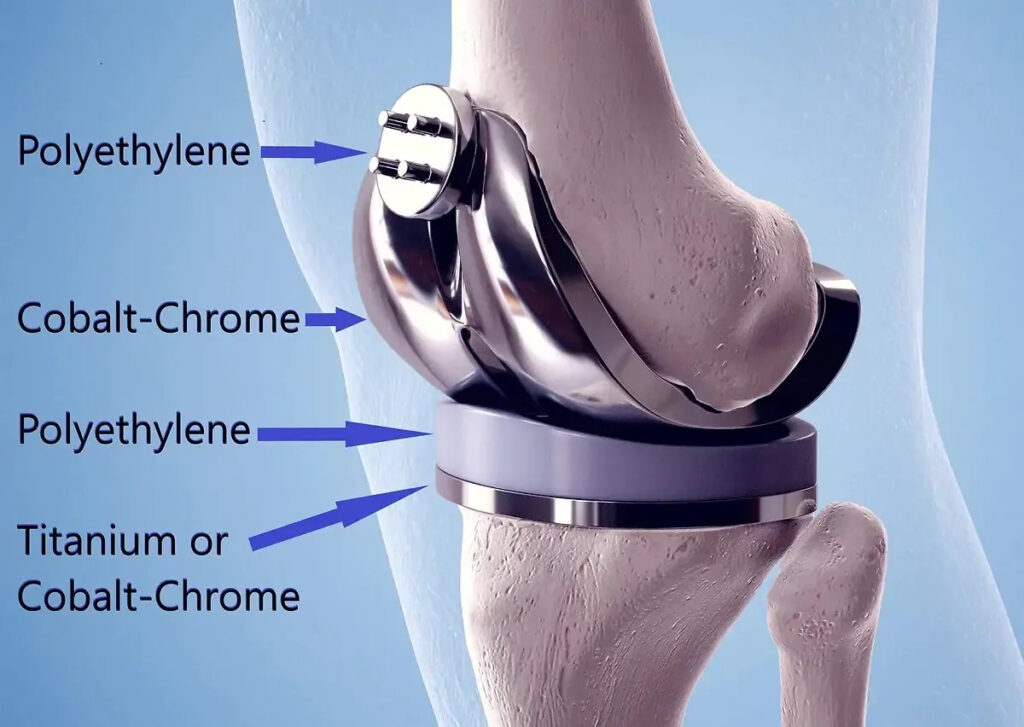
The femoral component replaces the damaged lower surface of the thigh bone. It is usually made from cobalt-chromium alloy or other strong metal materials. This part must be very smooth because it moves against the plastic insert during knee bending.
Cobalt-chromium is commonly used because it is strong and has good wear resistance. It can handle repeated movement and pressure. The surface is polished to reduce friction and support smoother motion.
The quality of placement is very important. Even a good material may not perform well if alignment is poor. That is why surgeon expertise matters.
Tibial Baseplate: Support for Body Weight
The tibial component sits on top of the shin bone. It supports body weight and provides a stable base for the plastic insert. It may be made of metal such as titanium or cobalt-chromium, depending on the implant design.
The tibial baseplate must be strong enough to handle walking, standing, and stair climbing. It also needs to remain stable inside the bone.
For patients looking for the Best orthopedic surgeon in Greater Noida, understanding this part helps them ask better questions during consultation.
Polyethylene Insert: The Artificial Cartilage Layer
The polyethylene insert is one of the most important parts of knee replacement. It acts as a smooth spacer between the femoral component and tibial baseplate. In a natural knee, cartilage allows smooth joint movement. In an artificial knee, polyethylene performs a similar role.
This material is designed to reduce friction and allow bending. Modern polyethylene is manufactured to improve wear resistance. However, like any material, it can wear gradually over time depending on activity, weight, alignment, and implant design.
Patients should follow advice on movement, exercise, and weight management to protect the implant.
Patellar Component: When the Kneecap Surface Is Replaced
In some knee replacement surgeries, the back surface of the kneecap may also be replaced. This is called the patellar component. It is commonly made from polyethylene.
Not every patient needs patellar resurfacing. The surgeon decides based on cartilage damage, kneecap tracking, pain pattern, and overall knee condition.
The goal is to reduce pain in front of the knee and support smoother movement when bending or climbing stairs.
Cemented and Cementless Implant Surfaces
Implant fixation is another important part of knee replacement. In cemented fixation, medical bone cement is used to attach the implant to bone. This method is widely used and provides early stability.
In cementless fixation, the implant surface is designed so that bone can grow into it. This may be considered for selected patients with strong bone quality. Cementless implants often have porous surfaces that encourage biological fixation.
Both methods have their place. The choice depends on patient age, bone health, surgeon preference, and implant type.
Special Materials for Sensitive Patients
Some patients may have concerns about metal sensitivity. If someone has a known history of metal allergy, skin reactions to jewelry, or previous implant-related issues, they should discuss this before surgery.
Special implant materials or coated implants may be available in selected cases. These may include ceramic-coated or hypoallergenic options. However, they are not necessary for all patients.
A patient should not self-select an implant type without proper evaluation. The orthopedic surgeon is the right person to guide material selection.
Does Implant Material Affect Knee Movement?
Implant material can influence smoothness, durability, and wear resistance, but movement after surgery depends on many factors. These include knee condition before surgery, muscle strength, physiotherapy, surgical technique, pain control, and patient effort.
A patient who follows rehabilitation properly often has better functional recovery. The implant material supports movement, but exercises help restore strength and flexibility.
Myths About Knee Replacement Materials
Many myths confuse patients. Some believe imported implants are always better. Some think metal implants are unsafe. Others believe that premium implants remove the need for physiotherapy. These ideas are not completely accurate.
The best implant is not decided by price alone. It should match the patient’s bone condition, activity level, medical profile, and knee structure. A skilled surgeon can explain why a particular material is suitable.
Choosing Surgery in Greater Noida
For patients considering knee replacement surgery in Greater Noida, the consultation should include proper diagnosis, X-rays, treatment history, lifestyle discussion, and implant planning. A transparent discussion helps patients understand benefits, limitations, recovery, and possible risks.
Dr Bharat Goswami may advise surgery only when clinically appropriate and after evaluating the patient’s condition. Patients should also understand that knee replacement is not an emergency decision in most arthritis cases. It should be planned carefully.
Safety, Follow-Up, and Long-Term Care
After knee replacement, regular follow-up is important. The doctor checks healing, movement, implant position, and recovery progress. Patients should avoid ignoring unusual pain, swelling, fever, wound issues, or sudden difficulty walking.
Long-term implant care includes maintaining a healthy weight, staying active with low-impact exercises, avoiding unsafe movements, and following medical guidance.
Conclusion
Knee replacement implants are made from carefully selected materials such as metal alloys, polyethylene, bone cement, and sometimes special coated surfaces. Each Knee Replacement Material has a specific role in strength, movement, stability, and comfort.
For anyone searching for the Best orthopedic surgeon in Greater Noida, a detailed consultation can help explain which implant material is suitable and why. With proper planning, skilled surgery, and disciplined recovery, knee replacement surgery in Greater Noida can help many patients regain mobility and improve quality of life.