
Most adults don’t wake up one day and think, “I might have ADHD.”
Instead, it shows up quietly — unfinished tasks, constant mental noise, emotional burnout, or the feeling of always being “a step behind.”
For many people, ADHD disorder goes unnoticed for years. Not because it isn’t there — but because it doesn’t look the way people expect.
This guide breaks down the real, often ignored signs of undiagnosed ADHD in adults, what it actually feels like, and how people are finally recognizing it in 2026.
What Is ADHD?
ADHD full form is Attention-Deficit/Hyperactivity Disorder.
But here’s what most definitions miss:
It’s not just about attention. It’s about how the brain manages focus, emotions, time, and energy.
Adults with ADHD often:
- Can focus deeply on things they enjoy
- Struggle with routine or boring tasks
- Feel mentally overwhelmed even with simple responsibilities
That’s why many people don’t realize they’re dealing with ADHD symptoms — they just think they’re “bad at life.”
Why ADHD Often Goes Undiagnosed in Adults
ADHD is usually associated with hyperactive children. But adult ADHD looks very different.
Here’s why people miss it:
- You were labeled “lazy” or “careless” growing up
- You developed coping mechanisms (last-minute work, overworking)
- You’re functioning — but constantly exhausted
- Emotional struggles were mistaken for anxiety or stress
In many cases, adults don’t consider ADHD diagnosis until their late 20s, 30s, or even later.
Hidden ADHD Symptoms Most Adults Ignore
These are not the obvious signs — these are the ones people live with daily without realizing.
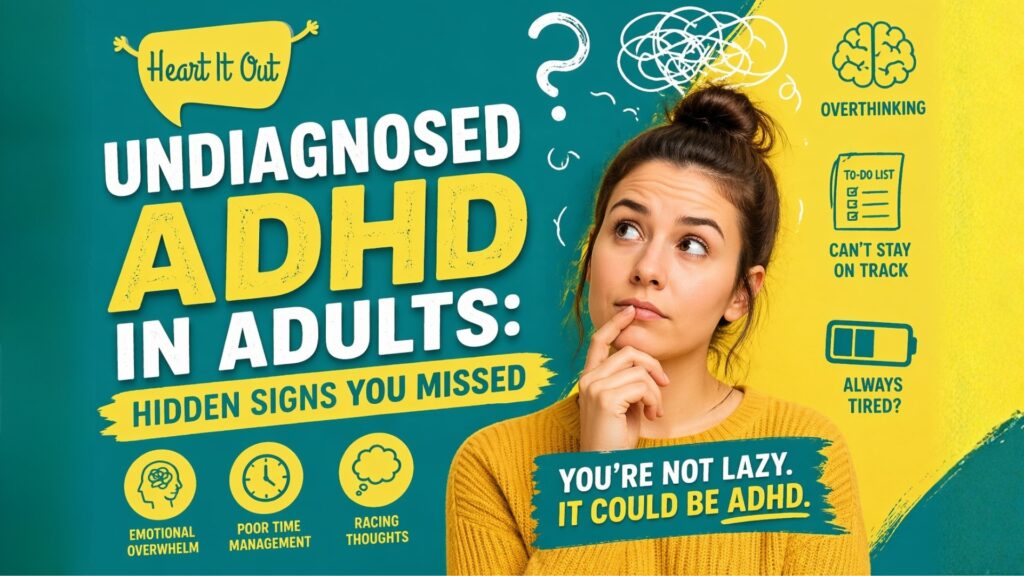
1. “I Start Everything, Finish Nothing”
You begin projects with excitement… but lose interest halfway.
- Multiple unfinished tasks
- Jumping between ideas
- Feeling guilty for not completing things
This is one of the most common ADHD symptoms in adults.
2. Constant Mental Noise (Overthinking Never Stops)
Your brain feels like:
- 10 tabs open at once
- Random thoughts interrupting focus
- Difficulty “switching off” even at night
Many people describe it as mental clutter, not hyperactivity.
3. Time Blindness (Losing Track of Time Easily)
- Underestimating how long tasks take
- Running late even when you try not to
- Spending hours on one small task
This isn’t poor discipline — it’s how ADHD affects time perception.
4. Emotional Sensitivity You Can’t Explain
You may feel:
- Overwhelmed by small criticism
- Intense frustration or anger
- Sudden mood shifts
This is linked to emotional regulation — a lesser-known part of ADHD disorder.
5. “I Work Better Under Pressure Only”
You delay tasks… until the deadline creates urgency.
- Last-minute productivity bursts
- Procrastination followed by panic
- Burnout cycles
This pattern is extremely common in undiagnosed ADHD.
6. Forgetfulness That Feels Embarrassing
- Forgetting conversations
- Missing appointments
- Losing everyday items
It’s not about memory — it’s about attention.
ADHD Symptoms in Hindi (Quick Understanding)
Many people search for clarity in their own language.
ADHD symptoms in Hindi can be understood simply as:
- ध्यान केंद्रित करने में कठिनाई
- बार-बार चीज़ें भूलना
- काम अधूरा छोड़ देना
- बेचैनी या मन का भटकना
- भावनात्मक उतार-चढ़ाव
These signs are often ignored or misunderstood in adults.
Should You Take an ADHD Test Online?
If you relate to multiple signs above, you might consider an ADHD test online.
But here’s the reality:
- Online tests are screening tools, not diagnosis
- They can help you understand patterns
- They should not replace professional evaluation
Think of them as a starting point, not a final answer.
How ADHD Diagnosis Actually Works
A proper ADHD diagnosis Bangalore (or anywhere) usually includes:
- Detailed personal history
- Behavioral pattern assessment
- Standardized psychological tools
- Understanding childhood and adult symptoms
Sometimes, people also look for ADHD diagnosis in Tamil or other regional languages — clarity in your native language can make the process more comfortable and accurate.
ADHD Treatment: What Actually Helps?
ADHD treatment is not one-size-fits-all. It usually combines:
1. Therapy & Behavioral Support
- Understanding patterns
- Building coping strategies
- Improving emotional regulation
2. Lifestyle Adjustments
- Structured routines
- Sleep and nutrition balance
- Reducing overwhelm triggers
3. Medication (If Required)
Prescribed by professionals when needed.
The goal is not to “fix” you — but to help your brain work better with your life.
When Should You See an ADHD Specialist?
You may want to search for an ADHD specialist near me if:
- Your daily life feels consistently chaotic
- You struggle despite trying hard
- Relationships or work are affected
- You feel mentally exhausted most of the time
Getting clarity is often the first step toward relief.
The Reality Most People Don’t Talk About
Undiagnosed ADHD often comes with:
- Self-doubt
- Shame from years of misunderstanding
- Feeling “different” without knowing why
But here’s the truth:
You’re not lazy.
You’re not careless.
You’re likely dealing with something that was never explained properly.
Final Thought
After going through research, real experiences, and how people describe their journey — one thing becomes clear:
Understanding ADHD is not about labels. It’s about clarity.
Many people spend years feeling stuck, only to realize later that they were dealing with something real — something explainable.
If you’re someone trying to understand these patterns deeply, exploring platforms like Heart It Out can be helpful — not as a quick solution, but as a place where conversations around mental health feel more practical, grounded, and human.
Sometimes, the right information — and the right kind of support — makes all the difference.
FAQs
1. Can ADHD develop in adulthood?
No, ADHD doesn’t suddenly appear. It usually starts in childhood but goes unnoticed and shows differently in adults.
2. Is ADHD a mental illness or disorder?
ADHD is a neurodevelopmental condition, often referred to as an ADHD disorder, affecting brain function and behavior.
3. How accurate is an ADHD test online?
Online tests can indicate patterns, but they are not a substitute for a clinical diagnosis.
4. What is the biggest hidden symptom of ADHD in adults?
Time blindness and emotional overwhelm are often the most ignored but impactful symptoms.
5. Can ADHD be treated without medication?
Yes. Many people manage ADHD with therapy, structure, and lifestyle changes, depending on severity.