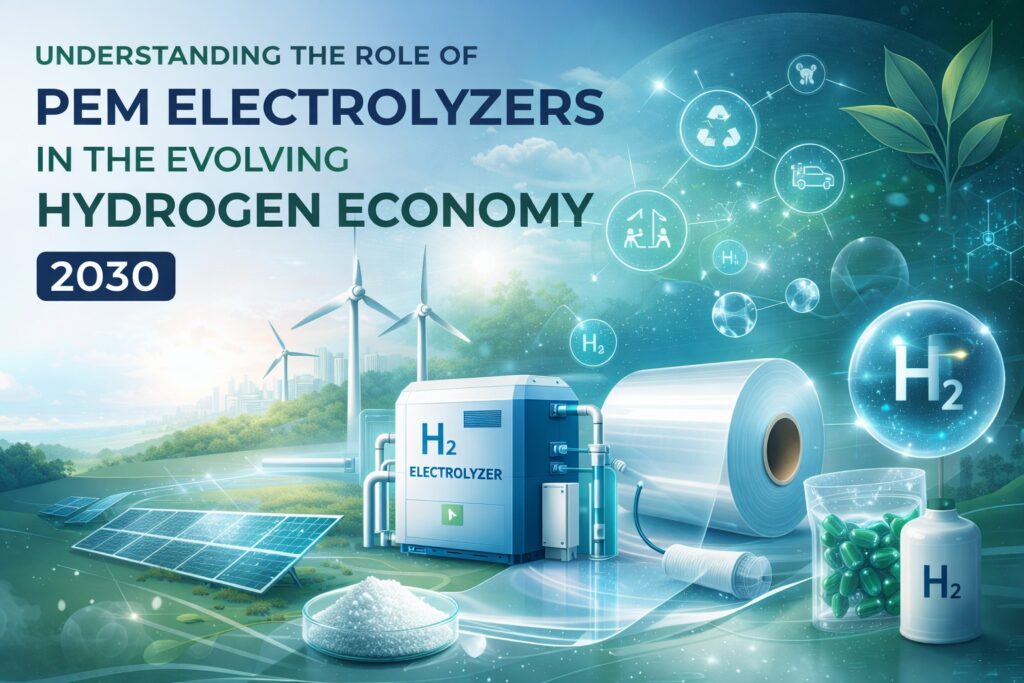

The global energy landscape is undergoing a structural transformation, driven by the need to decarbonize industrial processes and reduce dependence on fossil fuels. Within this shift, hydrogen has emerged as a promising energy carrier, particularly in sectors that are difficult to electrify. Among the various technologies enabling hydrogen production, Proton Exchange Membrane (PEM) electrolyzers are gaining increasing attention due to their operational flexibility and compatibility with renewable energy systems, as highlighted in insights by MarkNtel Advisors.
PEM electrolyzers function by using electricity to split water into hydrogen and oxygen through an electrochemical process. Unlike conventional alkaline electrolyzers, PEM systems rely on a solid polymer membrane that conducts protons while acting as a barrier to gases. This design enables higher efficiency, faster response times, and the ability to operate under variable power inputs, making them particularly suitable for integration with intermittent renewable energy sources such as solar and wind.
Growing Relevance of Green Hydrogen Production
The rising focus on green hydrogen produced using renewable electricity has significantly elevated the importance of PEM electrolyzer technology. As countries work toward net-zero emission targets, hydrogen is being positioned as a key enabler in decarbonizing industries such as steel, chemicals, refining, and heavy transport. PEM electrolyzers are particularly relevant in this context because they can quickly adjust to fluctuations in renewable power generation, ensuring stable hydrogen output even in dynamic energy environments.
In addition, PEM systems offer higher current densities and compact system designs compared to traditional technologies. This makes them more adaptable for decentralized hydrogen production, including on-site generation for industrial facilities or refueling stations. Their ability to produce high-purity hydrogen without extensive downstream purification further enhances their operational efficiency in critical applications.
Technological Advantages and Operational Flexibility
One of the defining characteristics of PEM electrolyzers is their dynamic response capability. Unlike alkaline systems, which are better suited for steady-state operations, PEM electrolyzers can ramp up or down quickly in response to changes in electricity supply. This flexibility allows operators to optimize production based on electricity availability and pricing, particularly in regions with high renewable energy penetration.
Furthermore, PEM electrolyzers operate at relatively higher pressures, which can reduce or eliminate the need for additional hydrogen compression. This contributes to lower overall system complexity and can improve the economics of hydrogen storage and transportation. The compact footprint of PEM systems also supports deployment in space-constrained environments, including urban or industrial clusters where land availability may be limited.
Material innovation is another important aspect shaping the development of PEM electrolyzers. The use of advanced catalysts, often based on precious metals such as platinum and iridium, enhances performance but also introduces cost considerations. Ongoing research is focused on reducing catalyst loading and identifying alternative materials to improve scalability and cost efficiency over time.
Market Dynamics and Industry Adoption
As per the study published by MarkNtel Advisors, the Global PEM Electrolyzer Market is experiencing steady growth, supported by increasing investments in hydrogen infrastructure and supportive policy frameworks. Governments across Europe, North America, and Asia-Pacific are introducing incentives, subsidies, and regulatory measures to accelerate the adoption of green hydrogen technologies. These initiatives are encouraging both public and private stakeholders to invest in large-scale electrolyzer projects.
Industrial sectors are also beginning to incorporate PEM electrolyzers into their decarbonization strategies. For example, refineries and chemical manufacturers are exploring the replacement of grey hydrogen traditionally produced from natural gas with green hydrogen generated through electrolysis. Similarly, the mobility sector is witnessing growing interest in hydrogen fuel cell vehicles, which rely on a stable supply of hydrogen produced through efficient technologies such as PEM electrolyzers.
The integration of PEM electrolyzers with renewable energy projects is another emerging trend. Co-locating electrolyzers with solar or wind farms can help utilize excess electricity that might otherwise be curtailed. This not only improves the economics of renewable energy projects but also contributes to the development of a more resilient and flexible energy system.
Challenges and Considerations
Despite their advantages, PEM electrolyzers face several challenges that may influence their adoption trajectory. One of the primary concerns is the relatively high capital cost compared to alternative electrolysis technologies. The reliance on scarce and expensive materials for catalysts and membranes contributes to this cost structure, although ongoing innovation is expected to address these limitations over time.
Infrastructure constraints also play a significant role. The development of hydrogen production facilities must be complemented by investments in storage, transportation, and distribution networks. Without a well-developed hydrogen ecosystem, the scalability of PEM electrolyzer deployment may be limited, particularly in regions where hydrogen demand is still emerging.
Additionally, the availability and cost of renewable electricity remain critical factors. Since the environmental and economic viability of PEM electrolyzers is closely tied to renewable energy inputs, fluctuations in power availability or pricing can impact hydrogen production costs. This highlights the importance of integrated energy planning and long-term policy support.
Outlook: A Gradual but Strategic Expansion
The role of PEM electrolyzers in the hydrogen economy is expected to expand gradually as technological advancements, policy support, and market demand converge. While challenges related to cost and infrastructure persist, the inherent advantages of PEM technology particularly its flexibility and efficiency position it as a key component in the transition toward cleaner energy systems.
As industries continue to explore pathways for decarbonization, PEM electrolyzers are likely to play a strategic role in enabling the production of green hydrogen at scale. Their integration with renewable energy sources, coupled with ongoing innovation in materials and system design, reflects a broader shift toward more sustainable and adaptable energy solutions.
In this evolving landscape, PEM electrolyzers are not merely a technological option but a critical enabler of a low-carbon future, bridging the gap between renewable energy generation and hydrogen-based applications across multiple sectors.