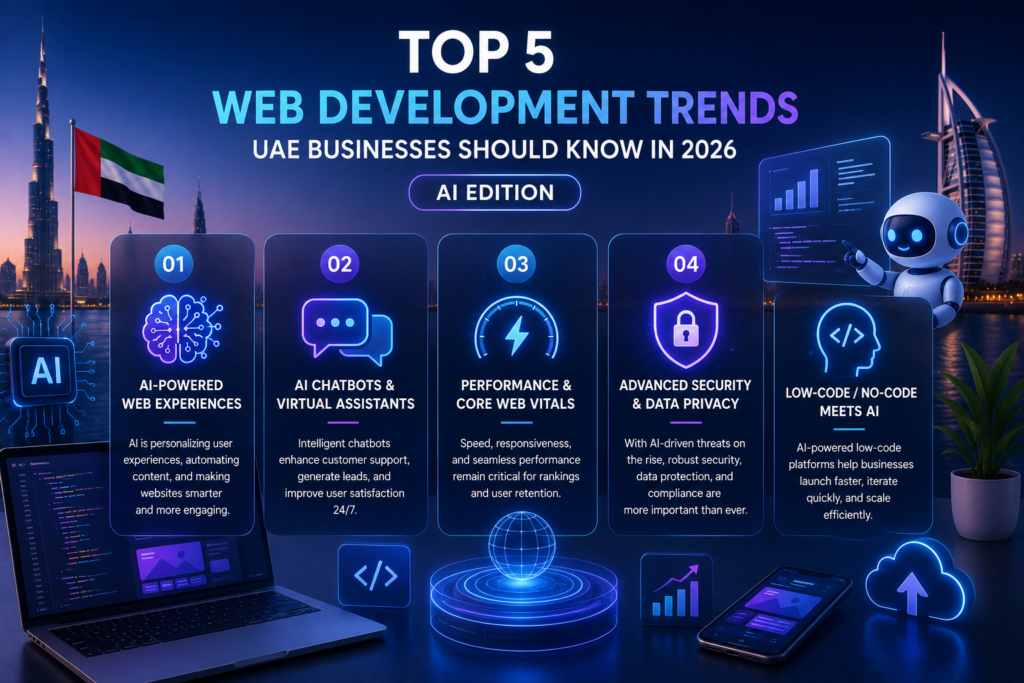

If you’ve noticed your competitors’ websites getting faster, smarter, and more personalized lately, you’re not imagining it. Something has genuinely shifted in how websites get built, and it’s largely thanks to AI moving from a “nice to have” into the core of the development process.
For UAE business owners, startups, and anyone browsing local websites daily, understanding these trends isn’t just interesting trivia. It directly affects how you choose a web development company in UAE that clients can trust, and what kind of website actually performs in this market.
Here are the five trends actually shaping web development in the UAE right now, backed by real data.
1. AI-Native Web Applications Are Becoming the Standard
A few years ago, AI was something bolted onto a website after the fact, a chatbot widget here, a recommendation engine there. That’s changing fast. Developers are now building AI capabilities into the foundation of a website or app from day one.
What does this look like in practice? Think of an e-commerce site that adjusts product recommendations in real time based on browsing behavior, or a UAE real estate platform that predicts what property type a visitor is likely searching for based on their search patterns. More than 90% of web designers now report using AI tools somewhere in their workflow, which tells you this isn’t a niche approach anymore; it’s becoming the default.
For a UAE startup building a new platform, this means asking your development partner early: “How will AI actually work inside this product, not just around it?”
2. AI-Assisted Coding Is Cutting Development Timelines
This is the trend business owners care about most, because it directly affects cost and speed to market. AI coding assistants now handle a large share of routine development work, and in practice, these tools can reduce project timelines by 30-50%.
For a UAE business trying to launch before a busy season, or a startup racing to get an MVP in front of investors, this timeline compression is a real competitive advantage. It’s worth noting, though, that this speed comes from AI handling the repetitive groundwork, not from replacing skilled developers who make the actual architectural and design decisions.
3. Personalization Powered by Real-Time Data
UAE audiences are diverse: Emirati nationals, a huge expat population, tourists, and a genuinely bilingual (often trilingual) customer base. Generic, one-size-fits-all websites don’t perform well here anymore.
AI-driven personalization now lets websites adjust content, language emphasis, and even layout based on who’s visiting and how they’re behaving. A hospitality business in Dubai, for instance, can show different offers to a visitor browsing in Arabic versus English, or prioritize mobile-optimized booking flows for the majority of UAE users who browse on their phones.
This isn’t theoretical. Businesses that adopt AI-driven personalization are seeing measurable gains in conversion rates because the experience feels relevant instead of generic.
4. AI Chatbots and Voice Search Are Becoming Essential
Voice search and AI chatbots used to feel like gimmicks. Not anymore. As more UAE consumers use voice assistants and expect instant answers, businesses that ignore this are leaving conversions on the table.
A well-built AI chatbot today can handle bookings, answer product questions in multiple languages, and hand off to a human only when necessary, which matters a lot for UAE businesses serving customers across different time zones, especially those working with international clients or tourists.
5. Meta-Frameworks and Faster, Leaner Builds
On the technical side, frameworks like Next.js and Nuxt have become the default starting point for most professional projects, handling routing, data fetching, and rendering in ways that used to require significant custom setup. Combined with AI-assisted coding, this means development teams spend less time on infrastructure and more time on the actual product experience, the parts that matter to your customers and your bottom line.
Real-World Application: Why This Isn’t Just Theory
It’s one thing to read about trends. It’s another to see how they actually play out on a real project.
Bootesnull, a web and app development company, has built apps that combined AI-assisted development with real UAE market data, resulting in a product that launched faster and performed better with local users than a traditional build would have. The key wasn’t just using AI tools for the sake of it. It was pairing those tools with genuine understanding of what UAE users actually respond to.
That combination- modern AI-driven tooling plus real regional expertise- is what separates a web development company in UAE startups can grow with from an agency simply following trends without understanding the local market.
If you’re currently evaluating options for your own project, ask potential partners for concrete examples of how they’ve applied these trends, not just a list of buzzwords.
What This Means for Your Next Website or App
If you’re planning a new project in 2026, here’s the practical takeaway:
- Ask about AI integration upfront, not as an afterthought bolted on later.
- Prioritize personalization if you’re targeting the UAE’s diverse, bilingual audience.
- Don’t skip mobile and voice optimization; most UAE users are browsing on their phones.
- Choose a partner who understands local context, not just global trends.
- Balance speed with quality; faster builds are great, but not at the cost of a stable, secure product.
Working with an experienced web development company in UAE that businesses already trust means you get both the technical advantage of AI tools and the local market knowledge that actually makes a website succeed here.
Final Thoughts
Web development in the UAE is moving fast, and AI is the biggest reason why. From AI-native apps to smarter personalization and faster builds, these trends aren’t going anywhere; they’re becoming the baseline expectation. Businesses that adapt now will have a real head start over those that wait.
Frequently Asked Questions
1. Do I need an AI-powered website, or is a traditional website still fine?
For most small businesses, a well-built traditional website still works. But if you’re targeting a diverse UAE audience or competing in a crowded space like e-commerce or hospitality, AI-driven personalization can meaningfully improve conversions.
2. How much more does an AI-integrated website cost compared to a regular one?
It varies. Basic personalization and chatbot features often add modest cost, while deeper AI integration (like predictive recommendations) requires more development time. A good agency will help you scope this based on your actual budget and goals.
3. Is Next.js or a similar framework necessary for my project?
Not always. For simple websites, it may be overkill. For web apps, e-commerce platforms, or anything expected to scale, modern frameworks make development faster and more maintainable long-term.
4. Will an AI chatbot actually help my UAE business, or is it just a trend?
For businesses handling frequent customer questions, bookings, or multilingual support, chatbots genuinely reduce workload and improve response times. For very small, low-traffic sites, the benefit may be minimal.
5. How do I know if a web development agency is actually using AI well, versus just claiming to?
Ask for specific examples: what AI tools they use, what measurable difference it made (timeline, bugs, personalization results), and how they balance AI with human oversight. Vague answers are a warning sign.