
Building a commercial cannabis cultivation facility is one of the most complex construction and design undertakings in the modern regulated industry. Unlike a standard warehouse conversion or retail buildout, a cannabis grow facility must simultaneously satisfy regulatory compliance requirements, agronomic performance demands, operational workflow efficiency, and long-term scalability all within the constraints of budget, timeline, and local permitting.
This ultimate guide to cannabis cultivation facility design covers the key pillars of successful project planning and execution, drawing on best practices from leading cultivators and facility design consultants across the United States.
Step 1: Site Selection and Feasibility Analysis
The right site sets the foundation for everything that follows. Key criteria include: zoning compliance with local cannabis ordinances, adequate utility service (especially electrical capacity; a 10,000 sq ft grow facility may require 800–1,200 amps at 480V), building structure suited for modification, and proximity to workforce and distribution infrastructure.
Feasibility analysis should include a utility pre-application, a zoning and use permit assessment, an environmental review if required, and a preliminary construction cost estimate. Skipping this step leads to costly surprises mid-project.
Step 2: Facility Layout and Workflow Optimization
Great cannabis facility design starts with workflow. The movement of people, plants, and products through the facility must be logical, efficient, and compliant. A well-designed cannabis facility separates:
- Propagation and Vegetative Areas: Dedicated rooms with 18-hour light cycles, high humidity tolerance, and multi-tier racking capacity.
- Flowering Rooms: 12-hour light cycle rooms with precise environmental control, typically the largest investment in the facility.
- Drying and Curing Rooms: Low-temperature, humidity-controlled spaces designed for consistent post-harvest quality.
- Trimming and Packaging: Clean room environments with one-way product flow, personnel airlocks, and contamination prevention protocols.
- Storage and Vault: Secure, climate-controlled inventory storage compliant with state seed-to-sale tracking requirements.
Staff movement should follow a unidirectional flow from clean to less-clean zones. Contamination prevention whether microbial, chemical, or pest-related is built into the physical design through spatial separation, pressure differentials, and gowning procedures.
Step 3: MEP Engineering HVAC, Electrical, and Plumbing
Mechanical, Electrical, and Plumbing (MEP) engineering accounts for 40–60% of cannabis facility construction costs, and it is where the most costly mistakes are made.
HVAC must be designed specifically for cannabis: high latent loads from transpiration, 24/7 operation, and the need for redundancy to prevent crop loss during equipment failure. Electrical systems must support high-intensity lighting, HVAC, irrigation pumps, security systems, and processing equipment all on separate circuits with arc-fault and ground-fault protection. Plumbing must support reverse osmosis water treatment, fertigation dosing systems, floor drains with containment, and fire suppression.
Step 4: Lighting Design
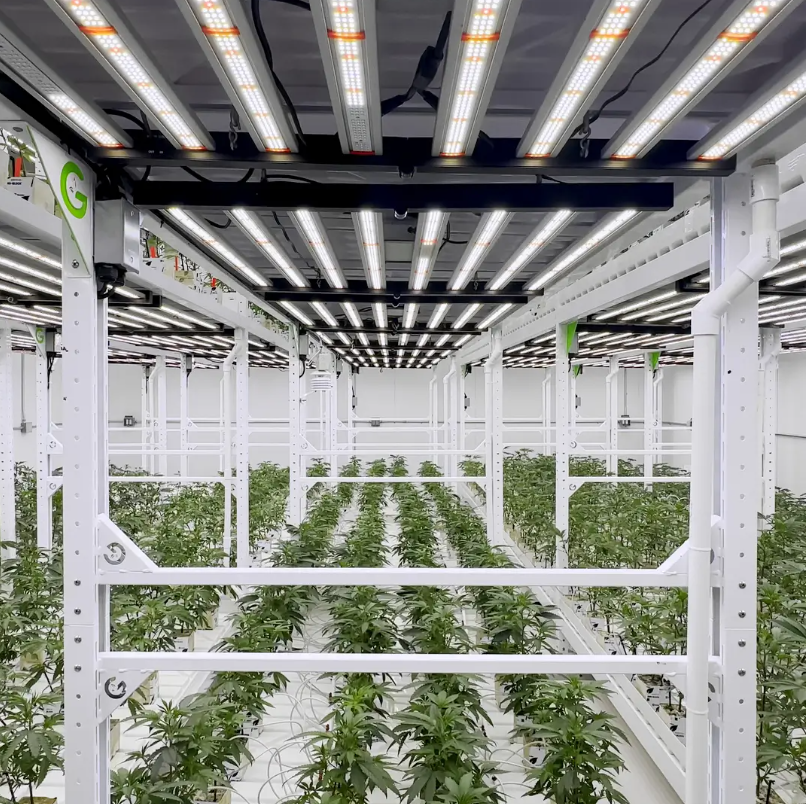
Lighting is the engine of cannabis production. Modern commercial grows are rapidly adopting full-spectrum LED technology for its energy efficiency, reduced heat output, spectrum tunability, and longer fixture lifespan compared to legacy HPS lighting. Lighting design must account for photosynthetic photon flux density (PPFD) uniformity across the canopy (target 800–1,200 µmol/m²/s for flowering), fixture mounting height, inter-canopy spacing, and electrical load calculations.
Step 5: Permitting, GMP, and GACP Compliance
Cannabis facility design must be built around the applicable regulatory framework from day one. State licensing requirements, local building permits, fire marshal approvals, and health department inspections all require detailed documentation of facility design, security systems, waste management, and environmental controls. Medical cannabis facilities pursuing GMP or GACP certification require additional design elements including validated cleaning procedures, environmental monitoring systems, and documented change control processes.
Design Review Management, Inc. delivers end-to-end cannabis cultivation facility design services across California and the broader USA. From initial site feasibility through turnkey construction management, our multidisciplinary team of engineers, architects, and compliance specialists brings every dimension of your project together. Reach out today to discuss your cultivation facility vision.