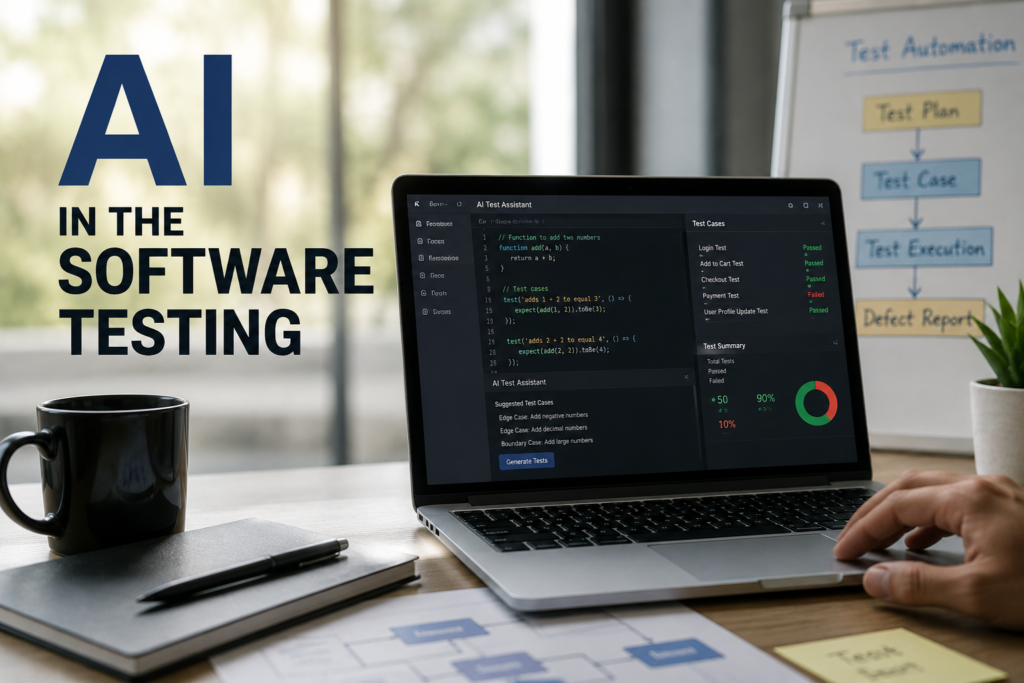

The software testing lifecycle (STLC) is going through a massive shift. Mainly because product complexity is scaling at an exponential rate. Meanwhile, the window for market delivery is shrinking. The challenge for modern engineering teams is no longer just about moving fast. It is about maintaining rigorous quality standards within hyper-connected ecosystems.
Armed with this realization, it is clear to understand why the traditional testing methods are reaching their breaking point. Manual regression cycles are no longer sustainable. They are too slow and prone to human fatigue. Most importantly, they are reactive. This is why the focus is shifting toward AI in the software testing lifecycle. Using AI for test automation services allows teams to move away from reactive fixes. It turns the entire process into a continuous engine of quality. Continue reading this article to explore the specific benefits and strategic impacts of AI on the modern engineering landscape.
What Testing Is and What it Includes
Testing is an essential step for any professional release. It ensures the interface is intuitive, and the underlying architecture is stable. However, the sheer volume of modern software creates an impossible burden for teams testing manually. AI serves as the solution to this scaling problem. It does not replace the foundational stages of testing; rather, it enhances them with a layer of proactive intelligence in the following ways:
Test Planning: AI analyzes historical data and works on timelines and resource requirements. It is also used in identifying risk factors and contingencies to predict where the code might fail. This transforms the strategy from a best guess into a data-driven roadmap.
Test Scenarios and Case Design: Large Language Models automate the generation of complex scenarios. This removes the burden of writing repetitive scripts. It ensures that test deliverables are comprehensive and standardized across the project.
Environment Setup: AI streamlines the setup of cloud resources and synthetic data. These systems mimic real-world situations without compromising sensitive user details. The result is a secure and highly available testing environment that is ready for immediate use.
Test Execution: LLMs can check which parts of the codes changed almost simultaneously and then run only the relevant tests. This surgical precision eliminates wasted compute time and speeds up the release.
Defect Tracking: Machine learning categorizes bugs and identifies patterns. It quickly distinguishes between a genuine flaw and a “flaky” test. This streamlines the defect tracking process by grouping similar issues for faster resolution.
Test Sign-off: AI provides a transparent, data-backed summary of the entire cycle. This final report builds team readiness for deployment. By providing a clear, metric-heavy summary, it ensures the product is truly ready for the user.
Shifting from Manual Execution to Engineering Readiness
When AI is discussed in testing, its use is considered beyond basic automation. Standard automation follows a script. It is rigid. If a single UI element shifts, the script fails. AI introduces a layer of cognitive resilience. It allows systems to adapt to change without human intervention.
AI also elevates the role of developers and teams in terms of readiness, which has become the new benchmark for product engineering. The era of just hiring testers is over. Modern engineering now requires professionals who are prepared to orchestrate complex, intelligent systems. This transition is vital as it moves the focus from “finding bugs” to “architecting quality.” AI serves as the foundation for this transition. It ensures that every phase of the STLC is optimized for technical rigor and strategic speed.
Immediate Benefits: The Efficiency Gains
The move to AI-driven testing offers instant, tangible gains. It effectively clears the operational hurdles that typically hold up the launch cycle.
Cost and Resource Savings
Reducing cost requirements is a constant priority for global enterprises. AI leads to serious cost savings by reducing the hours spent on manual maintenance. Traditional automation requires constant script updates. AI uses self-healing mechanisms to update scripts automatically when the UI changes. This reduces the manual workload. It allows organizations to reallocate their high-value human talent toward innovation and R&D.
Operational Speed
Speed is a primary currency of modern engineering, which is easily saved with the help of AI. In traditional environments, regression testing can take days. AI-driven tools execute these suites in hours. They use Test Impact Analysis to identify exactly which parts of the code have changed. The system then runs only the relevant tests. This precision eliminates wasted compute time. It allows for a much faster time-to-market for complex products.
Accuracy and Quality of Output
Intuition is a human strength, but repetition is a human weakness. AI provides the mechanical consistency required for modern testing. It executes every script with total precision, ensuring results are repeatable and trustworthy. This shift finds bugs and broadens the entire testing surface. By simulating massive user loads and niche edge cases, AI catches the errors that typically slip through the cracks.
Maintenance and Customization
Upkeep or test maintenance is often the most exhausting part of the testing cycle. AI removes this burden by streamlining how tests are updated and managed. This allows customization of regression cycles to match the actual needs of software. Instead of struggling with outdated scripts, the team has a testing suite that remains effective throughout the entire product lifecycle.
The Strategic Impact: AI for Transformation
While benefits focus on efficiency, the impact of AI is in transformation. It changes the fundamental DNA of the software development process.
Shift-Left and Parallel Readiness
Quality is no longer an afterthought as AI has made “Shift-Left” testing a reality. AI tools analyze requirement documents during the preparation phase. The proactive recognition of ambiguities ensures that quality, risk, and compliance are addressed in parallel with development.
Data Driven Decisions
AI integration turns testing into a predictive engine. It provides the insights needed for smarter decision-making. Instead of reacting to bugs, teams can anticipate them. The system ranks issues by their impact on the end user. This capability reshapes how projects are led. It frees managers from the cycle of task tracking and allows them to orchestrate the entire development strategy with confidence.
Market and Customer Transformation
Customers expect products to deliver value earlier than before. AI facilitates a shorter feedback cycle from stakeholders. By automating parallel execution across multiple devices and environments, AI provides swift feedback. This allows for rapid iterations. The impact of all this is seen in a more resilient market presence and immediate customer value as AI makes the organization more responsive to market shifts.
Professional and Cultural Evolution
Professional evolution is a key outcome of AI integration. The technology serves to support rather than replace the engineer. It significantly improves team experience by automating repetitive work. This reduction in cognitive load frees up time for high-level architectural decisions and complex problem-solving. QA leads can then step into more strategic roles dedicated to innovation. The result is a more efficient path for bringing good ideas to life.
Automation Intelligence
The final impact is the transition from “static scripts” to “living systems.” This shift allows for continuous reliability. It enables testing to be an autonomous, ever-present part of the development ecosystem.
A Future of Total System Readiness
The role of AI in the software testing lifecycle is clear. It is a catalyst for speed and strengthens overall quality. The benefits are undeniable. However, the true impact lies in the transformation of testing processes.
With AI, testing has now shifted to the very start of the lifecycle. Decisions now rest on predictive intelligence, and success depends on the readiness of engineering teams to harness these tools. This transition ensures that quality is built into the initial architecture rather than treated as a final hurdle. And with these transformations, AI has cemented its position in STLC as a core enabler.