
Artificial intelligence has become an integral part of modern cybersecurity. It analyzes massive datasets, identifies anomalies, accelerates investigations, and helps security teams respond to threats faster than ever before. Yet the next phase of AI is fundamentally different from anything enterprises have deployed to date.
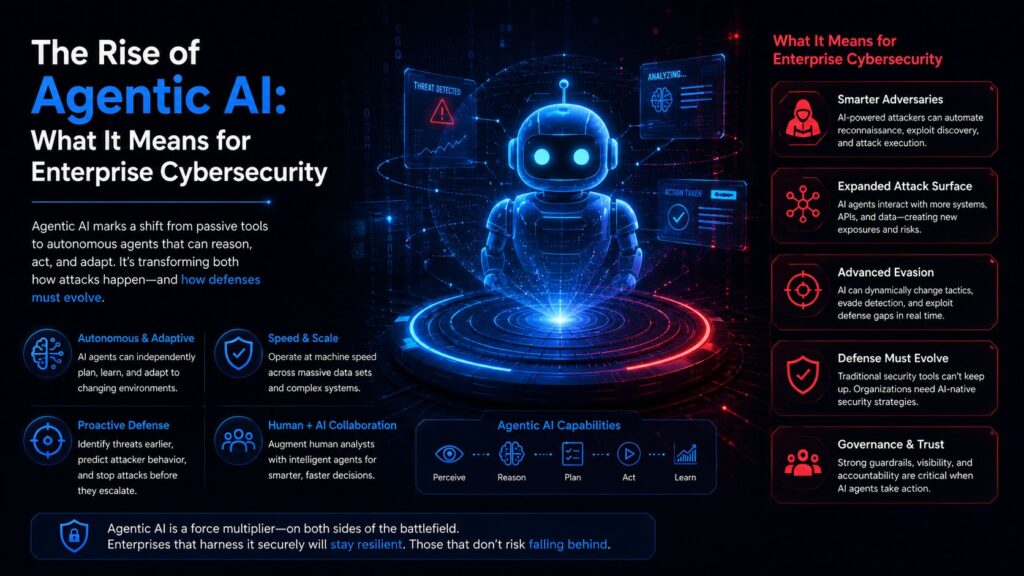
Rather than simply responding to prompts or executing predefined tasks, Agentic AI introduces systems capable of planning, reasoning, making decisions, and taking actions with limited human intervention. These AI agents can coordinate workflows, adapt to changing conditions, and continuously pursue objectives across multiple systems.
For enterprise cybersecurity, this evolution presents both extraordinary opportunities and significant new risks.
On one hand, Agentic AI has the potential to automate repetitive security operations, reduce alert fatigue, improve threat hunting, and accelerate incident response. On the other, cybercriminals are beginning to explore how autonomous AI agents can conduct reconnaissance, identify vulnerabilities, launch sophisticated phishing campaigns, and adapt attacks in real time.
The conversation is no longer about whether organizations should adopt AI – it is about how they can securely manage autonomous intelligence while preparing for an entirely new generation of cyber threats.
Why Traditional Security Models Are Being Challenged
Most enterprise security architectures were designed around predictable user behavior and rule-based automation.
Agentic AI changes that assumption.
Unlike conventional automation tools that perform predefined actions, autonomous AI agents continuously evaluate information, make decisions, and adjust their behavior in response to changing objectives. This creates a level of speed and adaptability that traditional security controls were never designed to monitor.
At the same time, enterprise environments continue to expand across:
- Multi-cloud infrastructure
- SaaS applications
- APIs and microservices
- Remote work environments
- Third-party ecosystems
- Connected AI platforms
As autonomous systems become part of everyday business operations, organizations must consider not only how AI protects the enterprise but also how AI itself becomes a new security boundary.
The Core Principles of Securing Agentic AI
Successfully adopting Agentic AI requires organizations to rethink cybersecurity through the lens of autonomous decision-making rather than simple automation.
Understand Autonomous AI Behavior
Traditional AI models generate responses based on user prompts.
Agentic AI goes further by pursuing objectives, interacting with multiple systems, and making independent decisions throughout complex workflows.
Security teams must understand how these agents operate, what resources they can access, and how their decisions affect business processes before introducing them into production environments.
Secure AI Identities and Permissions
Every AI agent should be treated as a privileged digital identity.
Without strong identity governance, excessive permissions could allow compromised agents to access sensitive data, modify configurations, or perform unintended actions across enterprise systems.
Applying least-privilege access and continuous identity validation helps reduce unnecessary exposure.
Monitor AI Decision Paths
One of the greatest challenges with autonomous AI is maintaining visibility into its actions.
Organizations should establish mechanisms to monitor:
- Decision sequences
- System interactions
- API usage
- Data access patterns
- Workflow execution
- Unexpected behavioral changes
This transparency improves trust while enabling security teams to investigate anomalies more effectively.
Prepare for AI-Powered Threats
Cybercriminals are also exploring autonomous AI capabilities.
Future attacks may involve AI agents capable of:
- Automated reconnaissance
- Adaptive phishing campaigns
- Vulnerability discovery
- Malware optimization
- Social engineering at scale
- Rapid attack iteration
Preparing for these threats requires continuous threat intelligence, AI-aware detection strategies, and proactive security planning.
Industry Spotlight: Technology & Telecommunications
Technology organizations are among the earliest adopters of Agentic AI to improve software development, customer support, and operational efficiency.
As autonomous AI becomes integrated across enterprise platforms, security teams must ensure these systems operate within clearly defined trust boundaries while maintaining visibility into AI-driven decision-making.
Organizations that secure AI from the beginning will be better positioned to scale innovation without increasing cyber risk.
Industry Spotlight: Business Services
Business service providers increasingly rely on AI to automate customer interactions, document processing, financial workflows, and operational decision-making.
The introduction of autonomous AI agents expands the potential attack surface by creating new identities, permissions, and business processes that require continuous governance.
Embedding cybersecurity into AI deployment strategies enables organizations to improve efficiency while maintaining client trust and regulatory confidence.
Why Agentic AI Is Reshaping Enterprise Cybersecurity
Agentic AI is not simply another cybersecurity tool – it represents a fundamental shift in how digital systems operate.
Organizations that successfully integrate autonomous AI into security operations can benefit from:
- Faster security investigations
- Continuous threat monitoring
- Improved security operations efficiency
- Reduced analyst workload
- Better incident prioritization
- Enhanced decision support
- Greater operational resilience
However, these benefits can only be realized when AI governance, identity management, and security oversight evolve alongside autonomous technologies.
Building a Secure Agentic AI Strategy
Preparing for Agentic AI requires collaboration across cybersecurity, technology, governance, and business leadership.
Organizations should focus on:
- Establishing AI governance frameworks
- Defining security policies for autonomous agents
- Implementing strong identity and access controls
- Monitoring AI behavior across enterprise environments
- Integrating AI into threat intelligence programs
- Continuously validating AI-driven decisions.
- Preparing security teams for AI-enabled attack scenarios
Organizations looking to strengthen their AI Security strategy should ensure autonomous intelligence is supported by governance, continuous monitoring, and proactive risk management throughout the AI lifecycle.
The Future of Agentic AI in Cybersecurity
Over the next several years, Agentic AI is expected to become deeply embedded within enterprise security operations.
Security teams will increasingly rely on autonomous agents to investigate alerts, coordinate incident response, prioritize vulnerabilities, and assist analysts with complex investigations.
At the same time, adversaries will continue adopting similar capabilities to automate cyberattacks, making AI-on-AI security an emerging reality.
The organizations that succeed will not simply deploy autonomous AI – they will build the governance, visibility, and trust needed to ensure it operates securely, responsibly, and in alignment with business objectives.
Final Thoughts
Agentic AI marks the beginning of a new chapter in enterprise cybersecurity. Its ability to reason, plan, and act independently has the potential to transform security operations while simultaneously creating new categories of cyber risk.
Rather than viewing autonomous AI as solely an opportunity or solely a threat, enterprise leaders should recognize it as both. Success will depend on balancing innovation with governance, automation with oversight, and intelligence with accountability.
Organizations that prepare today will be better equipped to harness Agentic AI as a strategic security capability while remaining resilient against the increasingly autonomous threats of tomorrow.