
Jewelry is one of the oldest and most universal forms of human behavior. The archaeological record contains examples of deliberately worn adornment, beads made from shells, teeth, and bone pierced for stringing, that predate all other evidence of symbolic thought by tens of thousands of years. At the Nassarius kraussianus shell bead cache found in Blombos Cave in South Africa, archaeologists have recovered perforated shells dated to approximately 100,000 years ago that were almost certainly worn as a necklace or bracelet. Similar finds from sites across the Levant, Europe, and North Africa suggest that wearing deliberate personal adornment is not merely an ancient habit but something close to a universal human behavior, one that appears to emerge in every human population that has been archaeologically studied in sufficient depth.
This universality demands explanation. Why do humans wear jewelry? The intuitive answers, because it is beautiful, because it signals wealth, because it is culturally expected, all contain partial truth but none is complete on its own. A fully adequate account of jewelry wearing draws on evolutionary psychology, cultural anthropology, social identity theory, cognitive science, and neuroscience. This article attempts to synthesize these perspectives into a coherent account of why humans adorn themselves and what that adornment actually accomplishes.
The Evolutionary Perspective: Adornment as a Costly Signal
The evolutionary psychology account of jewelry wearing begins with the observation that conspicuous personal adornment is costly. Shells, feathers, and beads in prehistoric contexts required effort to gather, process, and attach to the body. Metal jewelry in historical contexts required resource extraction, metallurgical skill, and trade. Gemstones required even more elaborate chains of production and distribution. The question from an evolutionary perspective is: what benefit offsets this cost?
The most persuasive answer draws on the theory of costly signaling, developed by economists and evolutionary biologists to explain why organisms (including humans) produce signals that are inherently expensive to produce. The key insight is that only genuine signals can sustain the cost of production. A signal that is cheap to produce conveys no reliable information, because it could be faked by anyone regardless of the underlying quality it is supposed to advertise. A signal that is genuinely expensive to produce is reliable precisely because it is beyond the means of those who lack the underlying quality it advertises.
In prehistoric contexts, wearing elaborate adornment made from rare or difficult-to-obtain materials signals access to resources, social networks, and skills that not everyone possesses. It communicates something real about the wearer’s position in the social hierarchy in a way that cannot be easily faked, because the material requirement of producing the adornment filters out those who cannot genuinely support the claim. This is why personal adornment in virtually every human culture correlates with social status: the social status signal embedded in costly ornament is genuine rather than arbitrary.
Sexual selection provides a parallel explanatory framework. In many species, males produce costly visual displays (elaborate plumage, complex structures) that communicate genetic quality to potential mates. The displays are costly to produce and therefore honest: only males with genuinely superior genetic quality can afford to maintain them without being eliminated by predation or other costs. In humans, personal adornment serves a comparable function in signaling mate quality, with the specific signals varying by cultural context but the underlying signaling logic remaining consistent.
Social Identity and Group Membership: Adornment as Communication
Beyond individual signaling, jewelry and other forms of personal adornment serve powerful functions in communicating group identity and social membership. Humans are extraordinarily social animals whose survival and reproduction have depended, across most of evolutionary history, on membership in stable social groups. The ability to identify members of one’s own group quickly and reliably is genuinely valuable in a social environment where the distinction between in-group members (potential allies, trading partners, kin) and out-group members (potential rivals or strangers) has real consequences.
Personal adornment serves this identification function across virtually every human culture. Group-specific jewelry styles, materials, and wearing conventions operate as visible markers of group membership that can be read at a glance by those who know the code. Religious jewelry, from the Christian cross to the Islamic shahada in calligraphic pendant form to the Hindu mangalsutra, simultaneously expresses individual belief and signals membership in a community of shared belief. Tribal and ethnic jewelry traditions in cultures across the world function similarly: the specific bead colors of a Maasai woman’s necklace, the silverwork conventions of a Navajo bracelet, the lacquer comb styles of a particular Japanese regional tradition all communicate cultural identity in a medium that is visible, durable, and difficult to fake without cultural knowledge.
This group-signaling function explains a phenomenon that puzzles purely aesthetic accounts of jewelry: why jewelry styles are so strongly correlated with cultural identity rather than varying independently according to individual aesthetic preference. If jewelry were purely about individual aesthetic pleasure, we would expect much more random variation across individuals within cultural groups. The strong clustering of jewelry styles within cultural groups reflects the role of adornment in maintaining group identity, where wearing the appropriate jewelry is not merely a matter of taste but a form of group participation.
Self-Concept and Identity Expression: The Private Logic of Adornment
The sociological accounts of jewelry as social signaling and group communication are accurate as far as they go, but they do not fully explain the subjective experience of wearing jewelry. Most people who wear jewelry are not primarily thinking about costly signaling or group identity marking. They are thinking about what the specific piece means to them personally, how it relates to their sense of who they are, and how it makes them feel.
This private, subjective dimension of jewelry wearing connects to the psychology of self-concept and identity construction. Psychologists studying self-concept, the organized bundle of beliefs a person holds about themselves, have consistently found that material objects play a significant role in that construction. The possessions we own, particularly those we choose deliberately and maintain carefully, are experienced as extensions of the self rather than merely as external objects.
Jewelry is a particularly intense version of this phenomenon because it is worn on the body itself, integrated into the physical self-presentation that others encounter as the person. A ring worn for thirty years does not merely belong to a person: it has become part of how that person experiences themselves and how others recognize them. The loss of such a piece is often experienced as a loss that is not simply practical but existential, involving a diminishment of the self as well as the loss of an object.
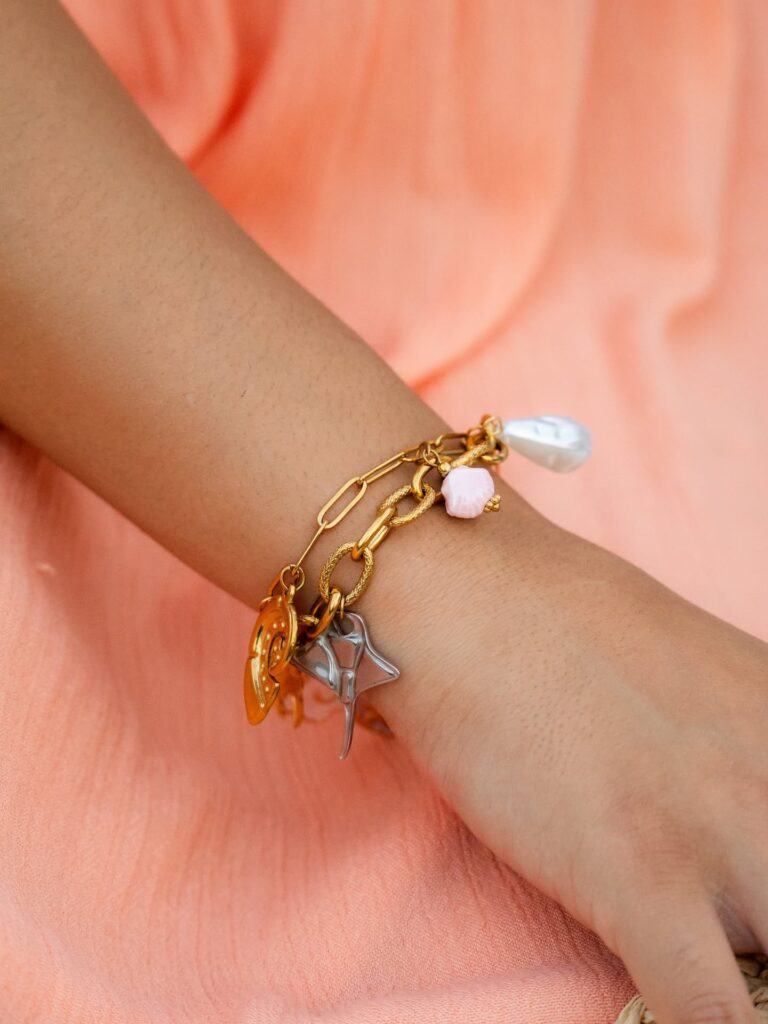
The deliberate selection of jewelry, particularly personalized jewelry that is chosen to represent specific values, relationships, or experiences, is therefore also a form of self-creation. When someone builds a charm bracelet and selects each charm with care, they are not merely assembling an aesthetic object. They are creating a physical representation of their own self-concept, making visible and portable the relationships, experiences, and values that they consider most central to their identity.
This is one reason why personalized jewelry formats, from Victorian charm bracelets to contemporary charm bars and permanent jewelry, consistently generate stronger emotional attachment in wearers than pre-made jewelry selected from a display case. The act of selection is itself a form of identity construction, and the finished piece carries the memory of that construction as part of its meaning. Jewelers who understand this, including those who design their service around the customer’s active participation in creating the piece, are serving not just an aesthetic preference but a genuine psychological need.
You can see this philosophy applied in practice at studios like The Pink Swan Shop, where the experience of building a piece is designed around the customer’s own choices rather than pre-assembled inventory.
The Ritual Dimension: Jewelry and Life Events
Across virtually every human culture, significant life transitions are marked with jewelry. The exchange of rings at a wedding. The first earrings given to a child at a coming-of-age milestone. The graduation gift of a watch or bracelet. The engagement ring as a formal announcement of intention and commitment. Mourning jewelry worn during bereavement. Military decorations awarded after service.
The universality of this practice across cultures that otherwise have little in common suggests that the use of jewelry to mark life transitions answers something fundamental about human psychology rather than being a culturally arbitrary convention. What does jewelry contribute to the marking of a life transition that other forms of celebration cannot?
The most compelling answer is that jewelry creates a durable, portable, bodily record of the moment. Most experiences and emotions are ephemeral: they occur and are gone, retained only in memory, which is itself unreliable and subject to fading and distortion over time. A physical object worn on the body creates a different kind of memory: an external, reliable, ever-present reminder that the moment occurred. The ring on the finger of a widow is not a record of grief in the abstract: it is the specific ring exchanged at a specific wedding on a specific day, worn every day since, now carrying decades of accumulated meaning that no other form of memorial could contain.
This memory function of commemorative jewelry connects to a broader phenomenon in cognitive psychology called object-centered cognition, the human tendency to use physical objects as cognitive tools for managing and organizing emotional experience. The bereaved child who wears a parent’s jewelry is not engaging in irrational magical thinking: they are using a well-established human cognitive strategy for maintaining connection with an absent person through their material trace.
Jewelry and Mood: The Psychological Effects of Wearing Adornment
Beyond the social and identity functions of jewelry, there is a more immediate psychological dimension: the effect of wearing jewelry on moment-to-moment emotional experience and self-perception. Research in what has been called “enclothed cognition” (the psychological effects of the clothes we wear) has found that wearing clothing associated with specific roles or qualities systematically affects cognitive performance and self-perception in those domains. The “white coat effect,” where wearing a white coat associated with doctors or scientists affects attention and analytical performance in laboratory settings, is one well-studied example.
Whether similar effects apply specifically to jewelry has received less systematic research attention than clothing effects, but there is suggestive evidence that jewelry wearing affects self-perception and emotional state in ways that go beyond the objective aesthetic value of the piece. People who describe themselves as more confident when wearing a specific piece of jewelry, who feel “dressed” only when a particular ring is on, or who feel a sense of security from a piece given by a parent or partner, are describing a real psychological effect rather than a mere preference.
The mechanism is likely related to the activation of associated memories and self-concepts triggered by the physical experience of wearing the piece: the ring on the finger activates the memory of the relationship in which it was given, which activates the emotional content of that relationship, which affects current emotional state. Over time, the piece becomes a reliable trigger for the associated emotional experience, which explains why the effects can be strong even for people who are not wearing the piece for external visibility but simply for the private experience of wearing it under clothing.
Jewelry in Grief and Remembrance
The use of jewelry in contexts of grief and remembrance is one of its most powerful and consistent functions across human cultures. Mourning jewelry has appeared in documented form in ancient Egypt (where certain amulets were specifically associated with the protection of the dead and the comfort of the bereaved), in ancient Rome (where grief tokens were exchanged among mourners), in medieval Europe (where memento mori rings reminded wearers of death), in Victorian England (where an elaborate material culture of mourning jewelry developed), and in contemporary culture (where memorial jewelry incorporating cremated remains or hair of the deceased is a significant market category).
What these diverse traditions share is the recognition that grief requires a material anchor: an object that gives abstract loss a physical form that can be held, worn, and incorporated into the physical self. The experience of loss involves a profound disruption of the self, since the lost person was typically interwoven with the bereaved person’s identity and daily experience in ways that leave visible absences when they are gone. Memorial jewelry addresses this disruption not by resolving it but by providing a tangible form of continued presence, a way of incorporating the lost person’s material trace into the ongoing physical experience of being alive.
The Victorian mourning jewelry tradition, which included pieces made from the hair of the deceased, lockets containing miniature portraits, and rings inscribed with death dates, is sometimes treated as an eccentricity of a particularly death-obsessed era. A more accurate reading is that the Victorians formalized and elaborated practices that are universal in human culture, giving material expression to grief needs that human beings always have and always manage through available cultural forms. Contemporary memorial jewelry serves identical needs through different aesthetic conventions.
The Social Psychology of Gift Jewelry
A significant proportion of all jewelry is given rather than chosen by the wearer for themselves, and this gifting dimension adds another layer to the psychology of jewelry. Gift jewelry is not simply a present: it is a communication about the relationship between giver and recipient, an object that carries the giver’s attention, care, and knowledge of the recipient into a form that persists and is worn.
Research in social psychology on gift giving has found that gifts are interpreted as communications about the giver’s knowledge and care rather than primarily as economic transfers. A gift that demonstrates genuine knowledge of the recipient, their tastes, history, and values, communicates more about the quality of the relationship than an expensive gift chosen without this knowledge. This is particularly relevant for personalized jewelry: a charm bracelet built around the specific biography of the recipient communicates more care and attention than a generic piece of equal or greater monetary value.
Jewelry and Professional Identity
In professional contexts, jewelry performs specific identity and authority functions that have been studied in organizational psychology. The professional significance of certain pieces, the attorney’s ring, the medical professional’s watch, the academic’s brooch, reflects the same group-identity signaling function observed in cultural and religious jewelry, adapted to the professional social environment.
Research on jewelry in professional contexts has also found that jewelry worn by women in professional settings is evaluated differently from jewelry worn by men in comparable situations, with women’s professional jewelry subject to more scrutiny and more likely to affect professional evaluations in both positive and negative directions depending on specific style choices. These findings reflect the complex gender politics of professional self-presentation rather than any inherent quality of the jewelry itself.
Frequently Asked Questions
Why do humans wear jewelry across all cultures?
The universality of personal adornment reflects multiple simultaneous functions: costly signaling of social status and genetic quality, communication of group identity and membership, expression of individual self-concept and identity, marking of significant life transitions, and management of emotional experience including grief and romantic attachment.
Is jewelry wearing an instinctive behavior or a learned cultural practice?
Both. The tendency toward personal adornment appears to be deeply embedded in human nature, given its presence in archaeological records predating all other forms of symbolic thought. The specific forms of adornment, which materials, what styles, what occasions, are thoroughly cultural and vary enormously across and within societies.
Why does personalized jewelry feel more meaningful than mass-produced pieces?
Because the act of selecting it is itself a form of identity construction. When you choose each element of a piece deliberately, the finished object carries the memory of that construction and functions as a more accurate material representation of your self-concept than a piece chosen because it was available and attractive.
Why is jewelry used to mark life transitions in so many cultures?
Because jewelry creates a durable, portable, bodily record of the moment. Physical objects worn on the body provide a more reliable and persistent memory of significant experiences than purely mental records, which are subject to fading and distortion. The object externalizes and anchors the emotional content of the transition in a form that can be worn and touched as a form of continued access to the experience.
What is the relationship between jewelry and grief?
Memorial jewelry provides material form for the experience of loss, giving the bereaved a tangible anchor for continued connection with an absent person. This meets a genuine human psychological need rather than being a merely sentimental practice, drawing on the well-documented human tendency to use physical objects as cognitive tools for managing emotional experience.
Does wearing jewelry actually affect how you feel?
There is good evidence from adjacent research areas (enclothed cognition, the psychology of sacred objects) that wearing personally significant objects affects self-perception and emotional state through the activation of associated memories and self-concepts. People who report feeling more confident or secure when wearing specific jewelry pieces are describing real psychological effects rather than mere preferences.
Conclusion
The human tendency to wear jewelry is older than written language, older than agriculture, and older than most of the other behaviors we think of as distinctively human. It has persisted across every culture, every historical period, and every level of technological development because it serves genuine psychological functions that have not become obsolete: communicating identity and status, marking the boundaries between life phases, providing material form for abstract emotional experiences, and constructing the self through deliberate selection of significant objects.
Understanding these functions does not diminish the aesthetic pleasure of jewelry. It enriches it by revealing that the pleasure is not merely sensory but deeply cognitive and social: the pleasure of an object that communicates who you are, that carries the history of significant relationships and experiences in a portable form, and that makes the private facts of identity and memory visible and permanent in the physical world.