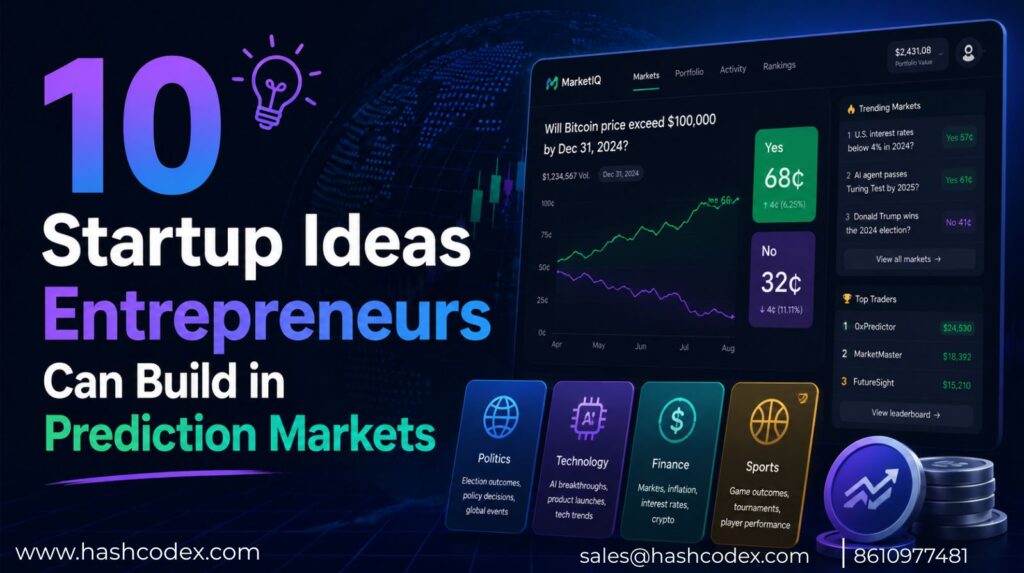

Prediction markets are becoming a new way to guess what might happen in the future, from politics to sports and even business trends.
Instead of just sharing opinions, people can place bets on what they believe will happen, which often leads to smarter and more interesting predictions.
In this blog, we will look at 10 startup ideas in this area that could really succeed.
These ideas are simple, useful, and based on real needs in the market.
If you are curious about new business opportunities in prediction Marketplace Development, this list will help you get started.
👀 There’s a small surprise waiting for you in this blog. Keep reading to find it. ✨
What Makes a Prediction Market Startup Successful
A successful prediction market startup needs to solve a real problem and make it easy for people to use. If the platform is simple, fast, and trustworthy, more users will join and stay active.
Liquidity is also important because users want to trade easily without waiting. Clear rules, fair outcomes, and strong security help build trust.
It also helps if the startup focuses on a specific niche first, like sports or finance, before expanding.
Finally, good incentives for users, such as rewards or earnings, can keep the community engaged and growing over time.
10 Prediction Market Startup Ideas Worth Building
Prediction markets are still pretty early. Most of them today are just websites where people bet on real world events. But the bigger opportunity is not just betting, it’s using these markets to understand the future better and help people and companies make decisions with clearer information.
Here are 10 simple, real startup ideas in this area.
1. Prediction markets inside companies
Companies often guess things like sales, hiring needs, or product success using spreadsheets and meetings. That usually becomes slow and political.
Instead, you could build an internal prediction market where employees “bet” on outcomes like:
-
Will we hit this quarter’s revenue target?
-
Will this new feature succeed?
The market price becomes a live, honest forecast from the whole company.
2. One simple “truth score” for all markets
Right now, prediction markets are spread across different platforms like Polymarket and Kalshi.
A startup could combine all of them into one clean number for each question. So instead of checking many sites, you just see:
“The combined market says there is a 62% chance of X happening.”
3. Prediction data for AI tools
AI tools need good real-world facts and probabilities. You could build an API that lets AI ask questions like:
-
“Will inflation go up next year?”
-
“Will this product launch on time?”
And it returns real market-based answers.
4. Reward good forecasters
Right now, people with more money have more influence in prediction markets.
You could change that by giving more power to people who are proven to be accurate over time. So if someone is good at predicting, their future bets matter more.
This makes the system smarter, not just richer.
5. Local prediction markets
Most prediction markets focus on big global events.
But there are many local questions people care about, like:
-
Will Chennai get heavy rain this monsoon?
-
Will this new metro line open on time?
-
Will a startup in the city raise funding?
Local markets could become very active and useful.
6. Bundles of predictions (like indices)
Instead of looking at one prediction at a time, you could group them.
For example:
-
“Tech boom index”
-
“Recession risk index”
-
“AI progress index”
This makes it easier for normal users to understand big trends.
7. Prediction feed like social media
Imagine a TikTok or Instagram style feed, but each post is a live prediction like:
“Will Apple launch new glasses in 2027?”
You can scroll, see what people think, and trade instantly.
It makes prediction markets feel social and addictive in a good way.
8. System to verify real world outcomes
Prediction markets need someone to decide what actually happened (for example, did an event really occur or not).
A startup could build a trusted system that checks facts and settles these markets correctly. Without this, prediction markets cannot scale well.
9. Risk dashboard for businesses and investors
Companies and investors always want to know risks early.
You could build a dashboard that shows probabilities like:
-
chance of recession
-
chance of regulation changes
-
chance of a startup failing
This helps people make better decisions.
10. Easy tool to create prediction markets
Right now, making a prediction market is not easy.
You could build a simple tool where anyone can create one in minutes:
-
“Will I finish my project on time?”
-
“Will my startup hit $10K revenue?”
It could be used for work, friends, or communities.
👀 Here’s the surprise 👉 Explore the live demo of a prediction market
Conclusion
Prediction markets are still early, but the direction is clear. They are slowly becoming a way to turn opinions and guesses into real signals about the future.
The opportunity is not just in building places to bet. It’s in building tools that help people see what is likely to happen next, reduce uncertainty, and make better decisions, whether that’s inside companies, for investors, or for everyday users.
In the long run, the most valuable startups in this space won’t feel like gambling platforms. They’ll feel more like decision tools: simple, fast, and surprisingly good at answering one question: what do people really think will happen?