
Taking medication as prescribed is one of the most important aspects of managing health conditions, recovering from illness, and maintaining overall wellness. Yet medication non-adherence remains a widespread challenge affecting millions of people every year. Whether it involves forgetting a dose, taking medication at the wrong time, or accidentally skipping an entire day, these seemingly small mistakes can have significant consequences.
Many people underestimate the true cost of medication non-adherence. While the immediate impact may seem minor, the long-term effects can influence health outcomes, healthcare expenses, and quality of life. Understanding these hidden costs and implementing effective solutions can help patients stay on track and achieve better results from their treatment plans.
What Is Medication Non-Adherence?
Medication non-adherence occurs when patients do not take their medications exactly as prescribed. This can include:
- Missing doses
- Taking medication at inconsistent times
- Taking incorrect amounts
- Stopping treatment prematurely
- Forgetting whether medication has already been taken
These issues can affect anyone, regardless of age or health status. Busy schedules, multiple prescriptions, memory challenges, and everyday distractions all contribute to medication adherence problems.
The Health Costs of Missed Doses
One of the most significant consequences of medication non-adherence is reduced treatment effectiveness.
Prescription medications are carefully prescribed with specific schedules designed to maintain proper levels within the body. When doses are skipped or delayed, those levels can fluctuate, potentially reducing the medication’s effectiveness.
For individuals managing chronic conditions, inconsistent medication use can make symptoms more difficult to control. Missing doses may lead to:
- Slower recovery
- Increased symptoms
- Disease progression
- Additional medical appointments
- Greater healthcare needs over time
Even with common over-the-counter products such as Advil, Tylenol, vitamins, and supplements, inconsistent use can disrupt intended benefits and create uncertainty about treatment routines.
The Financial Impact of Non-Adherence
Medication non-adherence can also lead to hidden financial costs.
When medications are not taken properly, patients may require:
- Additional doctor visits
- More frequent monitoring
- Additional prescriptions
- Emergency care in severe situations
- Extended treatment periods
These expenses can add up quickly. What begins as an occasional missed dose may eventually result in greater healthcare costs than expected.
Patients often focus on the price of medications themselves, but the financial impact of ineffective treatment can be much greater.
The Emotional Cost of Medication Confusion
Many people have experienced the frustrating moment of staring at a medication bottle and wondering, “Did I already take this today?”
This uncertainty creates stress and anxiety, particularly for individuals taking multiple medications each day.
Caregivers often face similar concerns when helping loved ones manage prescriptions. Without a clear system, family members may worry about missed doses or accidental double dosing.
The emotional burden of constantly trying to remember medication schedules can affect confidence and create unnecessary worry.
Why Traditional Reminder Methods Are Not Always Enough
Many patients attempt to stay organized using smartphone alarms, calendars, sticky notes, a 7 day pill box, or a medication bottle organizer.
While these tools can provide support, they do not always solve the core problem.
Phone notifications are frequently ignored or dismissed during busy days. Calendars require regular attention. Even a 7 day pill box may not provide certainty about exactly when medication was taken.
The challenge is not simply receiving a reminder. The challenge is maintaining a reliable record that helps patients confidently track their medication routine.
A Better Approach to Medication Adherence
One of the most effective ways to improve medication adherence is to place reminders directly where they are needed most: on the medication bottle itself.
Visual reminder systems help eliminate guesswork by creating an immediate reference point whenever medication is used.
This approach reduces dependence on digital notifications and keeps adherence information visible throughout the day.
When reminders are integrated directly into medication routines, patients are more likely to remain consistent with their schedules.
How Meticap Helps Prevent Missed Doses
Meticap was designed to address one of the most common causes of medication non-adherence: forgotten or ignored reminders.
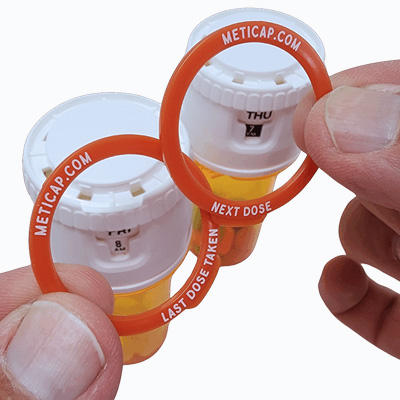
Unlike smartphone alerts that can disappear with a swipe, Meticap provides a visual reminder directly on the medication bottle. Users can quickly see both the day and time associated with their medication schedule, helping reduce confusion and uncertainty.
Tracking both day and time is particularly important because remembering only the time may not provide enough context. Having both pieces of information helps patients confidently determine when medication was last taken.
Meticap does not replace the original prescription cap. Instead, it screws onto an existing 1-Clic cap, allowing medications to remain in their original labeled containers.
The system also includes a flip-top ring that can be adjusted to reflect dosage instructions, making medication management even more convenient.
A Reusable Solution for Everyday Use
Prescription vials and caps are generally not reusable because of contamination concerns. Meticap offers a different approach.
The device itself is reusable and can continue supporting medication routines for years. This makes it a practical solution for individuals managing long-term prescriptions, daily vitamins, supplements, and even pet medications.
Meticap is available in convenient 6-pack, 12-pack, and 24-pack options. Families can share packs among multiple household members, and extra units can be used for various medications throughout the home.
Benefits for Caregivers and Families
Medication management often becomes a shared responsibility.
Caregivers supporting aging parents, spouses, or family members need reliable tools that help reduce confusion and improve consistency.
Because Meticap displays both day and time information directly on the bottle, caregivers can quickly verify medication schedules without relying on memory alone.
This added visibility helps create confidence for everyone involved in the medication process.
Conclusion
The hidden costs of medication non-adherence extend far beyond missed doses. Health complications, financial expenses, stress, and uncertainty can all result from inconsistent medication routines.
While tools such as a 7 day pill box or medication bottle organizer can provide some support, visual reminders placed directly on medication bottles offer a practical way to improve consistency.
Meticap helps patients, caregivers, and families stay organized by tracking both day and time on the medication bottle itself. With its reusable design, compatibility with existing 1-Clic caps, and easy-to-use visual reminder system, Meticap provides a simple solution to a common healthcare challenge.
By addressing the problem of ignored reminders and medication uncertainty, patients can build stronger habits, improve adherence, and gain greater confidence in managing their daily health routines.