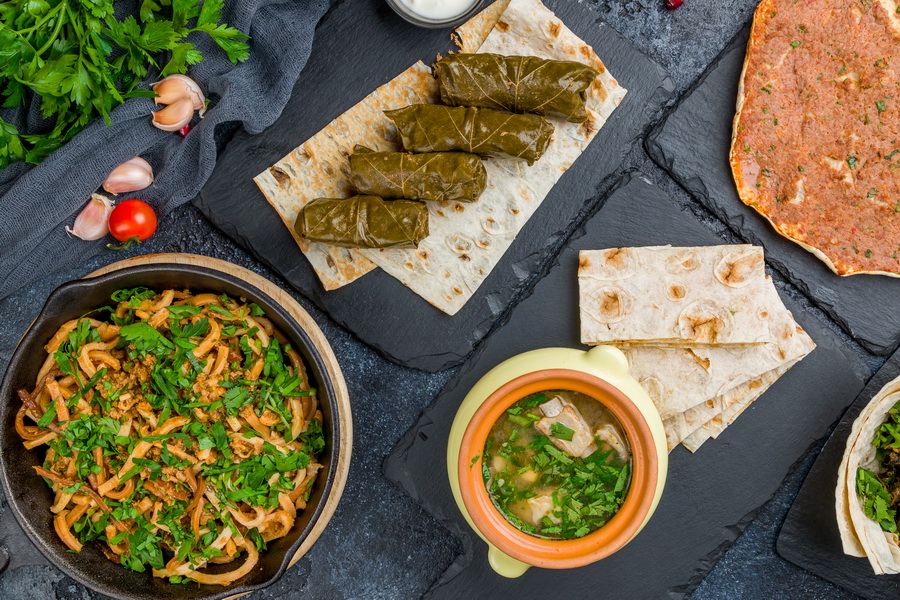

When you walk into an Armenian home, you don’t just get a seat at the table; you get a seat in history. There is a specific kind of warmth: a mixture of steam, loud laughter, and the scent of drying herbs that defines the Armenian kitchen. It’s a place where recipes aren’t written in books, but are etched into the muscle memory of grandmothers’ hands. To truly understand Armenian authentic food, you have to look past the ingredients and see the resilience of a people who have turned survival into an art form.
For over three thousand years, the Armenian plateau has been a crossroads of the world. But despite the empires that marched across this land, the flavors remained stubbornly, beautifully Armenian. This is a cuisine that doesn’t hide behind heavy creams or complex sauces. It’s a raw, honest celebration of the sun, the soil, and the stone.
The Sacred Bread and the Earth’s Oven
You cannot talk about Armenian cuisine without starting with Lavash. It’s more than just a flatbread; it’s a canvas. Watching a group of women bake lavash is like watching a choreographed dance. They stretch the dough over a cushion and slap it against the scorching walls of the tonir a deep clay oven buried in the earth.
The tonir is the spiritual center of the Armenian household. Historically, it wasn’t just for baking; it was the hearth that kept the family warm during bitter mountain winters. When you pull a piece of hot, bubbling lavash from the clay, you aren’t just eating bread. You are eating a tradition that has been UNESCO-recognized as a masterpiece of human heritage. It is the literal “wrap” that holds the story of Armenian authentic food together.
A Symphony of Slow Cooking
If there is one thing that defines the Armenian palate, it’s patience. Our ancestors didn’t have fast food; they had the “slow and low” philosophy long before it was a culinary trend.
- The Ritual of Khash: Imagine a chilly winter morning, the sun just peaking over Mount Ararat. Families gather for Khash, a rich broth made from simmering cow’s feet for an entire night. It is a rustic, communal experience. You crush dried lavash into the bowl, pile in the garlic, and eat with your hands. It’s a dish that demands you slow down and connect.
- The Art of Tolma: Every family has a “Tolma war” a friendly debate over who rolls the smallest, tightest grape leaves. Whether stuffed with succulent meat or the “fasting” version (Pasuts Tolma) filled with seven different grains and legumes, it represents the meticulous care inherent in Armenian cuisine.
The Gifts of the Sun
Armenia is often called the “Land of the Sun,” and you can taste that sunshine in every bite of fruit. The apricot, or Prunus Armeniaca, is the national treasure. But it’s not just about fresh fruit. Armenian authentic food excels in preservation.
From alani (sun-dried peaches stuffed with ground walnuts and sugar) to fruit lavash (sour fruit leather), the goal has always been to capture the essence of summer to last through the snowy highland winters. This resourcefulness is the backbone of the heritage, nothing is wasted, and everything is transformed into something delicious.
Hospitality: The Invisible Ingredient
There is an old Armenian saying: “A guest is a gift from God.” In our culture, the table is a sacred space. If you visit a village in Armenia, a local might not have much, but they will lay out a “maza” spread that looks like a king’s banquet.
A spread of Armenian authentic food is a colorful mosaic:
- Slabs of salty Lori or Chanakh cheese.
- Heaps of “Kananchi”: fresh purple basil, cilantro, and tarragon.
- The smoky, charred aroma of Khorovats (BBQ) drifting from the backyard.
This hospitality isn’t just about being polite; it’s a survival mechanism. Sharing food is how we have maintained our identity through centuries of displacement. When the table is full, the culture is safe.
Carrying the Torch Forward
Today, you’ll find Armenian chefs from Yerevan to Los Angeles reimagining these ancient flavors. They are taking the fermented tang of matzoon (Armenian yogurt) and the earthy crunch of toasted pumpkin seeds to create something new. Yet, even the most modern dish still carries the DNA of the highlands.
The heritage of Armenian cuisine is a living thing. It’s in the way we toast to our ancestors with a glass of pomegranate wine, and the way we insist a guest takes “just one more bite.”
To eat Armenian food is to take a culinary journey through time. It is a cuisine that tastes of woodsmoke, mountain herbs, and a deep, enduring love for the land. Whether you are breaking a piece of gata or savoring a slow-cooked stew, remember that you are tasting three thousand years of history.
In every bite of Armenian authentic food, there is a story of a people who refused to be forgotten and luckily for us, that story is absolutely delicious. Welcome to our table. Anush lini—may it be sweet to you.