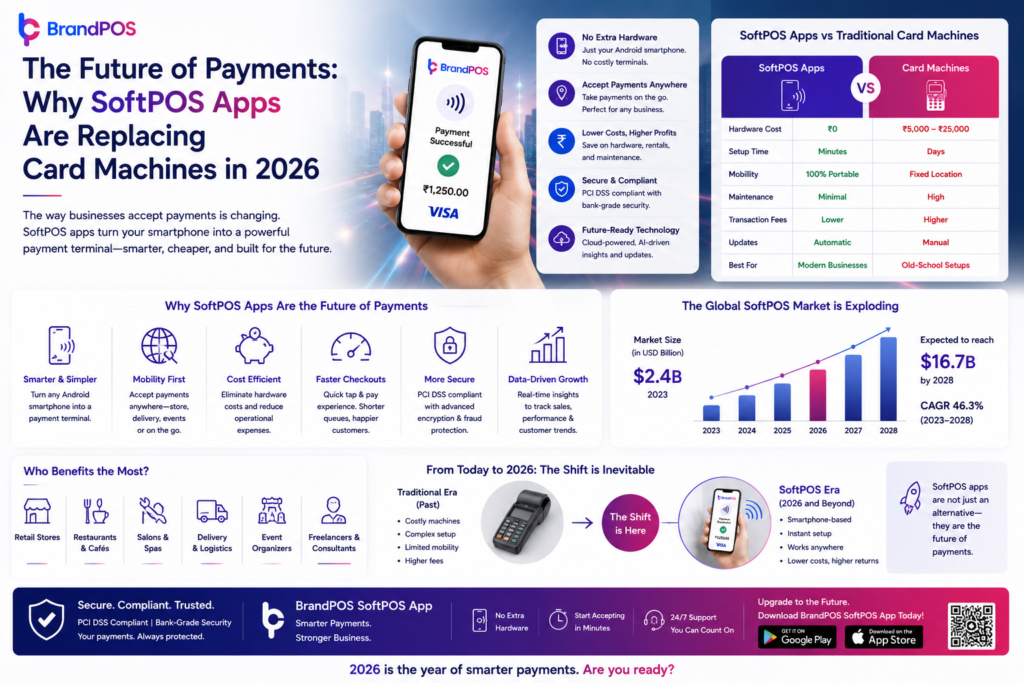

SoftPOS apps are rapidly replacing traditional card machines by turning smartphones into payment terminals. With rising contactless adoption and lower hardware dependency, businesses are shifting toward faster, more flexible payment solutions.
The Big Shift: From Hardware to Software
For years, card machines were the standard for accepting payments. If you wanted to take card payments, you needed a physical device—simple as that.
But things are changing.
With SoftPOS, the focus has moved from hardware to software. Your smartphone is no longer just a communication device—it’s now a complete payment terminal.
This shift is happening because businesses want flexibility. They don’t want to depend on machines that require setup, maintenance, and cost.
Instead, they want something that works instantly, scales easily, and fits into how they already operate.
That’s exactly what SoftPOS delivers.
Contactless Payments Are Becoming the Default
Consumer behavior is driving a big part of this change.
A SoftPOS app supports contactless payments, which are quickly becoming the preferred way to pay. Tapping a card or phone is faster, cleaner, and more convenient than inserting a card or handling cash.
In India and globally, this shift has accelerated over the past few years. Customers now expect businesses to accept tap-to-pay as a standard option.
For merchants, this means adapting to stay relevant.
SoftPOS makes that transition easier. You don’t need to upgrade to new machines or invest in additional hardware. You just update your payment method using a device you already own.
Why Businesses Are Moving Away from Card Machines
Traditional POS machines aren’t going away overnight, but their limitations are becoming more noticeable.
With SoftPOS, businesses are solving several common challenges:
- Cost reduction: No need to buy or rent machines
- Faster setup: Start accepting payments within hours
- Mobility: Accept payments anywhere, not just at a counter
- Scalability: Add more devices without extra hardware
Card machines, on the other hand, can slow things down. They require maintenance, can become bottlenecks during busy hours, and aren’t always easy to scale across teams.
As businesses grow and evolve, these limitations become harder to ignore.
That’s why many are gradually shifting toward software-based solutions.
Where SoftPOS Is Headed Next
The future of SoftPOS isn’t just about replacing machines—it’s about expanding capabilities.
We’re already seeing SoftPOS evolve beyond basic payments.
Future developments are likely to include:
- Deeper integration with business tools like inventory and accounting
- Enhanced analytics for better decision-making
- Support for more payment methods and global standards
- Improved offline capabilities for areas with limited connectivity
As technology improves, the gap between traditional POS systems and SoftPOS will continue to shrink—and in many cases, disappear.
What started as an alternative is quickly becoming the preferred choice.
Trust and Adoption Are Growing Fast
Whenever a new payment method emerges, trust takes time to build.
But SoftPOS is gaining traction quickly.
A SoftPOS app operates under strict security standards, including PCI compliance and encrypted transactions. These certifications ensure that payments are handled safely, just like traditional systems.
At the same time, more merchants are adopting SoftPOS across industries—from retail and restaurants to delivery and field services.
This growing adoption creates a cycle. As more businesses use SoftPOS, customers become more comfortable with it. And as customers trust it more, adoption increases further.
It’s a clear sign that the shift isn’t temporary—it’s structural.
Future-Proofing Your Business Starts Now
Every business reaches a point where it has to decide whether to stick with existing systems or adapt to new ones.
SoftPOS doesn’t require a complete overhaul. It can be introduced alongside your current setup and expanded gradually.
But waiting too long can mean falling behind customer expectations.
By adopting SoftPOS now, you’re not just solving today’s payment challenges—you’re preparing your business for where the industry is headed.
And in a fast-changing landscape, that kind of readiness matters.
FAQs
1. How fast is SoftPOS adoption growing among businesses?
Adoption is increasing rapidly, especially among small and medium businesses, due to lower costs and ease of use compared to traditional POS machines.
2. Will card machines become completely obsolete?
Not immediately. They will continue to exist, but their role is likely to reduce as software-based solutions become more popular.
3. Is SoftPOS suitable for large enterprises as well?
Yes, many large businesses are adopting SoftPOS for flexibility and scalability across multiple locations and teams.
4. How can I future-proof my payment system today?
Start by adding SoftPOS alongside your current setup. This gives you flexibility while preparing for future payment trends.
5. Are customers comfortable using SoftPOS for payments?
Yes, especially with the rise of contactless payments. Most customers are already familiar with tap-to-pay experiences.