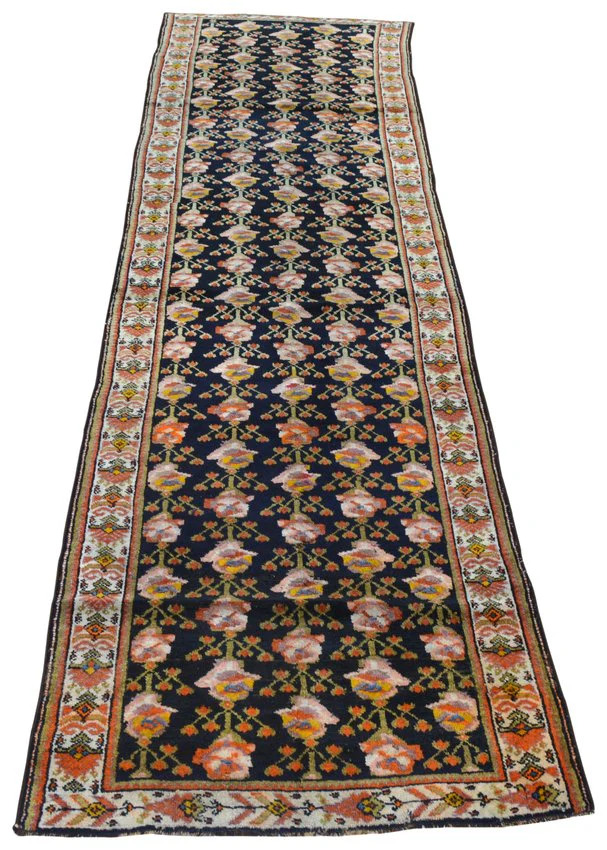

Few objects in the history of design carry as much continuous cultural weight as the Persian rug. What began as a practical solution to nomadic life on the Iranian plateau evolved, over two and a half millennia, into one of the most sophisticated textile art forms the world has ever produced — a lineage still visible in every hand-knotted piece made today.
The Earliest Threads: The Pazyryk Discovery
The oldest known surviving example of a knotted-pile rug is the Pazyryk carpet, discovered frozen in a Scythian burial mound in Siberia and dated to roughly the 5th century BCE. Remarkably well preserved by ice, this piece already displays a level of technical sophistication — tight knot density, complex bordered design — that suggests the craft was already mature by that point, meaning the true origins of the Persian rug likely stretch back even further into antiquity than this single surviving example can prove.
The Safavid Golden Age
If there is one era most responsible for elevating the Persian rug from functional textile to celebrated art form, it’s the Safavid dynasty of the 16th and 17th centuries. Royal workshops in cities like Isfahan and Tabriz began producing rugs specifically for palaces and royal gifts, employing master designers who treated each rug as a formal artistic composition rather than a folk craft. This period introduced the elaborate central medallion layouts, intricate arabesque vine work, and refined color palettes that remain instantly recognizable hallmarks of the Persian rug tradition today.
Regional Diversity Takes Shape
As weaving traditions matured across different regions of Persia, distinct regional identities emerged, each shaped by local materials, climate, and cultural motifs. Nomadic tribal groups produced bolder, more geometric patterns using rustic wool, while urban workshop centers refined finer, more curvilinear designs often incorporating silk. This regional diversity is why a Persian rug from Tabriz looks markedly different from one woven in a Baluchi tribal village, despite both belonging to the same broad textile tradition.
The 19th-Century Export Boom
The Persian rug’s global reputation expanded dramatically during the 19th century, when improved trade routes and growing Western interest in Oriental design created significant export demand. Workshops scaled production to meet international markets, and some historical adjustments were made to palette and sizing to suit Western tastes and room dimensions. This era cemented the Persian rug’s status as a global luxury good, appearing in the homes of European aristocracy and, later, American industrialists.
Surviving Industrialization
The 20th century introduced power looms and synthetic dyes to the broader textile industry, and Persian rug production faced a genuine crossroads. While machine-made imitations flooded lower-price markets, traditional hand-knotting techniques and natural dye practices persisted in dedicated workshops and family weaving traditions, preserved specifically because collectors and connoisseurs recognized that authenticity and craftsmanship simply couldn’t be replicated by machine. This preservation effort is why genuine, hand-knotted Persian rugs remain available and valued today, rather than existing only as museum artifacts.
A Living Tradition, Not a Relic
What makes the history of the Persian rug so remarkable is that it isn’t purely historical — it’s a living, continuing craft. Weavers today in Iran and surrounding regions still practice techniques passed down through direct generational transmission, using looms, natural dyes, and knot-tying methods that would be recognizable to a weaver from centuries past. Modern pieces exist on a continuum with ancient ones, meaning a newly woven Persian rug purchased today carries forward the same fundamental techniques documented in the Pazyryk carpet millennia ago.
Why This History Matters to Buyers Today
Understanding this 2,500-year arc changes how a buyer approaches purchasing a Persian rug. It’s not simply a decorative choice — it’s an acquisition within a continuous artistic tradition, one where regional origin, weaving technique, and dye method all carry specific historical meaning. Recognizing that lineage helps explain why an authentic, hand-knotted Persian rug commands the price and reverence it does, and why it belongs in the same conversation as other enduring, historically significant art forms rather than simply as home décor.