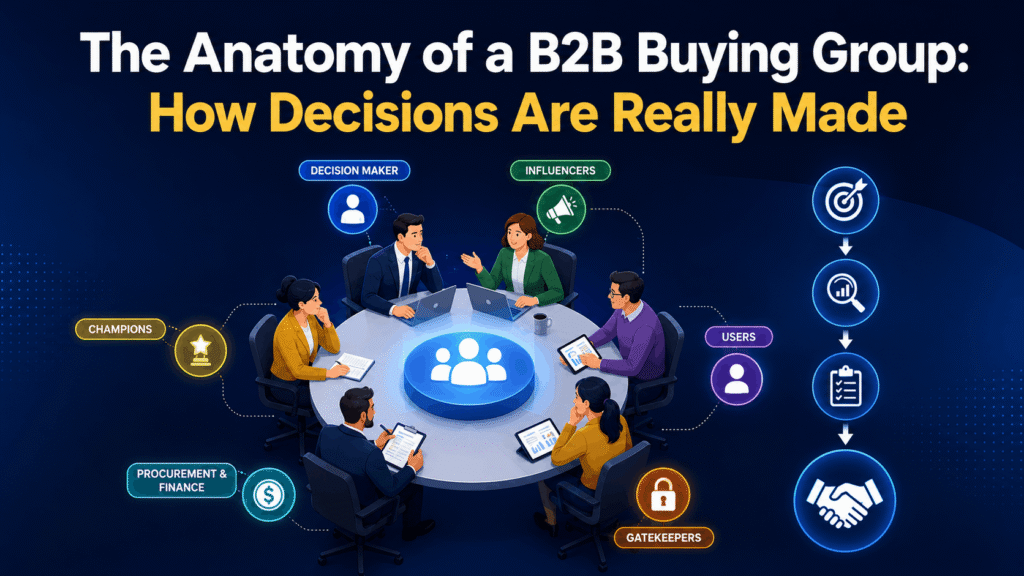

In today’s complex B2B landscape, purchasing decisions are no longer made by a single executive or department. Instead, they are shaped by a buying group—a collection of stakeholders, each with unique priorities, concerns, and influence over the final decision. Understanding how these groups operate is essential for sales and marketing teams aiming to close deals faster and more effectively.
As organizations grow more data-driven and risk-aware, buying decisions have become more collaborative, structured, and often slower. Vendors that fail to recognize and engage the full buying group risk losing deals—even when their product is the best fit. To succeed, businesses must understand the anatomy of a B2B buying group and how decisions are truly made behind the scenes.
What Is a B2B Buying Group?
A B2B buying group (also known as a buying committee or decision-making unit) is a set of individuals within an organization who collectively evaluate, influence, and approve a purchase decision. These groups can range from a handful of stakeholders in small businesses to dozens of participants in enterprise-level deals.
Each member plays a specific role, and their combined input determines whether a solution is approved, delayed, or rejected. Importantly, influence is not always tied to job titles—sometimes mid-level managers or technical experts can carry more weight than senior leaders in specific decisions.
Key Roles Within a Buying Group
To effectively engage a buying group, it’s critical to understand the different roles typically involved:
1. Decision Maker
This is the individual who has the final authority to approve or reject the purchase. They are often focused on business outcomes, ROI, and strategic alignment.
2. Influencers
Influencers shape opinions and provide recommendations. They may not have final authority, but their input heavily impacts the decision. These are often subject matter experts or department heads.
3. Users
End-users are the people who will interact with the product or service daily. Their concerns revolve around usability, efficiency, and practical value.
4. Gatekeepers
Gatekeepers control access to decision-makers and information flow. They can be executive assistants, procurement teams, or IT administrators.
5. Champions
Champions are internal advocates who believe in your solution and push for its adoption. They are critical for driving momentum within the organization.
6. Procurement and Finance
These stakeholders evaluate pricing, contracts, compliance, and risk. Their approval is essential for finalizing the deal.
Understanding these roles allows sales teams to tailor messaging and engagement strategies for each stakeholder, rather than relying on a one-size-fits-all approach.
How Decisions Are Really Made
While the structure of a buying group may seem straightforward, the actual decision-making process is often complex and non-linear. Here’s how it typically unfolds:
1. Problem Identification
The process begins when an organization identifies a challenge or opportunity. This stage is often led by business units or operational teams.
2. Research and Exploration
Stakeholders conduct independent research, comparing vendors, reading reviews, and exploring potential solutions—often before engaging with sales teams.
3. Internal Alignment
This is where complexity increases. Different stakeholders bring different priorities:
- IT may focus on integration and security
- Finance may evaluate cost and ROI
- Operations may prioritize efficiency
- Leadership may assess strategic impact
Achieving alignment across these perspectives can take time and requires negotiation and compromise.
4. Vendor Evaluation
Shortlisted vendors are evaluated through demos, proposals, and discussions. At this stage, vendors must address the specific concerns of each stakeholder group.
5. Consensus Building
Unlike traditional top-down decisions, modern B2B purchases often require consensus. Even if one stakeholder strongly supports a solution, lack of agreement from others can stall the deal.
6. Final Approval
Once consensus is reached, the decision moves to final approval, often involving senior leadership or procurement teams.
Challenges in Engaging Buying Groups
Engaging a B2B buying group comes with several challenges:
- Diverse priorities: Each stakeholder has different goals and concerns
- Longer sales cycles: More participants mean more discussions and delays
- Hidden stakeholders: Not all decision influencers are visible early in the process
- Conflicting opinions: Disagreements can stall or derail deals
Sales teams must be proactive in identifying stakeholders early and addressing their needs throughout the journey.
Strategies to Win the Buying Group
To successfully navigate B2B buying groups, organizations should adopt the following strategies:
1. Map the Stakeholders Early
Identify all key players involved in the decision. Understand their roles, priorities, and level of influence.
2. Personalize Messaging
Tailor your communication to each stakeholder. For example:
- Focus on ROI for executives
- Highlight usability for end-users
- Address technical requirements for IT teams
3. Enable Internal Champions
Equip your champions with the resources they need—case studies, ROI calculators, and presentations—to advocate for your solution internally.
4. Use Multi-Threaded Engagement
Don’t rely on a single point of contact. Engage multiple stakeholders simultaneously to build broader support.
5. Provide Clear Business Value
Ensure your value proposition resonates across the organization. Tie your solution to measurable outcomes such as cost savings, efficiency gains, or revenue growth.
6. Simplify Decision-Making
Make it easy for buying groups to choose your solution by providing clear comparisons, transparent pricing, and straightforward implementation plans.
The Future of B2B Buying Groups
In 2026 and beyond, buying groups are becoming even more complex due to digital transformation and remote collaboration. Virtual meetings, digital research, and AI-driven insights are reshaping how stakeholders interact and make decisions.
Additionally, the rise of data-driven decision-making means that subjective opinions are increasingly supplemented by analytics and performance metrics. Vendors that can provide data-backed insights and predictive outcomes will have a significant advantage.
Conclusion
The anatomy of a B2B buying group reveals a fundamental truth: decisions are no longer individual—they are collective. Success in modern B2B sales depends on understanding the roles, motivations, and interactions within these groups.
By mapping stakeholders, personalizing engagement, and building consensus, organizations can navigate complexity and close deals more effectively. In a world where buying decisions are increasingly collaborative, the ability to align and influence multiple stakeholders is not just a skill—it’s a competitive advantage.
Read More: https://intentamplify.com/blog/b2b-decision-making-unit-dmu/