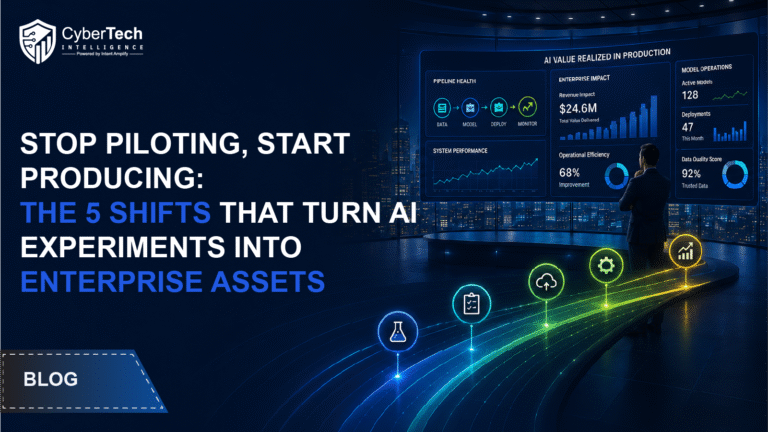

Artificial Intelligence has rapidly evolved from a futuristic concept into a strategic business priority. Over the last few years, enterprises across industries have invested heavily in AI pilots, proof-of-concept projects, and experimental initiatives aimed at exploring the technology’s potential. Yet despite growing investment and widespread enthusiasm, many organizations remain stuck in what industry experts call “pilot mode.”
The problem is no longer whether AI works.
The real challenge facing enterprises today is turning AI experimentation into measurable business outcomes.
Organizations worldwide are discovering that running isolated AI pilots is far easier than deploying scalable, production-ready AI systems that drive operational transformation. Many AI projects show promising early results in controlled environments, but struggle when integrated into real-world workflows, legacy infrastructure, governance frameworks, and enterprise-scale operations.
This growing gap between experimentation and execution is becoming one of the defining business challenges of the AI era.
Companies initially approached AI as an innovation initiative — testing chatbots, automating small tasks, or experimenting with generative AI tools. While these pilots created excitement, they often lacked a long-term operational strategy. As a result, many organizations are now facing fragmented AI ecosystems, disconnected use cases, governance concerns, escalating costs, and unclear return on investment.
Industry reports suggest that a significant percentage of enterprise AI pilots never successfully transition into production environments. The issue is rarely the technology itself. More often, organizations underestimate the complexity of scaling AI across enterprise systems, workflows, security environments, and business processes.
This is where the shift from “piloting” to “producing” becomes critical.
Modern enterprises can no longer afford to treat AI as a side experiment or isolated innovation project. Business leaders are under increasing pressure to demonstrate measurable value, improve operational efficiency, reduce costs, and create competitive advantage through AI adoption. Boards and executives now expect outcomes — not just prototypes.
Successful organizations are approaching AI differently.
Instead of focusing solely on experimentation, they are building production-first AI strategies designed for scalability, governance, security, integration, and long-term operational impact. These enterprises understand that AI success depends not only on advanced models, but also on data quality, workflow integration, infrastructure readiness, employee adoption, and organizational alignment.
The shift requires a fundamental mindset change.
AI initiatives must move beyond standalone tools and become embedded into core business operations. This includes integrating AI into decision-making processes, customer experiences, operational systems, cybersecurity workflows, supply chain management, and enterprise productivity platforms.
Governance also plays a major role in enterprise AI maturity.
As AI adoption expands, organizations face growing concerns around compliance, data privacy, model transparency, risk management, bias detection, and cybersecurity threats. Without proper governance frameworks, enterprises risk creating operational instability, regulatory exposure, and reputational damage.
Another major barrier is integration complexity.
Many AI pilots are developed in isolated environments with clean datasets and limited scope. However, production environments involve fragmented data sources, legacy systems, cross-functional teams, and evolving operational requirements. Scaling AI successfully requires enterprises to address infrastructure modernization, interoperability, workflow redesign, and continuous monitoring from the start.
Organizations are also recognizing that AI transformation is not just a technology challenge — it is a people challenge.
Employees need training, leadership support, process clarity, and trust in AI-driven systems. Enterprises that fail to address change management often encounter resistance, low adoption rates, and stalled implementations. AI success depends heavily on aligning people, processes, and technology under a unified strategy.
The future belongs to companies that operationalize AI effectively.
Businesses that can move beyond experimentation and deploy scalable AI systems across enterprise functions will gain significant advantages in productivity, agility, innovation, and customer experience. Meanwhile, organizations trapped in endless pilot cycles risk falling behind competitors that are already embedding AI into daily operations.
The AI era is entering a new phase — one focused less on hype and more on execution.
Enterprises must now transition from testing isolated use cases to building sustainable, production-ready AI ecosystems capable of delivering measurable business value at scale. The companies that succeed will not necessarily be the ones with the most pilots, but the ones that know how to operationalize AI responsibly, securely, and efficiently across the enterprise.
Read the Full Article
Want to learn how enterprises are shifting from AI experimentation to real-world production and scalable business outcomes?
Read the full article here: https://tinyurl.com/4ffz2dr6
Contact Us
1846 E Innovation Park Dr, Suite 100, Oro Valley, AZ 85755
Phone: +1 (845) 347-8894, +91 77760 9266