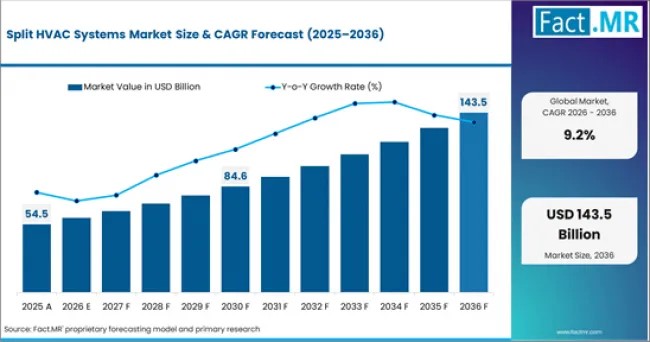

The global Split HVAC Systems Market is poised for substantial expansion over the next decade, driven by rising temperatures, growing air conditioning penetration in emerging economies, and accelerating adoption of energy-efficient climate control technologies. According to Fact.MR analysis, the market is estimated at USD 59.51 billion in 2026 and is projected to reach USD 143.5 billion by 2036, registering a robust CAGR of 9.2% during the forecast period.
Get detailed market forecasts, competitive benchmarking, and pricing trends: https://www.factmr.com/connectus/sample?flag=S&rep_id=11582
Split HVAC systems, consisting of indoor and outdoor units connected through refrigerant lines, have become the preferred climate-control solution across residential, commercial, and light industrial applications. Growing urbanization, increasing disposable incomes, and government-backed energy-efficiency initiatives are creating favorable conditions for long-term market growth worldwide.
Strong Demand Fundamentals Driving Industry Expansion
The market is expected to generate an absolute dollar opportunity of USD 83.99 billion between 2026 and 2036, supported by replacement demand in developed markets and first-time air conditioner purchases across emerging economies.
Increasing frequency of heat waves and rising average temperatures are accelerating HVAC adoption globally. Simultaneously, regulatory mandates encouraging energy-efficient appliances are driving replacement of conventional fixed-speed systems with advanced inverter-based technologies that offer lower power consumption and enhanced comfort.
Wall-mounted split HVAC systems are expected to account for 34.7% of total product demand in 2026, while residential climate management applications will contribute 38.2% of overall market revenue.
Analyst Perspective
“The split HVAC systems market is being shaped by two parallel growth forces: first-time air conditioning purchases in emerging economies and efficiency-driven replacement demand in developed markets. India represents one of the largest volume opportunities globally, while refrigerant transitions and inverter technology adoption are creating significant value-generation opportunities for manufacturers.”
Key Market Highlights
- Market value projected to increase from USD 59.51 billion in 2026to USD 143.5 billion by 2036
- Forecast CAGR of 2%
- Wall-mounted split systems to hold 7% market share
- Residential climate management to account for 2% of application demand
- Residential consumers represent 5% of end-use demand
- India and China emerge as the fastest-growing country markets at 4%and 9.1% CAGR, respectively
Production and Consumption Analysis
Asia Pacific remains the dominant production and consumption hub for split HVAC systems. China continues to benefit from large-scale manufacturing capabilities, vertical integration, and strong domestic demand, while India is rapidly expanding production capacity through government-backed manufacturing initiatives.
Consumption trends are increasingly concentrated in emerging economies where air conditioning penetration remains relatively low. India, Southeast Asia, Brazil, and parts of Africa represent substantial untapped opportunities as rising incomes and urbanization improve affordability and accessibility of cooling solutions.
Developed markets such as North America and Europe continue to generate significant replacement demand, particularly for inverter-driven and heat pump-equipped split systems.
Supply Chain and Procurement Intelligence
The split HVAC systems value chain includes compressor manufacturers, refrigerant suppliers, electronics providers, component assemblers, distributors, installers, and aftermarket service providers.
Procurement strategies are increasingly focused on:
- Energy efficiency performance
- Refrigerant compliance
- Total cost of ownership
- Smart connectivity features
- Installer support networks
- Supply chain reliability
The ongoing transition from R-410A refrigerants toward lower-global-warming-potential alternatives such as R-32 and R-290 is reshaping sourcing strategies across the industry. Manufacturers are also investing in localized production facilities to reduce supply-chain risks and improve responsiveness to regional demand.
Regional Growth Opportunities
India Leads Global Growth
India is forecast to expand at a 9.4% CAGR, supported by low household AC penetration, rising urban incomes, and increasing heat stress across major metropolitan regions. Government production-linked incentive (PLI) schemes and domestic manufacturing investments are further strengthening market fundamentals.
China Maintains Strong Momentum
China is expected to grow at 9.1% CAGR, supported by replacement demand, inverter adoption, commercial construction activity, and extensive domestic manufacturing capabilities.
North America and Europe
The United States is projected to grow at 8.4% CAGR, fueled by heat pump incentives, SEER2 efficiency standards, and rising adoption of ductless mini-split systems. Europe continues to benefit from electrification policies, energy-efficiency regulations, and government incentives supporting heat pump deployment.
Technology and Innovation Outlook
Technology innovation remains central to competitive differentiation in the split HVAC systems market. Inverter compressor technology continues to gain market share as consumers prioritize energy savings and comfort.
Meanwhile, smart connected HVAC systems equipped with artificial intelligence, occupancy sensing, predictive maintenance, and remote monitoring capabilities are rapidly moving from premium offerings into mainstream adoption.
Manufacturers are increasingly integrating HVAC systems with smart-home ecosystems such as Google Home, Amazon Alexa, and Apple HomeKit, enabling enhanced energy management and user convenience.
The growing adoption of IoT-enabled climate control systems is expected to create recurring revenue opportunities through software services, predictive maintenance programs, and energy optimization platforms.
Unlock the Complete Industry Analysis: https://www.factmr.com/report/split-hvac-systems-market
Competitive Landscape
The market remains highly competitive, led by multinational HVAC and electronics manufacturers investing aggressively in product innovation, refrigerant transition strategies, and digital connectivity solutions.
Leading companies include:
- Carrier Global Corporation
- Johnson Controls International plc
- Daikin Industries Ltd.
- LG Electronics
- Panasonic Corporation
- Midea Group
- Samsung Electronics
- Mitsubishi Electric Corporation
- Fujitsu General
- Voltas Limited
Recent industry developments include AI-powered smart air conditioners, hybrid solar cooling systems, advanced heat pump technologies, and expanded R-32 refrigerant product portfolios designed to meet evolving sustainability requirements.
To View Related Report:
Industrial Cable Reels Market https://www.factmr.com/report/1437/industrial-cable-reels-market
Emergency Warning Lights Market https://www.factmr.com/report/1438/emergency-warning-lights-market
Loading Spout Market https://www.factmr.com/report/1473/loading-spout-market
Drill Ships Market https://www.factmr.com/report/1538/drill-ships-market