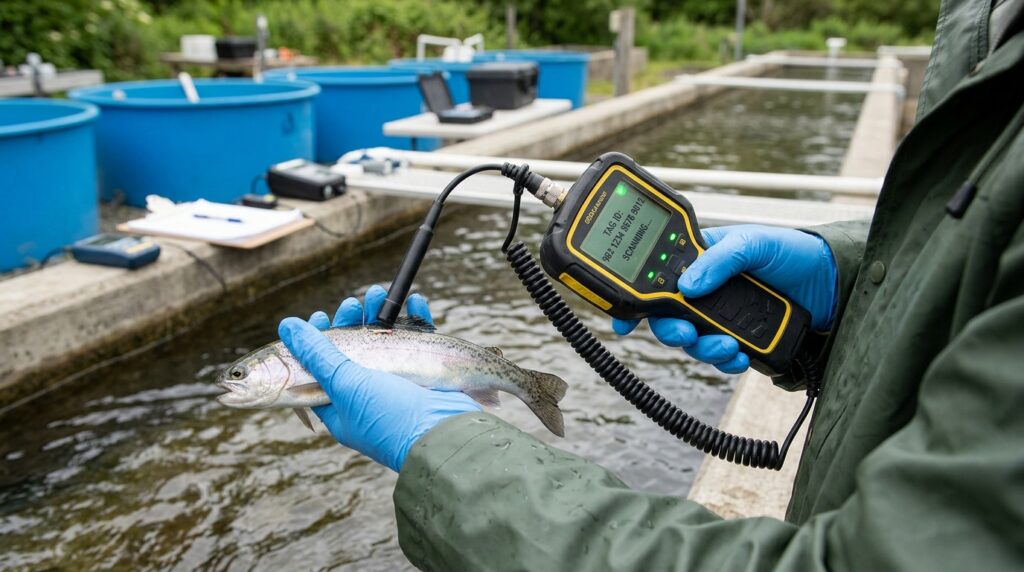

In the field of fisheries science, the value of a study is often measured by its duration. Decadal monitoring programs provide the longitudinal data necessary to understand climate change impacts, migratory shifts, and population bottlenecks. However, the most sophisticated data models are only as reliable as the physical hardware attached to the fish. For many researchers in 2026, the primary obstacle to accurate lifecycle data remains “tag shedding”—the biological or mechanical loss of fish tags over time.
Tag retention is not merely a technical specification; it is a fundamental pillar of mark-recapture accuracy. When a tag is expelled, it creates a “silent” data gap, often leading researchers to underestimate survival rates or miscalculate biomass. As monitoring projects increasingly move toward multi-year and transgenerational scopes, solving the challenges of long-term retention has become a priority for organizations like Vodaiq, which focuses on engineering higher-performing Passive Integrated Transponder (PIT) systems.
Identifying Biological Mechanisms of Tag Expulsion
Biological expulsion is the process by which a fish identifies a tag as a foreign body and works to eject it. In long-term studies, researchers often observe two primary pathways: trans-abdominal and trans-intestinal expulsion. Trans-abdominal loss occurs when the tag migrates toward the surgical incision or a new site in the body wall, eventually pushing through the skin. Trans-intestinal expulsion, a more complex mechanism often seen in salmonids and catfish, involves the tag being “engulfed” by the intestine and passed through the digestive tract.
Recent studies in 2025 and 2026 have shown that chronic inflammation is the leading catalyst for these mechanisms. When a tag causes persistent irritation, the fish’s immune system triggers a massive encapsulation response. While encapsulation can sometimes stabilize a tag, if the capsule remains inflamed, it can lead to tissue necrosis and subsequent tag loss. Minimizing this initial inflammatory “insult” during the tagging process is the first step in ensuring a tag stays in place for a decade or more.
- Trans-intestinal Expulsion: The tag enters the gut lumen through the intestinal wall and is excreted.
- Trans-abdominal Expulsion: The tag is pushed through the body wall or the original incision site.
- Wound Dehiscence: The surgical site fails to close properly, allowing the tag to fall out shortly after release.
- Bio-encapsulation: Fibrous tissue grows around the tag; if stable, it aids retention; if infected, it triggers ejection.
Optimizing the Tag-to-Body Mass Ratio for Lifespan Stability
One of the oldest rules in fisheries biology is the “2% rule,” which states that a tag should not exceed 2% of the fish’s total body mass. However, as we enter late 2026, modern research suggests that this rule is more of a guideline than a hard limit, especially for lifecycle studies. For juvenile fish that are expected to grow 1,000% in size, the initial tag burden must be balanced against the need for a tag large enough to be detected by stationary antenna arrays once the fish reaches adulthood.
If a tag is too small, its read range may be insufficient for deep-water monitoring or high-velocity river systems. Conversely, a tag that is too large for a juvenile can impair swimming performance and increase the likelihood of abdominal expulsion due to internal pressure. Researchers now often use a “burden-to-growth” projection, selecting a tag that might represent 3% of the mass at tagging but will drop to less than 0.1% of the mass within the first year of the study.
| Tag Size | Recommended Minimum Fish Length | Targeted Life Stage | Read Range Potential |
| :— | :— | :— | :— |
| 8 mm (Nano) | 40 mm – 60 mm | Juveniles / Small-bodied species | Moderate (Stationary) |
| 12 mm (Standard) | 60 mm – 150 mm | Smolt / Sub-adults | High (Universal) |
| 23 mm (Large) | >200 mm | Adults / Pelagic species | Maximum (Open Water) |
| External Streamer | N/A | Large Pelagics (Sharks/Tuna) | Visual Only |
The Superiority of Laser-Sealed Glass vs. Traditional Heat Sealing
For a fish tag to function for 10 to 20 years, its internal electronics must remain perfectly dry. The industry standard has long been heat-sealed glass, where the ends of the glass capsule are melted shut. However, heat sealing can create microscopic stresses and “thin spots” in the glass, which are vulnerable to moisture ingress over long periods. In the high-pressure environment of the deep ocean or the variable salinity of estuaries, even a single molecule of water can corrode the copper coil, rendering the tag dead.
Vodaiq has pioneered the use of green glass laser sealing to address this vulnerability. Unlike heat sealing, which applies broad thermal stress, laser sealing is a precise, cold-tip process that creates a hermetic bond without compromising the structural integrity of the surrounding glass. This technology significantly reduces the risk of “tag failure,” which is often mistaken for “tag shedding” in the field. If a tag stops transmitting due to moisture, it is effectively lost to the researcher, even if it remains inside the fish.
- Precision Sealing: Laser technology ensures a uniform wall thickness across the entire tag.
- Moisture Ingress Prevention: Eliminates the “breathing” effect caused by thermal expansion in heat-sealed tags.
- Enhanced Crush Strength: Laser-sealed tags can withstand higher hydrostatic pressures in deep-sea monitoring.
- Biocompatibility: Pure glass surfaces minimize the risk of the chemical rejection often seen with lower-quality polymers.
Advanced Surgical Protocols for Maximizing Retention Rates
The skill of the surgeon and the choice of implantation site are the most controllable variables in tag retention. While many researchers still use the mid-ventral incision, 2026 field protocols are increasingly favoring the pelvic girdle or the dorsal musculature for certain species. The pelvic girdle, in particular, provides a stable “pocket” of connective tissue that reduces tag migration, which is a major cause of trans-abdominal expulsion.
Furthermore, the sharpness of the needle is a critical factor that is often overlooked. A dull needle creates jagged tissue tears rather than clean incisions, leading to slower healing and a higher risk of infection. Advanced field stations now implement “three-fish-per-needle” rules to ensure every puncture is as clean as possible. In some 2026 studies, researchers are also experimenting with bio-compatible adhesives (surgical glues) to reinforce sutures, providing an extra layer of security during the critical first 72 hours of post-tagging recovery.
- Incision Site Selection: Move away from high-movement areas to stable zones like the pelvic girdle.
- Needle Protocol: Use medical-grade, silicon-coated needles and replace them frequently to maintain sharpness.
- Antiseptic Use: Standardize the use of iodine-based solutions to prevent the infections that trigger expulsion.
- Suture Technique: Employ “non-wicking” monofilament sutures to prevent bacteria from entering the body cavity.
Environmental Impacts on Long-Term Tag Integrity
Even a perfectly implanted tag must survive the environmental rigors of the aquatic world. Salinity, temperature, and bio-fouling are the three horsemen of tag degradation. In marine environments, the accumulation of algae and barnacles on external components (such as the antennas of satellite tags) can increase drag, leading to mechanical “tear-out.” While PIT tags are internal and protected from bio-fouling, they are still affected by water chemistry.
In 2025-2026 research, it was discovered that high-salinity environments can slowly leach ions from lower-quality glass, leading to “glass rot” over decadal timescales. This makes the material purity of the tag housing essential. Additionally, temperature fluctuations can affect the internal pressure of the tag; tags that are not vacuum-sealed or laser-sealed can experience internal condensation during rapid depth or temperature changes, which are common in migratory species like Atlantic salmon or sturgeon.
- Salinity Resistance: High-purity borosilicate glass is required for multi-year marine studies.
- Thermal Stability: Internal components must be secured to prevent shifting during high-velocity swimming.
- Pressure Compensation: Tags must be tested for the specific barometric pressures of the target habitat.
- Bio-fouling Mitigation: For hybrid tagging (internal PIT + external sensor), use non-toxic anti-fouling coatings.
Improving Data Accuracy through High-Performance PIT Tagging
Solving the challenge of tag retention is ultimately about data integrity. In 2026, the use of AI-driven population models has made it possible to process millions of detection events, but these models are highly sensitive to “tag shed bias.” If a model assumes a 100% retention rate when the actual rate is 85%, the resulting population estimates can be dangerously optimistic, potentially leading to the over-harvesting of vulnerable stocks.
By utilizing high-performance tags like those offered by Vodaiq, researchers can bridge the gap between short-term observations and lifecycle-scale data. The combination of laser-sealed durability, optimized biocompatibility, and refined surgical techniques allows for monitoring windows that extend beyond a decade. This enables the tracking of long-lived species, such as sturgeon or sharks, throughout their entire reproductive lives, providing the high-resolution data needed for the conservation efforts of the future.
- Decadal Monitoring: Reliable hardware allows for 10+ years of continuous data collection.
- Reduced Bias: Higher retention rates lead to more accurate mark-recapture population estimates.
- Cost Efficiency: While high-quality tags have a higher upfront cost, the “cost-per-data-point” is lower due to reduced loss.
- Conservation Impact: Accurate data leads to better-informed policy decisions and sustainable fisheries management.