
Introduction: The Hidden Crisis in Fish Migration Monitoring
Every year, billions of fish migrate across rivers, estuaries, and ocean corridors. Yet scientists and fisheries managers often lose track of them entirely. Gaps in migration data compromise conservation decisions, regulatory compliance, and species recovery programs. Traditional monitoring methods — visual observation, fin-clipping, or basic radio telemetry — simply cannot keep pace with the scale and complexity of modern fisheries research.
This is where pit tagging has emerged as a game-changer. By embedding a passive integrated transponder inside a fish, researchers gain a permanent, unique identifier that lasts the animal’s lifetime. According to the National Oceanic and Atmospheric Administration (NOAA), PIT-based monitoring programs have significantly improved survival rate estimates for endangered salmon populations across the Pacific Northwest. The precision and reliability this technology offers makes PIT tagging for fish identification and tracking one of the most valuable tools in modern aquatic research.
What Is PIT Tagging and Why Does It Matter?
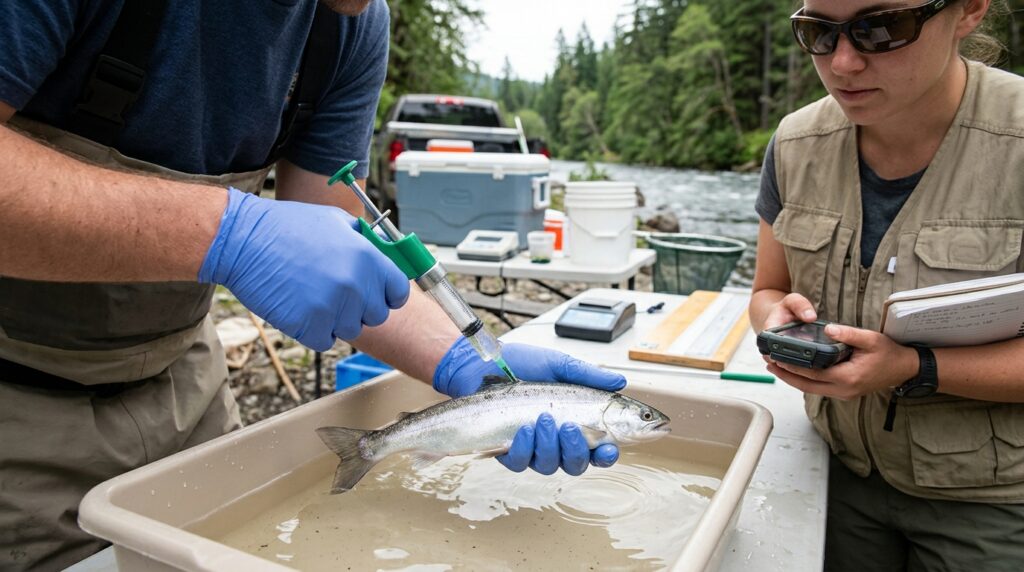
Pit tagging refers to the implantation of a passive integrated transponder — a tiny RFID microchip encased in biocompatible glass or polymer — into a fish’s body cavity or muscle tissue. These tags carry no battery. Instead, they activate when scanned by an electromagnetic reader, transmitting a unique 15-digit ISO code instantly.
Unlike acoustic or radio tags, pit tagging does not require active signal broadcasting. This eliminates battery replacement, reduces tag size, and extends usability across an animal’s entire lifespan. Tags typically measure between 8mm and 23mm in length and weigh less than 0.6 grams — making them suitable for juvenile fish as small as 50mm in length.
Key advantages include:
- Permanence: Once implanted, data identity never changes
- No interference: Passive architecture avoids signal collision issues
- Cost efficiency: Lower per-unit cost compared to acoustic transmitters
- Multi-species applicability: Used in salmon, sturgeon, trout, eel, and lamprey research
The Core Tracking Gaps That Have Plagued Fisheries Science
Gap 1: Incomplete Migration Route Data
Traditional mark-recapture methods produce incomplete route maps. Fish are tagged, released, and then only detected if physically recaptured — an event that depends heavily on fishing effort. Studies published in Transactions of the American Fisheries Society have consistently shown recapture rates below 5% using conventional methods, leaving massive data voids.
Pit tagging solves this by coupling with fixed antenna arrays installed at dams, fish ladders, irrigation diversions, and tributary junctions. Whenever a tagged fish swims past an antenna, detection is automatic and instantaneous — no human intervention required.
Gap 2: Survival Rate Estimation Errors
Poorly calibrated survival models have led to miscalculated population estimates, sometimes resulting in overfishing of vulnerable stocks. The Columbia River Basin PIT Tag Information System (PTAGIS), maintained by the Pacific States Marine Fisheries Commission, has processed over 180 million detection records from more than 7 million unique tags since 1987. This dataset has fundamentally improved smolt-to-adult survival modeling for Snake River salmon — a landmark example of what systematic pit tagging programs can accomplish.
Gap 3: Behavioral Response to Environmental Stressors
Climate change is reshaping migration timing. Fish are shifting their routes and schedules in response to altered temperature regimes and altered river flows. Understanding these shifts requires longitudinal, individual-level tracking — exactly what pit tagging delivers. Individual fish detected repeatedly across multiple seasons provide behavioral baselines that aggregate-level methods simply cannot capture.
Advanced Deployment Strategies Closing the Data Gap
Automated Antenna Networks
Fixed PIT detection arrays now span entire river systems. The Columbia-Snake River corridor, for instance, has over 30 PIT detection sites operated by federal and tribal agencies. Each site records date, time, location, and fish identity automatically, enabling real-time data flow to centralized databases.
Modern deployments pair antennas with solar panels and cellular data transmission, allowing remote monitoring in locations with no grid access. This dramatically expands where pit tagging data can be collected without continuous human presence.
Mobile Detection Platforms
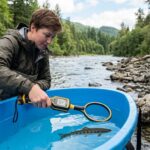
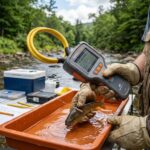
When fixed arrays cannot be deployed — due to cost, geography, or temporary monitoring needs — mobile detection backpacks, boat-mounted readers, and handheld wands allow field teams to scan tagged fish during electrofishing surveys or in-stream counts. These portable solutions make pit tagging viable for smaller tributary surveys and international research programs with limited infrastructure.
Data Integration with Fisheries Management Software
Raw detection logs are meaningless without context. Leading-edge fisheries management platforms now integrate pit tagging detection data with environmental variables — water temperature, flow rate, dissolved oxygen — enabling researchers to correlate migration behavior with ecological conditions in real time.
VodaIQ, VodaIQ, a recognized leader in aquatic monitoring technology, provides integrated PIT tag systems designed to bridge detection hardware and data management tools, supporting end-to-end fish tracking workflows for researchers and resource managers worldwide.
Real-World Impact: Case Studies Worth Noting
Columbia River Salmon Recovery: NOAA Fisheries data credits PTAGIS-based pit tagging programs with directly informing dam bypass operation schedules — changes estimated to have increased juvenile salmon survival by up to 20% at some facilities.
European Eel Monitoring: Under the EU Eel Regulation, member states are increasingly deploying PIT systems in river barriers to quantify downstream silver eel passage — data that directly informs stocking decisions and barrier mitigation funding.
New Zealand Longfin Eel Research: National Institute of Water and Atmospheric Research (NIWA) studies using pit tagging have revealed previously unknown migration corridors, prompting protection orders on key spawning pathways.
Addressing Implementation Challenges
Tag Retention and Animal Welfare
Studies consistently show retention rates exceeding 95% when implantation follows best-practice protocols. Researchers must adhere to species-specific guidelines covering fish size minimums, anesthesia protocols, and post-tagging recovery monitoring. Welfare considerations are paramount, and regulatory approvals are typically required before program initiation.
Reader Range Limitations
Standard low-frequency (134.2 kHz) PIT readers offer detection ranges of 20–60cm depending on antenna size and tag orientation. For high-velocity river channels, antenna designs must account for turbulence and tag tumbling. Engineering advances in flat-panel and multiplexed antenna systems are progressively extending effective detection zones.
Conclusion: PIT Tagging as the Foundation of Modern Fisheries Science
The gaps in fish migration tracking are not inevitable — they are solvable. Pit tagging technology, when deployed thoughtfully within well-designed monitoring networks, transforms fragmented snapshots of fish behavior into continuous, individual-level datasets with the precision conservation biology demands.
From endangered salmon in the Pacific Northwest to commercially important eels in European river systems, the evidence is clear: programs built around pit tagging deliver more accurate data, better management outcomes, and stronger scientific foundations for species recovery. As climate change intensifies migration disruptions, the urgency to close these tracking gaps has never been greater — and the technology to do so has never been more capable.