
Choosing the wrong server memory can mean a machine that refuses to boot, throttles under load, or silently corrupts data for weeks before anyone notices. Whether you are upgrading legacy infrastructure or building a new deployment from scratch, understanding server memory compatibility is the single most important step before you spend a dollar. This guide cuts through the noise and gives you exactly what you need to know about DDR3, DDR4, and DDR5.
Why Server Memory Compatibility Cannot Be an Afterthought
Server memory is not desktop RAM in a different package. Enterprise modules carry ECC (Error-Correcting Code) to catch and fix single-bit errors on the fly, and registered DIMMs (RDIMMs) place a signal buffer between the controller and the DRAM chips, allowing far more modules per channel without signal degradation. Mixing module types, such as RDIMMs with LRDIMMs, is almost universally unsupported and will prevent a server from posting. Organizations that buy server memory in bulk need to lock in exact part numbers from the server’s qualified vendor list before procurement, not after.
DDR3: The Legacy Standard Still Running in Production
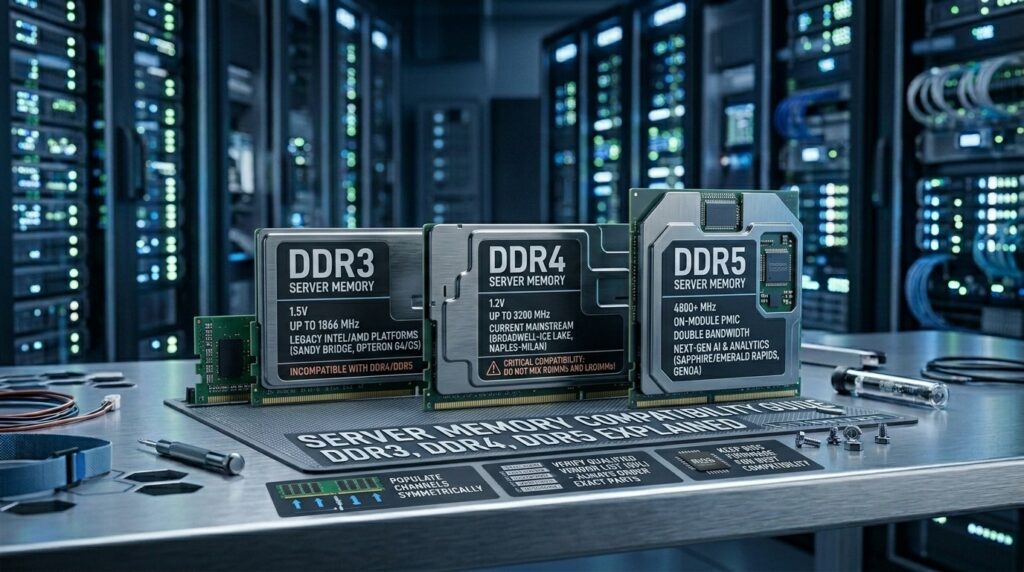
DDR3 server memory operates at 1.5V (1.35V for low-voltage variants) with speeds ranging from 800 MHz to 1866 MHz. It powers platforms like Intel Sandy Bridge-EP and Ivy Bridge-EP Xeon processors and AMD Opteron G4 and G5 generations. If your infrastructure sits on any of these platforms, you are locked into DDR3 entirely. The sockets are physically and electrically incompatible with newer generations, and mixing speed grades within the same server drops every channel to the slowest module installed. DDR3 remains a cost-effective option for sustaining existing workloads, but it offers no upgrade path to newer memory standards.
DDR4: The Current Mainstream Workhorse
DDR4 runs at 1.2V and covers speeds from 2133 MHz to 3200 MHz in standard server configurations, making it considerably more efficient than DDR3. It spans an enormous range of platforms, from Intel Broadwell-EP through Ice Lake Xeon and AMD Naples through Milan EPYC. The key server memory compatibility trap with DDR4 is assuming that two servers using the same socket will accept the same modules. For example, first-gen and second-gen AMD EPYC both use the SP3 socket, yet their optimal memory population rules and maximum supported speeds differ significantly. Always check the specific server model’s hardware compatibility list, not just the processor generation.
DDR4 Module Types Matter
RDIMMs and LRDIMMs are not interchangeable on the same platform. Most servers support one or the other, and attempting to mix them will result in a failed boot. Verify which type your server requires before ordering, and confirm that all modules within a channel share the same rank configuration and capacity for stable operation.
DDR5: The Next-Generation Standard
DDR5 begins at 4800 MHz and scales past 6400 MHz, delivering roughly double the bandwidth of DDR4. It also moves power management directly onto the module itself, which means DDR5 cannot be adapted to DDR4 platforms under any circumstances. Supported on Intel Sapphire Rapids and Emerald Rapids Xeon processors and AMD Genoa EPYC 9004 series, DDR5 is becoming the
Server memory compatibility spans voltage, speed grades, module type, channel population rules, and firmware support. Verify your server’s qualified vendor list, populate channels symmetrically, and keep BIOS firmware current. Get those fbaseline for AI inference, in-memory analytics, and high-core-count virtualization workloads. For any new server build planned to run through the next several years, DDR5 is the generation worth investing in.
Conclusion
Server memory compatibility spans voltage, speed grades, module type, channel population rules, and firmware support. Verify your server’s qualified vendor list, populate channels symmetrically, and keep BIOS firmware current. Get those foundational steps right every time, and your memory investment will perform exactly as intended.