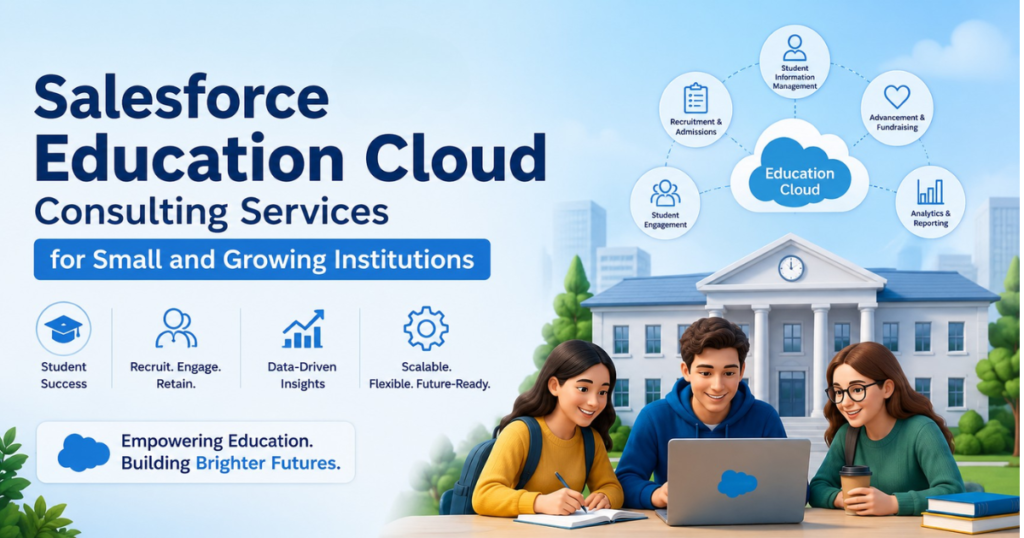

Small colleges and growing schools face a tough reality. They compete against large universities with bigger budgets and bigger IT teams, yet they still need modern systems to recruit, support, and retain students. Salesforce Education Cloud Consulting gives smaller institutions a way to close that gap without building an enterprise IT department from scratch.
Why Small Institutions Cannot Ignore Modern CRM Tools
Student expectations have changed across every type of institution, not just large universities. Prospective students expect fast responses, personalized outreach, and simple online processes. Small institutions that still rely on spreadsheets and manual emails fall behind quickly.
The data supports this shift. Institutions that adopt Salesforce Education Cloud report a 15% increase in first-year student retention, a 10% increase in fundraising contributions, and a 5.5% rise in student enrollment, according to a Forrester study on the platform’s impact. These gains matter even more for small institutions, where every enrolled student has a larger effect on overall revenue.
Common Struggles Without a Connected System
- Admissions staff track applicants across scattered spreadsheets and inboxes.
- Marketing teams send generic emails instead of personalized outreach.
- Advisors lack visibility into a student’s full history before a meeting.
- Alumni and donor data sits disconnected from student records.
- Leadership cannot get a clear picture of enrollment trends in real time.
These problems compound as an institution grows. A school that manages 500 applicants manually cannot use the same process at 2,000 applicants. This is exactly where Education Cloud, guided by the right consulting partner, makes a measurable difference.
What Salesforce Education Cloud Consulting Services Actually Include
Salesforce Education Cloud Consulting Services cover far more than basic software setup. A qualified partner works through several stages to match the platform to an institution’s actual needs and budget.
1. Needs Assessment and Planning
Consultants start by reviewing current systems, staff workflows, and pain points. Small institutions often carry legacy student information systems alongside disconnected marketing tools. A proper assessment identifies what to keep, what to replace, and what to integrate.
2. Education Data Architecture (EDA) Configuration
Education Cloud runs on the Education Data Architecture, a data model built specifically for schools and universities. Consultants configure this model to match the institution’s structure, covering:
- Student and applicant records
- Program and course relationships
- Application and admissions stages
- Affiliations between students, staff, and departments
3. Recruitment and Admissions Setup
Consultants build automated workflows for lead capture, application tracking, and applicant communication. This turns a manual, error-prone process into a system that responds to prospective students without constant staff intervention.
4. Integration with Existing Systems
Most small institutions already run a student information system (SIS), a learning management system, and possibly a separate finance platform. Consultants connect these systems to Education Cloud, so data flows in one direction instead of requiring duplicate entry.
5. Training and Change Management
Small teams often wear multiple hats. A consultant’s training plan needs to fit staff who cannot spend weeks in workshops. Good partners build simple, role-specific training that gets staff productive fast.
Why Consulting Support Matters More for Small Institutions
Large universities often have internal Salesforce administrators and dedicated IT departments. Small institutions rarely do. This makes external consulting support even more valuable, not less.
Key Reasons Small Institutions Need Expert Guidance
- Limited Internal Technical Staff Most small colleges have one or two IT staff members handling everything from network security to software support. They cannot also become Salesforce configuration experts overnight.
- Budget Constraints Require Smart Prioritization A consulting partner helps identify which features deliver the fastest return, so institutions do not waste limited budget on capabilities they will not use for years.
- Faster Time to Value Consultants who specialize in education already understand common configurations. This experience shortens implementation timelines compared to a general Salesforce partner learning education needs from scratch.
- Avoiding Costly Rework Poor initial configuration creates problems that are expensive to fix later. A consultant who understands EDA prevents structural mistakes that surface months after go-live.
A Practical Implementation Roadmap for Smaller Institutions
Small institutions benefit from a phased rollout instead of a single, large deployment. This approach spreads cost over time and lets staff adjust gradually.
Phase One: Core Recruitment and Admissions
Start with the highest-impact area first. Most small institutions see immediate value from automating recruitment and admissions, since this directly affects enrollment numbers.
Phase Two: Student Success and Advising
Once admissions data flows properly, expand into student success tools. Advisors gain a full view of each student’s history, which supports earlier intervention for at-risk students.
Phase Three: Alumni and Fundraising
Smaller institutions often delay fundraising tools, but connecting alumni data to the same platform pays off. Indiana University’s advancement team saw a 230% increase in recurring giving after connecting donor engagement tools to their Salesforce platform. Smaller institutions can achieve proportional gains with the same approach.
Phase Four: Advanced Analytics and AI
Once the core data model is stable, institutions can add AI-powered tools for predictive enrollment analysis and personalized communication. This phase works best after staff feel comfortable with the base platform.
Real-World Proof Points from Higher Education
Results from larger institutions still offer useful benchmarks for smaller schools planning similar projects.
LSU Online and Continuing Education achieved more than 20% year-over-year enrollment growth after implementing Salesforce, growing to more than 15,000 students. DePaul University used Salesforce Data 360 to consolidate 37 data streams and more than 95 million records into a single source of truth, which helped staff identify at-risk students faster.
Small institutions will not manage data at this scale, but the underlying lesson applies at any size. Connected data leads to faster decisions and better student outcomes. A small college with 2,000 students benefits from the same principle, just with a smaller technical footprint.
Common Mistakes Small Institutions Make During Implementation
Institutions without consulting guidance tend to repeat predictable mistakes.
- Trying to implement every module at once instead of starting with core needs.
- Skipping proper data cleanup before migration, which carries old problems into the new system.
- Underestimating staff training time, leading to low adoption after go-live.
- Choosing a generic Salesforce partner without education-specific experience.
- Failing to assign a clear internal owner to manage the platform after launch.
A rushed or overly ambitious rollout often costs more in the long run than a slower, phased approach guided by an experienced consulting team.
Cost Considerations for Growing Institutions
Budget remains the biggest concern for small institutions considering Education Cloud. A few factors affect overall cost:
- License tier selected, since Education Cloud offers different editions based on institution size and needs.
- Scope of customization, as heavily customized workflows cost more to build and maintain.
- Number of integrations, since each connected system adds setup and testing time.
- Ongoing support needs, including whether the institution needs managed services after go-live.
Working with a consulting partner experienced in smaller deployments helps control these costs. Partners who only work with large universities may design solutions that exceed what a smaller institution actually needs.
How to Choose the Right Consulting Partner
Not every Salesforce consulting firm understands education-specific needs. Small institutions should look for a few key qualifications.
Signs of a strong education-focused partner:
- Direct experience with the Education Data Architecture (EDA).
- A portfolio that includes institutions similar in size and budget.
- A clear, phased implementation approach rather than an all-at-once model.
- Transparent pricing that fits smaller budgets.
- Ongoing support options beyond the initial go-live date.
Asking for references from similarly sized institutions gives a clearer picture than reviewing case studies from large universities alone.
Measuring Success After Implementation
Small institutions should track specific metrics to confirm the platform delivers real value, not just a new interface for old problems.
Metrics worth watching in the first year:
- Application-to-enrollment conversion rate before and after go-live.
- Average response time to prospective student inquiries.
- Staff time spent on manual data entry versus automated workflows.
- First-year student retention compared to prior cohorts.
- Alumni engagement and donation rates, if fundraising tools are in scope.
Reviewing these numbers every quarter helps small teams catch problems early. If application conversion rates do not improve within two admissions cycles, that signals a workflow issue worth revisiting with the consulting partner, not a reason to abandon the platform.
Conclusion
Small and growing institutions no longer need to settle for outdated systems just because they lack a large IT department. Salesforce Education Cloud Consulting gives these institutions a practical path toward the same connected, data-driven operations that larger universities already use.
The right approach starts small, prioritizes the highest-impact areas first, and grows the platform alongside the institution. Consulting guidance matters at every stage, from initial data architecture decisions to long-term platform support.
For institutions ready to modernize recruitment, student support, and alumni engagement, partnering with experienced Salesforce Education Cloud Consulting Services providers offers a realistic, budget-conscious way to compete with larger, better-resourced schools.