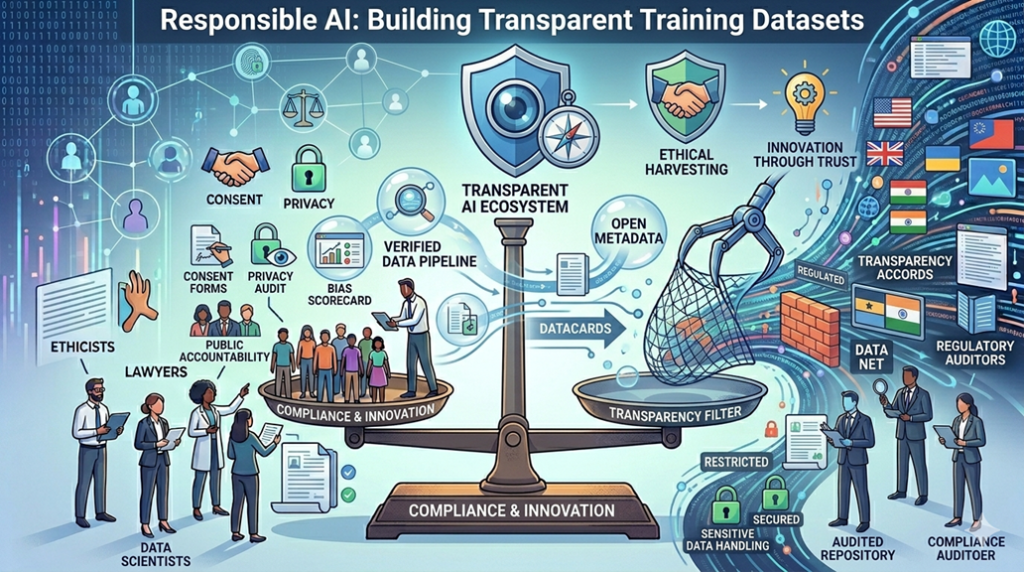

The rapid adoption of artificial intelligence across industries has brought unprecedented opportunities—and equally significant responsibilities. As organizations increasingly rely on large language models (LLMs) and other AI systems, the integrity of the data used to train these models has become a critical concern. Responsible AI is no longer a theoretical concept; it is a practical necessity. At the core of this responsibility lies one foundational element: transparent training datasets.
For any data annotation company, transparency is not just a best practice—it is a competitive differentiator and an ethical imperative. Building transparent datasets ensures accountability, reduces bias, and strengthens trust in AI systems. This article explores how organizations can develop transparent training datasets and why this approach is essential for scalable, reliable AI.
The Importance of Transparency in AI Training Data
Transparency in training datasets refers to the ability to clearly understand, trace, and audit how data is collected, processed, annotated, and utilized. Without transparency, AI systems become “black boxes,” making it difficult to identify errors, biases, or compliance risks.
Transparent datasets enable:
- Traceability: Understanding where data originates and how it evolves through the pipeline
- Auditability: Ensuring compliance with regulatory and ethical standards
- Accountability: Assigning responsibility for data quality and annotation decisions
For organizations investing in data annotation outsourcing, transparency ensures that third-party workflows align with internal governance standards.
How High-Quality Training Data Impacts LLM Performance
The performance of any LLM is directly proportional to the quality of its training data. Poorly annotated or opaque datasets can introduce inconsistencies, bias, and inaccuracies that propagate through the model’s outputs.
High-quality, transparent datasets contribute to:
- Improved model accuracy and generalization
- Reduced hallucinations and misinformation
- Better alignment with user intent through RLHF Annotation Services
When transparency is embedded into dataset creation, organizations can more effectively debug model behavior and optimize performance over time. This is especially critical in enterprise applications where precision and reliability are non-negotiable.
Key Components of Transparent Training Datasets
Building transparency into training datasets requires a structured approach. Below are the essential components that every organization should prioritize:
1. Data Provenance and Lineage
Understanding where data comes from is fundamental. Organizations must document:
- Source of data (public, proprietary, synthetic)
- Collection methods
- Licensing and usage rights
Maintaining detailed data lineage ensures that every data point can be traced back to its origin, reducing legal and ethical risks.
2. Annotation Guidelines and Consistency
Clear, standardized annotation guidelines are critical for maintaining dataset integrity. A professional data annotation company ensures:
- Well-defined labeling taxonomies
- Annotator training and calibration
- Continuous quality checks
Consistency in annotation directly influences how well models learn patterns and make predictions.
3. Bias Detection and Mitigation
Bias in training data can lead to unfair or harmful AI outcomes. Transparent datasets include:
- Bias audits during data collection and annotation
- Diverse and representative data sampling
- Ongoing evaluation using fairness metrics
Through structured data annotation outsourcing, organizations can scale bias detection processes while maintaining oversight.
4. Versioning and Dataset Governance
Datasets evolve over time, and tracking these changes is essential. Version control allows teams to:
- Compare dataset iterations
- Reproduce model results
- Roll back to previous versions if issues arise
Strong governance frameworks ensure that updates are documented and validated before deployment.
5. Human-in-the-Loop Feedback Systems
Transparency is enhanced when human feedback is integrated into the training loop. RLHF Annotation Services (Reinforcement Learning from Human Feedback) play a pivotal role by:
- Refining model outputs based on human judgment
- Improving contextual understanding
- Aligning models with ethical and practical expectations
This iterative feedback mechanism ensures continuous improvement and accountability.
Challenges in Building Transparent Datasets
While the benefits are clear, achieving transparency in training datasets is not without challenges:
Scale and Complexity
Modern AI systems require massive datasets, often sourced from multiple channels. Managing transparency at scale demands robust infrastructure and standardized processes.
Cost Considerations
High-quality annotation and governance frameworks require investment. However, cutting corners in transparency often leads to higher downstream costs due to model failures or compliance issues.
Vendor Coordination
When leveraging data annotation outsourcing, ensuring alignment between internal teams and external vendors can be complex. Clear communication and shared standards are essential.
Data Privacy and Compliance
Balancing transparency with privacy regulations such as GDPR requires careful handling of sensitive data. Organizations must implement anonymization and secure data handling practices.
Best Practices for Building Transparent Training Datasets
To overcome these challenges, organizations should adopt the following best practices:
Establish Clear Data Policies
Define policies for data collection, annotation, and usage. Ensure that all stakeholders—including external vendors—adhere to these guidelines.
Invest in Annotation Expertise
Partner with a specialized data annotation company that prioritizes quality and transparency. Experienced annotators and robust QA processes significantly improve dataset reliability.
Implement End-to-End Monitoring
Use tools and platforms that provide visibility into every stage of the data pipeline. Monitoring ensures that issues are identified and resolved early.
Standardize Documentation
Maintain comprehensive documentation for:
- Annotation guidelines
- Data sources
- Version histories
- Quality metrics
Documentation is the backbone of transparency and enables effective collaboration across teams.
Leverage Automation with Human Oversight
Automation can streamline data processing, but human oversight remains essential for nuanced tasks. Combining both ensures efficiency without compromising quality.
The Role of Annotera in Responsible AI
At Annotera, we recognize that responsible AI begins with responsible data practices. As a trusted partner in data annotation outsourcing, we are committed to delivering transparent, high-quality training datasets that empower organizations to build reliable AI systems.
Our approach includes:
- Rigorous annotation workflows with multi-layered quality checks
- Detailed data lineage tracking and documentation
- Advanced bias detection and mitigation strategies
- Scalable RLHF Annotation Services for continuous model improvement
By prioritizing transparency at every stage of the data lifecycle, we help organizations unlock the full potential of AI while maintaining ethical and operational integrity.
The Future of Transparent AI Training
As AI continues to evolve, transparency will become a baseline expectation rather than a differentiator. Regulatory frameworks are tightening, and users are demanding greater accountability from AI systems.
Organizations that invest in transparent training datasets today will be better positioned to:
- Meet compliance requirements
- Build user trust
- Achieve sustainable AI scalability
In contrast, those that neglect transparency risk not only technical failures but also reputational damage.
Conclusion
Responsible AI is fundamentally about trust—and trust is built on transparency. Training datasets are the foundation of every AI system, and their quality and clarity determine the system’s success.
By focusing on data provenance, annotation consistency, bias mitigation, and robust governance, organizations can create transparent datasets that drive better outcomes. Whether through in-house efforts or strategic data annotation outsourcing, the goal remains the same: to build AI systems that are accurate, fair, and accountable.
At Annotera, we are committed to helping organizations navigate this journey with precision and expertise. Because when it comes to AI, transparency is not optional—it is essential.