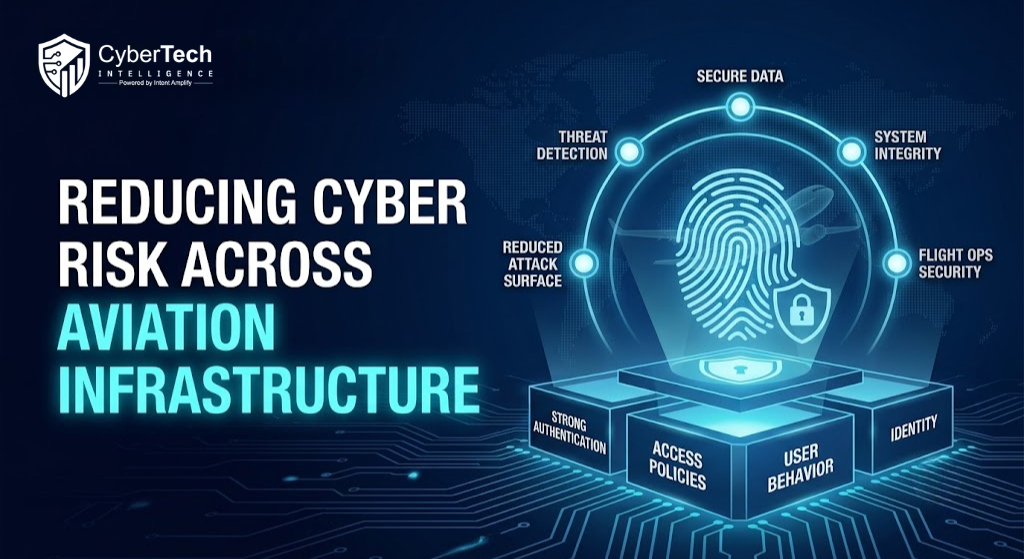

The aviation industry is one of the most technologically advanced and interconnected sectors in the world. Modern airports, airlines, air traffic management systems, aircraft manufacturers, and defense organizations rely heavily on digital technologies to ensure safe, efficient, and reliable operations. From passenger check-in systems and flight scheduling to aircraft maintenance and navigation, digital infrastructure supports nearly every aspect of aviation. While these advancements improve operational efficiency and customer experience, they also introduce new cybersecurity challenges. As cyber threats continue to evolve, reducing cyber risk across aviation infrastructure has become a critical priority for organizations responsible for protecting passengers, critical assets, and national security.
Aviation infrastructure includes airports, communication networks, operational technology (OT), air traffic control systems, cloud applications, connected aircraft, and supply chain partners. Because these systems are highly interconnected, a successful cyberattack on one component can affect multiple parts of the aviation ecosystem. Cybercriminals increasingly target aviation organizations through ransomware, phishing campaigns, supply chain attacks, insider threats, distributed denial-of-service (DDoS) attacks, and credential theft. Preventing these threats requires a comprehensive cybersecurity strategy focused on resilience, continuous monitoring, and proactive risk management.
Read More: https://tinyurl.com/3d6z992x
One of the most effective ways to reduce cyber risk is by implementing a Zero Trust security model. Traditional security approaches assumed that users and devices inside the network could be trusted. However, today’s aviation environments support remote employees, cloud services, contractors, and third-party vendors, making perimeter-based security insufficient. Zero Trust continuously verifies every user, device, and application before granting access to critical systems. By enforcing continuous authentication and least-privilege access, aviation organizations can significantly reduce the risk of unauthorized access.
Identity and Access Management (IAM) is another essential component of aviation cybersecurity. Employees, maintenance teams, contractors, and operational personnel often require access to sensitive applications and infrastructure. Without proper access controls, compromised credentials can provide attackers with entry into critical systems. IAM solutions centralize identity management while enforcing strong authentication, role-based access controls, and Multi-Factor Authentication (MFA). These capabilities ensure only authorized individuals can access aviation systems while minimizing the impact of compromised accounts.
Network segmentation also plays a critical role in reducing cyber risk. Aviation environments contain multiple operational systems with different security requirements. Passenger services, administrative networks, aircraft maintenance systems, and operational technology should be isolated from one another using network segmentation. Separating critical infrastructure from general business systems limits lateral movement if attackers gain access to one segment, helping contain cyber incidents before they spread across the organization.
Continuous threat monitoring is equally important for protecting aviation infrastructure. Modern Security Information and Event Management (SIEM) platforms, Extended Detection and Response (XDR) solutions, and Security Operations Centers (SOCs) provide centralized visibility across networks, cloud environments, endpoints, and operational systems. Continuous monitoring enables security teams to identify unusual activity, investigate suspicious events, and respond quickly before attackers disrupt critical operations.
Artificial intelligence is transforming aviation cybersecurity by improving threat detection and response capabilities. AI-powered security platforms analyze vast amounts of network traffic, user behavior, and operational data to identify anomalies that may indicate cyber threats. Machine learning algorithms establish normal behavioral patterns and automatically detect deviations, enabling security teams to identify sophisticated attacks more quickly while reducing false positives.
Protecting operational technology is particularly important within aviation infrastructure. Air traffic management systems, aircraft maintenance platforms, baggage handling systems, fuel management, and airport operations rely on specialized technologies that require continuous availability. Cyberattacks targeting these systems can disrupt flights, delay operations, and create safety concerns. Organizations should implement dedicated security controls, network isolation, continuous monitoring, and secure access policies to protect operational technology environments.
Cloud adoption has introduced additional cybersecurity considerations. Many aviation organizations now use cloud-based applications for reservation systems, maintenance records, workforce management, and operational analytics. Securing these cloud environments requires strong identity controls, encryption, configuration management, and continuous security assessments. Cloud security posture management solutions help identify configuration weaknesses while maintaining visibility across hybrid environments.
Third-party vendors and supply chain partners also present significant cybersecurity risks. Aviation organizations depend on manufacturers, maintenance providers, logistics companies, technology vendors, and service providers that frequently require network access. Organizations should perform thorough vendor risk assessments, establish strict access controls, monitor third-party connections, and regularly evaluate supplier security practices. Effective supply chain security reduces exposure to external threats that could affect aviation operations.
Employee awareness remains an essential layer of defense. Human error continues to contribute to many successful cyberattacks through phishing, social engineering, and credential compromise. Regular cybersecurity awareness training helps employees recognize suspicious communications, protect sensitive credentials, follow secure operating procedures, and report potential incidents promptly. Building a strong security culture strengthens organizational resilience against evolving threats.
Threat intelligence further enhances aviation cybersecurity by providing organizations with insights into emerging attack techniques, threat actors, and industry-specific risks. Threat intelligence platforms collect information from global cybersecurity communities, government agencies, and industry sources, enabling organizations to anticipate attacks before they occur. Integrating threat intelligence into daily security operations improves threat detection while supporting proactive decision-making.
Incident response planning is another key element of reducing cyber risk. Despite strong preventive measures, no organization can completely eliminate the possibility of cyber incidents. Aviation organizations should establish detailed incident response plans that define roles, responsibilities, communication procedures, and recovery processes. Regular tabletop exercises and simulation drills help security teams prepare for real-world scenarios while improving coordination during security events.
Business continuity planning complements incident response by ensuring essential aviation services remain operational during cyber incidents. Secure backups, disaster recovery procedures, redundant infrastructure, and recovery testing enable organizations to restore critical systems quickly while minimizing operational disruption. Maintaining business continuity is particularly important in aviation, where system availability directly affects passenger safety and operational reliability.
As digital transformation continues to reshape the aviation sector, cybersecurity will remain fundamental to operational resilience and public confidence. Organizations must continuously evaluate emerging risks, strengthen security controls, modernize defensive capabilities, and invest in proactive security strategies that evolve alongside the threat landscape.
Ultimately, reducing cyber risk across aviation infrastructure requires a comprehensive approach that combines Zero Trust principles, Identity and Access Management, continuous monitoring, artificial intelligence, operational technology security, supply chain risk management, employee awareness, and threat intelligence. By implementing these strategies, aviation organizations can strengthen cyber resilience, protect mission-critical infrastructure, maintain safe operations, and support the continued growth of secure and connected aviation ecosystems.
Read More: https://tinyurl.com/3d6z992x