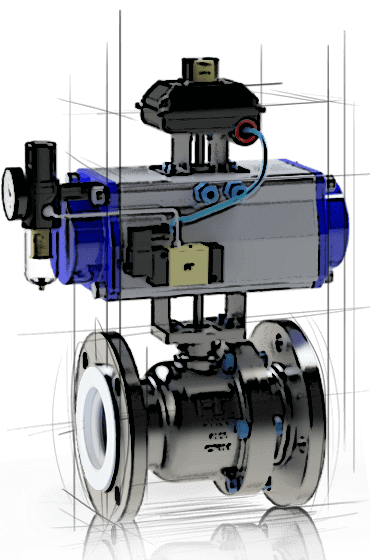

Oil and gas is one of the most demanding environments for any piece of process equipment. Hydrocarbons under high pressure, sour gas with hydrogen sulphide (H₂S), produced water laden with chlorides, and chemical injection streams carrying corrosion inhibitors and methanol — these are not textbook fluid conditions. They are real-world service scenarios where valve selection errors translate directly into safety incidents, production losses, and unplanned shutdowns.
PTFE ball valves occupy a specific and important position within oil and gas valve specifications — not as the universal answer, but as the correct answer for a defined set of service conditions where chemical resistance, tight shutoff, and low contamination risk matter most. This article clarifies exactly where and how PTFE ball valves fit into oil and gas operations.
Where PTFE Ball Valves Fit in Oil & Gas Operations
To understand PTFE ball valve applications in oil and gas, it helps to think across the three segments of the value chain:
- Upstream (Exploration & Production): Chemical injection systems are among the most common PTFE ball valve applications in upstream operations. Methanol injection (for hydrate inhibition), corrosion inhibitor dosing, scale inhibitor injection, and biocide treatment lines all carry aggressive chemicals that attack standard metallic valve internals. PTFE-lined or PTFE-seated ball valves provide chemical resistance and leak-free shutoff in these injection skids. Produced water handling — with its chloride content, dissolved H₂S, and pH variation — also benefits from PTFE ball valves in sampling connections and chemical treatment circuits.
- Midstream (Pipelines, Gas Processing & LNG): Gas processing plants use PTFE ball valves in amine treating units (DEA, MDEA circuits), glycol dehydration systems, and sulphur recovery unit (SRU) chemical handling lines. In LNG facilities, the cryogenic performance of PTFE seats (rated down to –50°C for standard PTFE, and lower with extended testing) makes them suitable for certain utility and chemical service connections at low temperatures.
- Downstream (Refining & Petrochemicals): Crude oil refineries and petrochemical complexes use PTFE ball valves extensively in laboratory sampling lines, chemical additive injection, caustic washing circuits, and wastewater treatment within the refinery boundary. Sulphuric acid alkylation units, for example, require valves with genuine resistance to concentrated H₂SO₄ — where PTFE is one of the few reliable sealing materials available.
Chemical Injection Skids: The Primary PTFE Ball Valve Application
Chemical injection is the dominant application for PTFE ball valves in oil and gas, and it deserves detailed attention. A typical chemical injection skid on an offshore platform or onshore production facility includes:
- Suction and discharge isolation valves on injection pumps
- Sampling valves and flush connections
- Vent and drain valves on chemical storage tanks and day tanks
- Manual and automated isolation on injection headers
- Instrument root valves for pressure gauges and flow transmitters on chemical lines
In all of these positions, the valve is in direct contact with concentrated inhibitor chemicals, methanol, or acid-based treatments. PTFE ball valves — typically SS 316 body with PTFE seats and PTFE stem packing — are the industry-standard specification for this service.
Fire-Safe Requirement: Understanding API 607
Any ball valve installed in hydrocarbon service must be evaluated for fire-safe performance. API 607 defines the test protocol: a valve is subjected to a controlled fire at 750–1000°C for 30 minutes, followed by a pressure test to confirm that leakage to atmosphere and across the seat is within acceptable limits.
This requirement presents an important consideration for PTFE ball valves: PTFE seats and seals will not survive a fire intact. They are designed to burn away. A fire-safe PTFE ball valve compensates for this with secondary metallic seating surfaces that engage when the PTFE seats are destroyed, providing a backup seal to prevent uncontrolled hydrocarbon release during and after a fire.
When specifying PTFE ball valves for oil and gas service, always confirm fire-safe certification to API 607 or API 6FA. This is a non-negotiable requirement for hydrocarbon isolation service — onshore or offshore.
Sour Service Considerations: NACE MR0175 / ISO 15156
H₂S-containing (sour) service introduces the risk of sulphide stress cracking (SSC) in metallic valve components. NACE MR0175 / ISO 15156 defines the material requirements for valve bodies, balls, stems, and bolting in sour service environments.
For PTFE ball valves in sour service:
- Ball and stem material: Must comply with NACE MR0175 hardness and heat treatment requirements. Standard SS 316 is generally acceptable; exotic alloys (Inconel, Duplex SS) are required for more severe H₂S partial pressures.
- PTFE seats and seals: PTFE itself is not susceptible to SSC and does not require special NACE compliance. However, any metallic backup seat or secondary seal must be specified in NACE-compliant material.
- Body bolting: ASTM A193 B7M / A194 2HM studs and nuts are the standard NACE-compliant bolting specification.
- Material documentation: Third-party certified material test reports (EN 10204 Type 3.2) are typically required for sour service valve procurement.
Fugitive Emission Standards: ISO 15848-1
Environmental regulations and operator HSE requirements increasingly mandate low fugitive emission (LFE) performance from process valves — particularly in volatile hydrocarbon and chemical service. ISO 15848-1 defines the test protocol for fugitive emission classification:
- Class AH: Highest tightness — leakage rate below 1×10⁻⁶ mg/s per mm of stem diameter, tested with helium.
- Class BH: Standard tightness for general hydrocarbon and chemical service.
- Class CH: Acceptable for utility and non-hazardous applications.
PTFE stem packing in ball valves naturally provides good fugitive emission performance due to PTFE’s low permeability. For applications with strict LFE requirements — LDAR (Leak Detection and Repair) programme boundaries, VOC-containing streams, or offshore HSE requirements — specify ISO 15848-1 Class BH or AH tested valve assemblies.
Selecting PTFE Ball Valves for Oil & Gas: Key Specification Points
- Confirm fire-safe certification: API 607 or API 6FA — mandatory for hydrocarbon isolation
- Verify sour service compliance: NACE MR0175 / ISO 15156 for H₂S-containing streams
- Specify fugitive emission class: ISO 15848-1 BH or AH for VOC and hydrocarbon service
- Confirm PTFE grade: Virgin PTFE for chemical injection; RPTFE for elevated pressure/temperature applications
- Request API 598 test certificates: Shell, seat low-pressure, and seat high-pressure test documentation with serial number traceability
- Evaluate actuation requirements: Spring-return pneumatic for emergency shutoff; double-acting for process control; manual for infrequent operation
| Specifying PTFE ball valves for oil and gas service is not a catalogue exercise — it requires a manufacturer who understands the fire-safe standards, sour service requirements, and fugitive emission expectations that define this industry. Freture Techno Pvt. Ltd. supplies fire-safe PTFE ball valves with API 607 certification, NACE MR0175-compliant metallic components, and full API 598 pressure test documentation. Our technical team engages directly with your valve datasheets to ensure every unit we supply meets the exact service requirement — not just the standard minimum. For oil and gas valve requirements, visit freture.com or contact our engineering team for a technical review. |