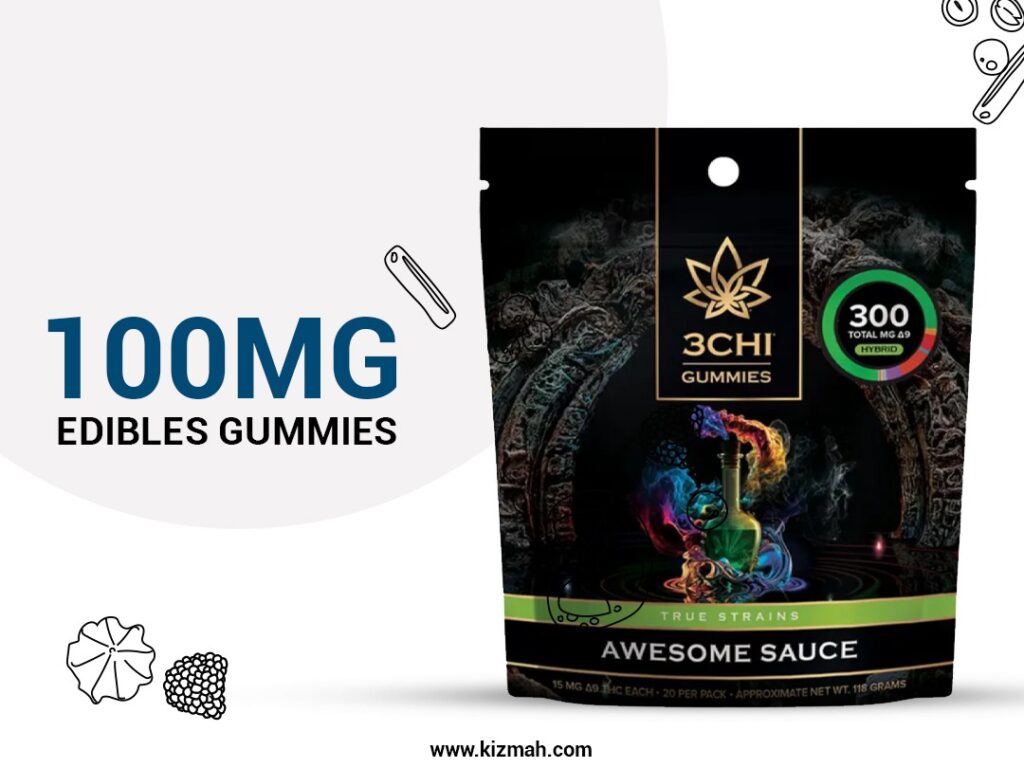

Curiosity, when paired with discipline, often leads to more thoughtful experimentation. That was the case for a particular individual known among peers for a near-clinical approach to health and consumption. Someone who had long avoided alcohol, declined most recreational substances, and maintained a careful relationship with anything that altered baseline cognition. The introduction to 100 mg THC gummies did not come from impulse, but from a moment of considered persuasion, framed not as indulgence, but as an alternative mode of experience.
The setting was a live performance, immersive and kinetic, where a friend suggested that a controlled edible format might enhance perception without compromising awareness. The proposition was not entirely convincing at first. Questions surfaced immediately. What exactly is THC, and how does it behave when ingested rather than inhaled. More importantly, could a gummy offer a structured, predictable experience in a way that more traditional methods, such as smoking, often do not.
When Curiosity Meets Constraint: Why Edibles Entered the Equation
The decision to engage with THC was not rooted in experimentation for its own sake. It was driven by a desire to understand whether altered states could coexist with control.
From a physiological standpoint, THC interacts with the body differently when consumed as an edible. The onset is slower, often ranging between 30 to 90 minutes, and the duration is more extended. This alone introduces a different kind of discipline. Unlike inhalation, which allows for rapid feedback and adjustment, edibles require patience and foresight.
In this context, 100 mg THC gummies presented an interesting paradox. On paper, the dosage appeared substantial. In practice, the format allowed for segmentation. The gummy could be divided, approached incrementally, and observed over time.
This ability to “stage” the experience was what made the product viable for someone otherwise resistant to unpredictability.
The Architecture of Experience: Why Format Matters More Than Method
One of the more striking realisations was that the method of consumption fundamentally shapes the experience.
Smoking, whether through a bong or other means, tends to prioritise immediacy. The effects are felt quickly, but they can also dissipate or fluctuate with equal speed. For someone accustomed to controlled inputs, this variability introduces friction.
Edibles, by contrast, operate more like a system.
The individual described the experience of consuming a carefully portioned segment of a gummy as analogous to entering a slow-moving current rather than stepping into a wave. The onset was gradual, almost imperceptible at first, followed by a steady shift in perception.
There was no abrupt transition. No disorientation. Instead, there was a sense of continuity, where the experience unfolded in layers.
This distinction, between abruptness and progression, became central to how the product was evaluated.
Precision Over Potency: What Set Structured Gummies Apart
Not all edible formats are created equal. What differentiated these particular products was not simply their composition, but their design logic.
The individual noted several features that stood out:
- Segmented dosing, allowing for controlled intake rather than fixed consumption
• Consistency across portions, reducing the risk of uneven effects
• Clear labeling, which provided a framework for expectation rather than guesswork
Even at higher concentrations, such as 1000 mg THC gummies, the same principles applied. The total potency was less relevant than how it could be divided and managed.
This reframed the concept of “high dosage.” Instead of being inherently excessive, it became a matter of flexibility. A single product could serve multiple use cases, depending on how it was approached.
For someone accustomed to measuring intake across diet and supplementation, this alignment with existing habits was significant.
A Live Setting, Reinterpreted: The John Summit Experience
The true test came during the live performance itself. The environment was dynamic, with shifting lights, layered sound, and a dense crowd.
After consuming a measured portion, the initial phase was marked by anticipation rather than immediate change. Then, gradually, the sensory field began to shift.
Music felt more dimensional. Rhythms seemed to occupy space rather than simply pass through it. Visual elements gained a subtle depth, not in a hallucinatory sense, but in a way that suggested heightened attention.
Importantly, there was no loss of control.
The individual remained fully aware of surroundings, able to engage in conversation, navigate the environment, and make decisions without impairment. The experience was not overwhelming. It was amplifying.
This distinction, between enhancement and disruption, reinforced the value of a measured approach.
The Unexpected Outcome: A Shift in Consumption Philosophy
What emerged from this experience was not a newfound enthusiasm for THC in general, but a more nuanced understanding of how it could be integrated responsibly.
There was a noticeable shift in perspective.
Previously, the category had been dismissed as inherently unpredictable or excessive. The introduction of structured formats challenged that assumption. It suggested that, under the right conditions, these products could align with a disciplined lifestyle.
The individual also observed a broader implication. The same principles applied here could extend to other areas of consumption. Whether in nutrition, supplementation, or even caffeine intake, the emphasis on measured, repeatable inputs created more stable outcomes.
In this sense, the experience was less about the substance itself and more about the system surrounding it.
Rethinking the Trade-Off: Discretion, Control, and Experience
A recurring question remained. Is a gummy truly comparable to more traditional methods such as a bong, beyond the obvious advantage of discretion.
The conclusion was not framed as a direct comparison, but as a difference in philosophy.
Smoking offers immediacy and flexibility in real time. Edibles offer structure and continuity over time.
For individuals who value control, predictability, and integration into existing routines, the latter presents a compelling case. The discreet nature of gummies is secondary. The primary benefit lies in their ability to transform an otherwise variable experience into something more stable.
A More Considered Engagement With Altered States
In the end, the experience did not convert a cautious individual into an unrestrained participant. It did something more subtle and arguably more meaningful.
It introduced a framework.
Through 100 mg THC gummies and even higher-capacity formats like 1000 mg THC gummies, the individual discovered that altered states need not be synonymous with loss of control. When approached with structure, they can become extensions of intentional living rather than departures from it.
That insight, more than the experience itself, is what continues to resonate.