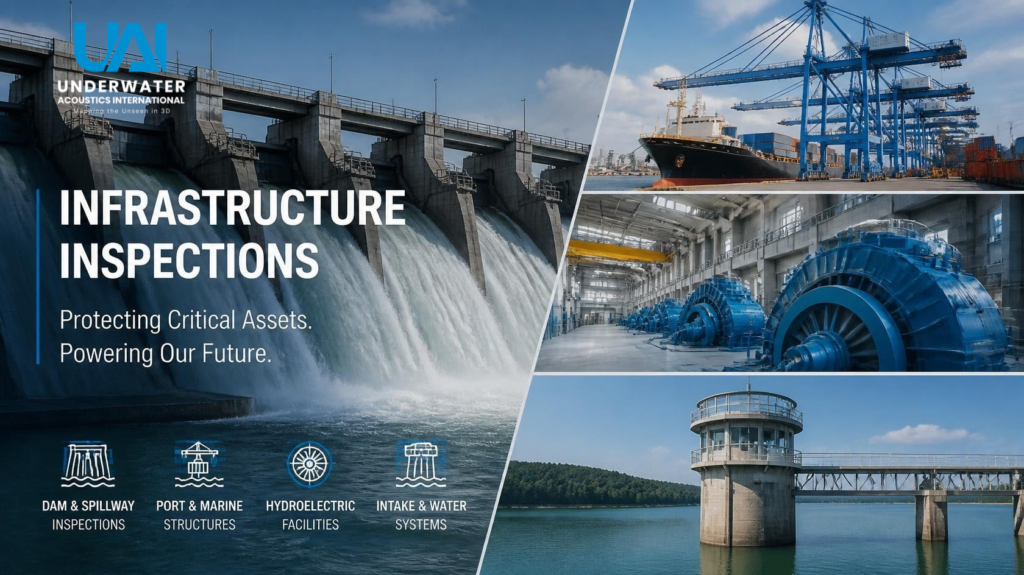

Ports and marine terminals are critical components of global trade and transportation networks. Maintaining underwater infrastructure integrity is essential for operational safety, cargo efficiency, and long-term structural reliability. At Underwater Acoustics International, we provide advanced inspection technologies that help port authorities, engineering firms, and marine operators evaluate submerged infrastructure with precision and efficiency.
Modern Port Infrastructure Inspection services use remotely operated vehicles (ROVs), multibeam sonar, underwater photogrammetry, and high-resolution imaging systems to assess underwater structures without disrupting operations. These technologies allow marine asset owners to identify hidden defects, corrosion, sediment accumulation, and structural deterioration before they create serious operational or safety concerns.
Importance of Port Infrastructure Inspections
Marine environments expose infrastructure to constant stress from tides, currents, vessel impacts, corrosion, and biological growth. Over time, these conditions can weaken underwater structures and reduce operational reliability.
Routine inspections help maintain:
- Structural integrity
- Navigation safety
- Regulatory compliance
- Operational efficiency
- Asset lifespan
- Environmental protection
Ports depend on accurate underwater condition data to support maintenance planning and reduce costly emergency repairs.
Critical Structures Requiring Inspection
Port facilities contain numerous submerged components that require regular evaluation, including:
Piers and Wharves
Structural supports beneath loading docks can experience corrosion, cracking, and scour damage.
Pilings
Steel, timber, and concrete pilings deteriorate over time due to marine growth, impact forces, and corrosion.
Seawalls
Wave action and sediment movement can weaken seawall foundations and retaining structures.
Berthing Structures
Constant vessel contact can create hidden underwater damage.
Navigation Channels
Sediment buildup and underwater obstructions can restrict vessel movement and reduce operational safety.
Mooring Systems
Anchors, chains, and mooring components require regular monitoring to ensure vessel stability and safety.
Accurate underwater inspections help identify problems early while supporting long-term infrastructure planning.
Advantages of ROV-Based Inspections
Traditional commercial diving inspections can be time-consuming, weather-dependent, and hazardous in busy marine environments. ROV technology offers a safer and more efficient solution for underwater infrastructure assessments.
At Underwater Acoustics International, our ROV systems provide:
- Real-time underwater video
- High-definition imaging
- 2D and 3D sonar scanning
- Underwater photogrammetry
- Precise positioning data
- Digital inspection recording
ROVs can safely inspect confined spaces, deep water areas, and low-visibility environments while reducing risks to personnel.
Identifying Common Underwater Defects
Port infrastructure inspections commonly reveal issues such as:
Corrosion
Saltwater exposure accelerates corrosion on steel structures and reinforcement systems.
Scour and Erosion
Water movement around pilings and seawalls can remove supporting sediment and compromise stability.
Cracking and Structural Damage
Repeated vessel impacts and environmental forces may create fractures or material degradation.
Marine Growth
Barnacles, algae, and biofouling can obscure defects and affect operational performance.
Sediment Accumulation
Excess sediment can reduce navigational depth and obstruct underwater structures.
Debris Hazards
Submerged debris may create navigation risks or damage marine infrastructure.
Early detection allows facility operators to prioritize repairs and avoid operational disruptions.
Benefits of 3D Sonar and Photogrammetry
Underwater Acoustics International uses advanced 3D imaging technologies to create highly detailed digital models of underwater assets. These models provide measurable data that supports engineering analysis and future condition monitoring.
Benefits include:
- Accurate dimensional measurements
- Digital baseline development
- Enhanced structural visualization
- Improved maintenance planning
- Change-over-time comparisons
- Detailed inspection documentation
Digital models improve communication between engineers, contractors, and asset managers while supporting informed maintenance decisions.
Improving Operational Efficiency
Port operations require continuous vessel movement and cargo handling activities. Inspection methods that minimize downtime are essential for maintaining productivity.
ROV inspections can often be completed while facilities remain operational, reducing disruptions and improving efficiency. Real-time imaging and data acquisition also accelerate engineering evaluations and repair planning.
Supporting Regulatory Compliance
Marine infrastructure owners must comply with safety standards and environmental regulations established by local, national, and international authorities. Accurate inspection documentation helps demonstrate compliance while supporting risk management programs.
Inspection reports may include:
- Structural condition assessments
- Sonar imagery
- Defect identification
- Underwater photographs
- Engineering observations
- Maintenance recommendations
Comprehensive reporting improves transparency and long-term asset management.
Long-Term Infrastructure Protection
Port infrastructure represents a significant investment that requires ongoing maintenance and monitoring. Advanced underwater inspection technologies help extend asset lifespan while reducing repair costs and operational risks.
At Underwater Acoustics International, our team combines advanced sonar imaging, underwater robotics, hydrographic surveys, and 3D mapping solutions to deliver reliable inspection data for marine infrastructure projects.
Modern underwater inspections provide critical information that supports safer operations, improved maintenance planning, and stronger infrastructure performance in demanding marine environments.