
Introduction
If you have ever watched movers carry a piano through a front door, you already know it is not a simple job. But what most people do not realize is that moving a grand piano and moving an upright piano are two completely different processes. The equipment differs, the preparation differs, the crew requirements differ, and the risks at each stage of the move are entirely different depending on which type of instrument you own.
Across Ontario, from Toronto and Oshawa to Belleville and Cobourg, piano owners regularly make the mistake of assuming any experienced moving crew can handle either type. That assumption leads to damaged instruments, cracked cabinets, and internal repairs that cost far more than the move itself.
This blog breaks down exactly what separates a grand piano move from an upright piano move, so you know what to expect and what questions to ask before your instrument is touched.
Understanding the Two Piano Types Before the Move
Before getting into the moving process itself, it helps to understand why these two instruments are structurally so different from a handling perspective.
An upright piano stands vertically. The strings run from top to bottom inside the cabinet, and the entire instrument is contained in a rectangular case that stands on four legs. Despite being tall and heavy, an upright has a relatively consistent center of gravity and a flat back that can rest against surfaces during a move. Most uprights weigh between 400 and 800 pounds depending on the model and size.
A grand piano is built horizontally. The strings run from front to back inside the body, and the instrument sits on three legs arranged in a triangle formation. The shape is irregular, the weight distribution is uneven, and the instrument cannot be moved in its assembled form through most doorways. Grand pianos typically weigh between 500 and 1,200 pounds depending on the size, with concert grands at the upper end of that range.
These structural differences are what drive every other difference in how the two instruments are moved.
Equipment Differences: Upright vs Grand
Moving an Upright Piano
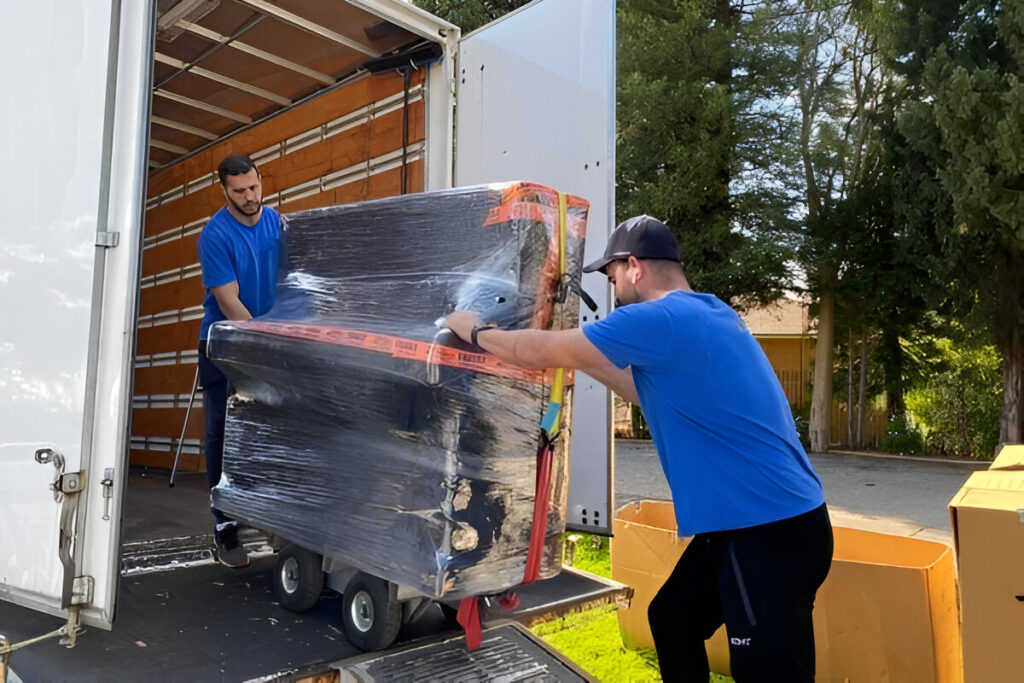
The core equipment for an upright piano move includes a heavy duty piano board, which is a flat reinforced board with built-in straps that the piano is secured to during transport. The piano sits upright on this board and is rolled on a piano dolly with rubber wheels designed to carry the weight without damaging floors.
Additional equipment includes moving blankets to wrap the entire cabinet, stretch wrap to hold the blankets in place, corner guards for the cabinet edges, and ratchet straps for securing the instrument in the truck. For stairwells, a stair-climbing dolly or additional strap anchoring system is used to control the descent or ascent safely.
Moving a Grand Piano
A grand piano move requires a completely different toolkit. Because the instrument must be disassembled before it can be moved, the crew brings tools for removing the legs and pedal lyre, a padded skid board specifically designed for grand piano bodies, and individual wrapping materials for each component that comes off the instrument.
The skid board used for grand pianos is not the same as the flat board used for uprights. It is designed to support the full weight of the piano body while it lies on its side, and it includes cushioning to protect the lid hinges, the keybed, and the cabinet finish from contact pressure during transport. Moving a grand piano without the correct skid board is one of the most common causes of damage during amateur or underprepared moves.
The Disassembly Process: Why Grand Pianos Require It
This is the most significant practical difference between the two types of moves. Upright pianos are moved intact. Grand pianos are partially disassembled before they leave the room they are in.
The disassembly sequence for a grand piano follows a specific order that must not be rushed or skipped.
The music desk is removed first. This is the panel that holds sheet music above the keys, and it lifts out without tools on most models.
The lid prop and lid are removed next. The lid is typically large, heavy, and awkward to handle on its own. It is wrapped separately and transported flat.
The fallboard, which is the cover over the keys, is either removed or secured tightly depending on the model. On some instruments it is hinged and can be held in place with padding. On others it needs to come off completely to prevent it from opening during the tilt.
The pedal lyre is disconnected from the underside of the piano. This is the bracket that holds the three pedals and connects to the action inside the body. It is fragile and must be removed carefully to avoid bending the pedal rods.
The three legs are removed one at a time in a specific sequence. This is where the most risk occurs. The piano body must be supported at all times during leg removal, because as each leg comes off, the weight distribution shifts. A crew that removes legs without properly supporting the body risks the entire instrument tipping onto an unprotected corner, which causes immediate and often irreparable damage to the cabinet.
Once all three legs are off, the body is carefully tilted onto the padded skid board by the crew working in coordinated movements. The instrument then travels on its side for the rest of the move until it reaches its destination and is reassembled.
An upright piano requires none of this. It moves as a single unit from start to finish, which is why it is generally considered the less complex of the two moves, though it is by no means simple.
Crew Size Requirements
The crew size required for each type of move is different, and this is something to confirm specifically when booking piano movers in Ontario.
An upright piano move typically requires a minimum of two experienced movers, and three are recommended when stairs are involved. The weight is manageable with two people on flat surfaces, but the stairwell is where the third person becomes important for guiding and controlling the movement safely.
A grand piano move requires a minimum of three experienced movers for a baby grand, and four or more for a full grand or concert grand. The disassembly and reassembly process, the handling of individual components, and the physical demands of tilting the body onto the skid board all require more hands and more coordination than an upright move.
If a company quotes you a two-person crew for a grand piano move without asking about the size of the instrument or the access conditions, that is a sign the job has not been properly assessed.
Navigating Tight Spaces: Different Challenges for Each Type
Both types of pianos present challenges when it comes to moving through a home, but the nature of those challenges is different.
Upright pianos are tall and narrow when viewed from the front, but they are deeper than most people realize from side to side. Standard interior doorways in Ontario homes are typically 32 to 36 inches wide. Many upright pianos are between 24 and 30 inches deep, which means they can pass through standard doorways, but only with careful angling and precise control through the frame.
The height of an upright piano is rarely the problem. The depth and the weight distribution are what make doorways and corners challenging. The crew needs to angle the piano, guide it through the frame without catching the corners, and re-straighten it on the other side without losing control of the weight.
Grand pianos present a different challenge. With the legs removed and the body on the skid board lying on its side, a grand piano is much lower to the ground but significantly wider than an upright. The width of a baby grand body on its side is typically between 48 and 58 inches depending on the model. This means some doorways and hallways cannot accommodate a grand piano at all without additional planning, and in rare cases, windows or alternate entry points are used instead of the front door.
Stairs present the most complex challenge for both types, but the approach differs. An upright piano on stairs is controlled from above and below simultaneously, with straps providing braking resistance on the descent. A grand piano on a skid board requires the same controlled approach but with the added complexity of managing a board-mounted instrument that cannot be repositioned during the descent. The crew must commit to the line they have chosen before they start moving on the stairs.
Loading and Securing in the Truck
Once outside, both types of pianos are loaded using a ramp and dolly, but their positioning in the truck is handled differently.
An upright piano is loaded and secured in its upright position against the cab wall of the truck. This is the most stable position for transport because the cab wall does not move independently of the truck floor. The piano is strapped from multiple anchor points on both sides to prevent any rocking during transit.
A grand piano travels on its side on the skid board. It is positioned securely and strapped from multiple points, with additional padding placed against the keyboard side of the body to prevent the fallboard from receiving pressure. No other items are loaded against the piano or stacked on top of it regardless of how carefully they might otherwise be placed.
For anyone planning a long distance piano move across Ontario, whether from Toronto to Ottawa or from Hamilton to Kingston, the securing method matters even more because the instrument is in the truck for a longer period over varying road conditions. To understand how professional crews handle the full transport process in detail, the guide on how movers safely transport pianos and instruments covers the wrapping, loading, and road transport practices used on professional moves.
Reassembly at the Destination
Upright piano reassembly is straightforward because there is nothing to reassemble. The piano arrives in the same condition it left, is rolled into the intended room, positioned, and the wrapping is removed. The crew checks that all four legs are stable and the floor contact is even before finishing the job.
Grand piano reassembly is the reverse of disassembly and must be done in the correct sequence. The body is tilted upright from the skid board, the legs are reattached one at a time with the body supported throughout, the pedal lyre is reconnected and adjusted, the fallboard is secured or replaced, the lid and lid prop are reinstalled, and the music desk goes back in last.
A good moving crew will take as much care during reassembly as they did during disassembly. Rushing the reassembly is where problems occur. Legs that are not fully locked into their sockets, a pedal lyre that is not properly aligned, or a lid hinge that has been forced rather than seated correctly can all cause problems that only become apparent during the first time the piano is played after the move.
After the Move: Tuning and Settling Time
Both grand and upright pianos need time to settle after a move before tuning. The settling period allows the soundboard, strings, and pin block to adjust to the temperature and humidity of the new environment. Most piano technicians recommend waiting between two and four weeks after a move before scheduling a tuning.
This advice applies equally to both instrument types, but grand pianos are sometimes more sensitive to environmental changes due to their larger soundboard surface area. If the new location has significantly different humidity levels than the previous one, a humidifier or dehumidifier in the room where the piano is kept can help stabilize the environment and reduce the frequency of tuning required after the move.
Choosing the Right Piano Movers in Ontario
Whether you are moving a grand or an upright, the standard for who you hire should be the same. The company you choose should be able to clearly describe their process for your specific instrument type, confirm the crew size they will assign, explain what equipment they will bring, and outline what their liability coverage includes if something goes wrong.
For residents across Ontario from the Greater Toronto Area through Durham Region and into Northumberland County, working with a team that has genuine experience moving both grand and upright pianos across a range of property types and access conditions makes a measurable difference in the outcome. The professional piano moving services available through Kapoor Moving Services cover both instrument types across Ontario with crews trained specifically for the handling requirements each type demands.