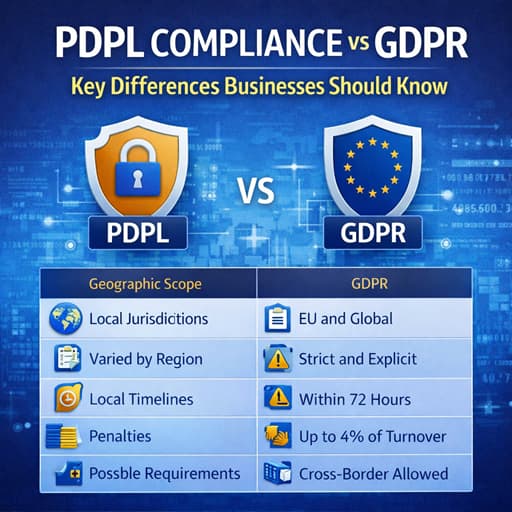

In today’s global digital landscape, data privacy regulations have become a critical part of business operations. Organizations that collect, process, or store personal data must follow strict legal frameworks designed to protect individuals’ information. Two important regulations in this space are PDPL Compliance and GDPR (General Data Protection Regulation).
While both frameworks aim to protect personal data and enhance privacy, they differ in scope, requirements, and implementation. Understanding the differences between PDPL Compliance and GDPR is essential for businesses operating across regions or handling international data.
What Is PDPL Compliance?
PDPL Compliance refers to adhering to the Personal Data Protection Law, a regulatory framework designed to safeguard personal data and ensure responsible data handling. It sets rules for how organizations collect, process, store, and share personal information.
The law emphasizes:
- Transparency in data collection
- Consent from individuals
- Secure data processing
- Protection against misuse or unauthorized access
- Accountability for data handling practices
Organizations operating in regions where PDPL applies must align their processes with these requirements to avoid legal risks.
What Is GDPR?
GDPR is a comprehensive data protection regulation introduced by the European Union. It applies to any organization that processes personal data of EU residents, regardless of where the business is located.
GDPR focuses on:
- Strong data protection rights for individuals
- Strict consent requirements
- Data breach reporting obligations
- Accountability and documentation
- Heavy penalties for non-compliance
GDPR is often considered one of the most stringent data privacy regulations globally.
Key Similarities Between PDPL Compliance and GDPR
Before exploring the differences, it is important to understand that PDPL Compliance and GDPR share several common goals.
1. Protection of Personal Data
Both frameworks aim to protect personal data from misuse, breaches, and unauthorized access.
2. Transparency and Consent
Organizations must inform individuals about how their data is used and obtain consent before processing it.
3. Accountability
Businesses are responsible for ensuring that their data practices comply with legal requirements.
4. Data Security
Both regulations require organizations to implement technical and organizational measures to protect data.
5. Individual Rights
Individuals have rights regarding their data, such as access, correction, and deletion.
These similarities mean that organizations familiar with GDPR may find it easier to adapt to PDPL Compliance, although differences still exist.
Key Differences Between PDPL Compliance and GDPR
While the goals are similar, there are important distinctions between PDPL Compliance and GDPR that businesses must understand.
1. Geographic Scope
One of the main differences lies in the geographic scope of each regulation.
- PDPL Compliance applies to organizations operating within specific jurisdictions where the law is enforced, typically focusing on local data protection requirements.
- GDPR has a broader reach, applying to any organization worldwide that processes the data of EU residents.
This means GDPR often affects more global businesses compared to PDPL Compliance.
2. Consent Requirements
Both regulations require consent, but GDPR is generally stricter in how consent must be obtained.
- Under GDPR, consent must be explicit, clear, and freely given. Pre-ticked boxes or implied consent are not allowed.
- PDPL Compliance also requires consent, but the level of strictness may vary depending on the jurisdiction and interpretation.
Businesses must ensure that their consent mechanisms align with the stricter standard when operating internationally.
3. Data Breach Notification
Data breach handling is another area where differences exist.
- GDPR requires organizations to report certain data breaches within a specific timeframe (usually 72 hours).
- PDPL Compliance also requires breach notification, but timelines and procedures may differ based on local regulations.
Organizations must understand these timelines to avoid penalties.
4. Penalties and Enforcement
GDPR is known for its strict penalties, which can be substantial.
- GDPR fines can reach up to a significant percentage of global annual turnover, making non-compliance extremely costly.
- PDPL Compliance also includes penalties, but they may vary in severity depending on the region and enforcement authority.
Businesses must take both regulations seriously to avoid financial and reputational damage.
5. Data Localization Requirements
Some PDPL frameworks include stricter rules regarding where data can be stored or transferred.
- PDPL Compliance may require certain types of data to be stored within the country or impose restrictions on cross-border transfers.
- GDPR allows data transfers outside the EU but requires appropriate safeguards, such as standard contractual clauses.
This difference can impact how businesses design their data infrastructure.
6. Documentation and Record-Keeping
GDPR places strong emphasis on documentation and accountability.
- Organizations must maintain detailed records of data processing activities under GDPR.
- PDPL Compliance also requires documentation, but the level of detail may vary.
Proper documentation helps demonstrate compliance during audits or investigations.
Business Impact of PDPL Compliance vs GDPR
Understanding the differences between PDPL Compliance and GDPR helps organizations align their strategies effectively.
Operational Changes
Businesses may need to update their data collection processes, consent mechanisms, and security systems to meet compliance requirements.
Technology Investments
Compliance often requires investment in cybersecurity tools, data management systems, and monitoring solutions.
Legal and Compliance Teams
Organizations may need dedicated teams to ensure ongoing compliance with both PDPL and GDPR.
Global Strategy Alignment
Companies operating internationally must design a unified data protection strategy that meets the strictest applicable standards.
How Businesses Can Stay Compliant
To manage both PDPL Compliance and GDPR effectively, organizations should take a proactive approach.
Conduct Data Audits
Understand what data is collected, where it is stored, and how it is used.
Implement Strong Security Measures
Use encryption, access controls, and monitoring systems to protect data.
Update Privacy Policies
Ensure policies clearly explain data usage and comply with both regulations.
Train Employees
Educate staff on data protection practices and compliance requirements.
Monitor Compliance Regularly
Continuously review and update processes to align with changing regulations.
By following these steps, businesses can reduce risks and maintain compliance across multiple jurisdictions.
Conclusion
Both PDPL Compliance and GDPR play a crucial role in protecting personal data and ensuring responsible data management. While they share similar goals, their differences in scope, requirements, and enforcement make it essential for businesses to understand each framework clearly.
Organizations that operate across regions must carefully align their practices to meet both PDPL and GDPR requirements. By doing so, they can not only avoid legal risks but also build trust with customers and stakeholders.
In an era where data privacy is a top priority, staying compliant with regulations like PDPL and GDPR is not just a legal necessity. It is a strategic advantage that supports long-term growth and sustainability.