
Introduction
You’ve built your website, added content, maybe even targeted keywords—but your pages still aren’t ranking on Google. It’s frustrating, especially when you see competitors with similar or even lower-quality websites outranking you.
Here’s the reality: most websites don’t fail because of competition. They fail because of hidden on-page SEO issues that quietly hold them back. These issues are often overlooked because they’re not obvious. Your website might look perfect on the surface, but small problems in structure, content, and optimization can prevent search engines from understanding it properly.
The good news? These problems are fixable.
With the right approach—and sometimes professional on page SEO services—you can turn things around and start driving real, consistent traffic.
Why Your Website Isn’t Ranking ?
Your website is not ranking on Google because of poor on-page SEO, including mismatched search intent, weak content structure, slow page speed, lack of internal linking, and unoptimized titles and metadata.
What Is On-Page SEO?
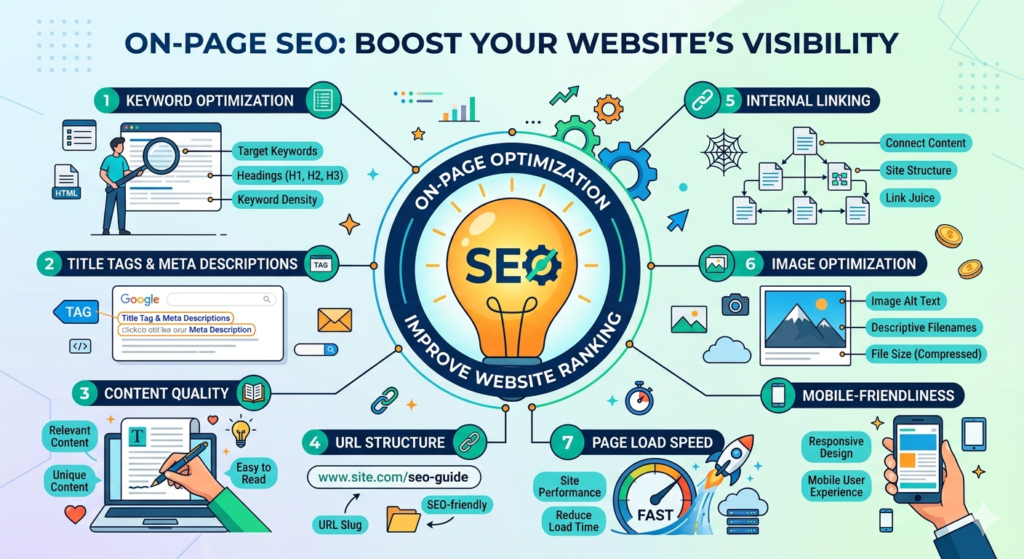
On-page SEO refers to the process of optimizing elements within your website—such as content, headings, meta tags, internal links, and page experience—to improve search engine rankings and user engagement.
1. Your Content Doesn’t Match Search Intent
One of the biggest ranking killers is ignoring what users actually want.
For example, if someone searches “best laptops under 50,000,” they expect a comparison list—not a general blog about laptops. If your content doesn’t match the intent behind the search, users leave quickly. This increases bounce rate and signals to Google that your page isn’t useful.
How to fix it:
Study top-ranking pages and align your content with what users expect—whether it’s a guide, list, product page, or tutorial.
2. Weak Titles and Meta Descriptions
Even if your page ranks, you won’t get traffic if people don’t click. Your title and meta description are your first impression on search results. If they are unclear or unappealing, users scroll past.
How to fix it:
Write clear, benefit-driven titles and descriptions that make users want to click. Keep them concise and relevant.
3. Poor Content Structure
Long, unstructured content is hard to read—and even harder for search engines to understand. If your page lacks headings, sections, and formatting, users are less likely to stay.
How to fix it:
Break content into sections using headings (H1, H2, H3), keep paragraphs short, and use bullet points where needed.
4. Keyword Usage Problems
Keywords still matter, but how you use them matters more. Overusing keywords makes your content look spammy, while underusing them makes it unclear what your page is about.
How to fix it:
Use keywords naturally within your content and include related terms to cover the topic comprehensively.
5. No Internal Linking Strategy
Internal links help search engines understand how your pages are connected. Without them, your website structure looks weak and disorganized.
How to fix it:
Link relevant pages within your content using natural anchor text. This improves navigation and SEO value distribution.
6. Slow Page Speed
If your website takes too long to load, users leave—and Google notices. Page speed is a confirmed ranking factor and directly impacts user experience.
How to fix it:
Optimize images, reduce unnecessary scripts, and use reliable hosting to improve loading time.
7. Not Mobile-Friendly
Most users browse on mobile devices. If your website doesn’t work well on smaller screens, it affects both user experience and rankings.
How to fix it:
Use responsive design and test your website across devices to ensure smooth usability.
8. Unoptimized Images
Images can enhance your content, but if not optimized, they can slow down your website and reduce SEO performance.
How to fix it:
Compress images, add descriptive alt text, and use relevant visuals.
9. Thin or Low-Quality Content
Content that lacks depth or value struggles to rank. Google prefers content that fully answers user queries and provides meaningful insights.
How to fix it:
Create detailed, helpful content that solves problems and provides real value. This is where professional on page SEO services can help improve content quality significantly.
10. No Clear Call-to-Action (CTA)
Even if your page gets traffic, it won’t convert without direction. Users need to know what to do next—whether it’s contacting you, reading more, or making a purchase.
How to fix it:
Add clear and relevant CTAs that guide users toward the next step.
How Fixing On-Page SEO Improves Rankings
When these issues are fixed, your website becomes easier for search engines to understand and more useful for users.
This leads to:
- Better rankings
- Increased organic traffic
- Higher engagement
- Improved conversion rates
That’s the real impact of effective on page SEO services—they don’t just improve visibility, they drive growth.
Conclusion :
If your website isn’t ranking, it’s not always about competition—it’s about optimization. Small, hidden on-page issues can have a big impact on your performance. The good news is that once you identify and fix these problems, your website can start gaining visibility and traffic faster than expected. Instead of guessing, focus on improving your content, structure, and user experience—or get expert help to speed up the process.
Call to Action :
If you’re tired of not seeing results from your website, it’s time to fix what’s holding it back.
Get a professional on-page SEO audit and discover exactly what’s stopping your website from ranking. Start turning your website into a high-performing traffic and lead generation asset.
FAQs :
1. Why is my website not ranking on Google?
Your website may not be ranking due to poor on-page SEO, including weak content, slow speed, poor structure, and lack of optimization.
2. What are on-page SEO issues?
On-page SEO issues are problems within your website—such as content, meta tags, and internal links—that affect search engine rankings.
3. How long does it take to fix SEO issues?
You may start seeing improvements within a few weeks, but full results depend on competition and the extent of optimization.
4. Can on-page SEO improve rankings without backlinks?
Yes, on-page SEO can significantly improve rankings, especially for low to medium competition keywords.
5. Do I need professional SEO services?
While you can do it yourself, professional services help identify issues faster and implement effective strategies for better results.