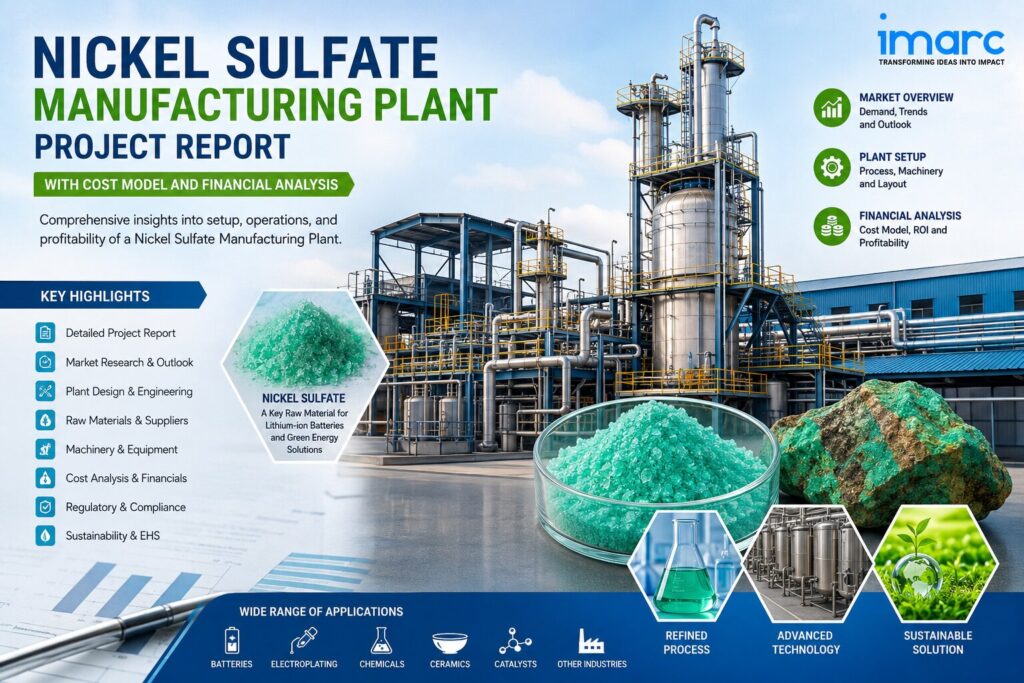

IMARC Group’s report, “Nickel Sulfate Manufacturing Plant Project Report 2026: Industry Trends, Plant Setup, Machinery, Raw Materials, Investment Opportunities, Cost and Revenue,” offers a comprehensive guide for establishing a manufacturing plant. The nickel sulfate manufacturing plant cost report offers insights into the manufacturing process, financials, capital investment, expenses, ROI, and more for informed business decisions.
In addition to covering operational aspects, the report offers detailed insights into the nickel sulfate manufacturing plant process and project economics.
- Detailed insights into the nickel sulfate manufacturing plant process.
- In-depth project economics and financial metrics.
- Covers capital investments and project funding.
- Analysis of operating expenses and income projections.
- Breakdown of fixed and variable costs, direct and indirect expenses.
- Evaluation of ROI (Return on Investment) and NPV (Net Present Value).
- Profit and Loss account analysis.
- Comprehensive financial analysis for decision-making.
- Provides a roadmap for successfully establishing a nickel sulfate manufacturing unit.
What is Nickel Sulfate?
Nickel sulfate (NiSO₄·6H₂O) is an inorganic salt that appears as a bright green, water-soluble crystalline solid. It is one of the most commercially important nickel compounds and is predominantly produced in hexahydrate form for industrial applications. Battery-grade nickel sulfate, with very high purity (≥22% Ni, low impurities of Co, Fe, Na, Mg, Ca), is the critical precursor material used in the synthesis of nickel-cobalt-manganese (NCM) and nickel-cobalt-aluminium (NCA) cathode active materials for lithium-ion batteries. Electroplating-grade nickel sulfate is used in Watts nickel plating baths and electroless nickel plating processes to deposit corrosion-resistant and hardwearing nickel coatings on metal and plastic substrates. Nickel sulfate is also used in the production of nickel catalysts, ceramic colorants, and as a reagent in various chemical synthesis processes.
Key Investment Highlights
- Process Used: Nickel metal or intermediate (nickel hydroxide, MHP, MSP) dissolution in sulfuric acid, solution purification and impurity removal (solvent extraction or ion exchange), evaporation and crystallization, centrifugation, drying, and packaging.
- End-use Industries: Electric vehicle battery manufacturing, consumer electronics batteries, electroplating and surface finishing, chemical catalysts, and ceramic colorants.
- Applications: Battery-grade NiSO₄ as NCM/NCA cathode precursor for lithium-ion batteries; electroplating-grade NiSO₄ for Watts bath and electroless nickel plating; catalyst manufacture; and ceramic and glass colorants.
How to Start a Nickel Sulfate Manufacturing Business?
Starting a nickel sulfate manufacturing business begins with choosing a specific product focus such as battery-grade nickel sulfate hexahydrate (high-purity, ≥22% Ni, ≤0.5 ppm Co/Fe/Na impurities) for lithium-ion battery precursor cathode active material (pCAM) manufacturers, or electroplating-grade nickel sulfate for surface finishing applications. It is important to research the market to understand demand from EV battery cell manufacturers, cathode active material (CAM) producers, electroplating job shops, and specialty chemical distributors. You can decide whether to build an integrated plant starting from nickel metal, nickel oxide, or mixed hydroxide precipitate (MHP)/mixed sulfide precipitate (MSP) dissolution, or a refining and purification unit working with impure nickel sulfate solution. A clear business plan should include nickel feedstock sourcing, dissolution in sulfuric acid, multi-stage purification (solvent extraction, ion exchange, or chemical precipitation for cobalt, iron, sodium, and other impurity removal), evaporation, crystallization, centrifugation, drying, and cleanroom or controlled-environment packaging. Register your business, secure necessary chemical manufacturing licenses, hazardous chemical handling and storage approvals, pollution control board clearances for acidic effluent treatment, and occupational health clearances for nickel compound handling (IARC Group 1 carcinogen classification). Build reliable supply chain relationships with nickel intermediate producers (MHP, MSP, ferronickel refiners, Class 1 nickel producers). Focus on achieving consistently high nickel content, ultra-low impurity profiles, tight particle size distribution, and certification to battery OEM material qualification standards for premium battery-grade supply.
What Is Driving Nickel Sulfate Manufacturing?
Nickel sulfate manufacturing is growing due to multiple critical factors, most prominently the rapid global expansion of electric vehicle production and the associated lithium-ion battery supply chain investment. Battery-grade nickel sulfate is an indispensable precursor for high-nickel NCM (811, 622) and NCA cathode chemistries, which are increasingly preferred in EV batteries for their superior energy density compared to lower-nickel or LFP alternatives. Global EV sales surpassed 14 million units in 2023, a 35% increase from 2022, with projections pointing to continued strong growth through 2030 driven by government emission targets, consumer adoption, and expanding charging infrastructure. The shift toward higher-nickel cathode formulations — with NCM811 requiring approximately 0.8 kg of nickel sulfate equivalent per kWh of battery capacity — is significantly amplifying per-vehicle nickel sulfate demand. The consumer electronics sector, particularly smartphones, laptops, and power tools with high-energy-density cells, provides an additional stable demand base. Growing investment in battery gigafactories across the United States (supported by the Inflation Reduction Act), Europe (EU Battery Regulation), South Korea, Japan, and India is driving strategic demand for domestically produced battery-grade nickel sulfate to meet supply chain localization requirements. At the same time, the electroplating and surface finishing industry continues to provide consistent baseline demand, with applications in automotive components, aerospace parts, electronics connectors, and decorative finishes further sustaining the nickel sulfate manufacturing industry’s growth.
Request for a Sample Report: https://www.imarcgroup.com/nickel-sulfate-manufacturing-plant-project-report/requestsample
Key Insights Covered in the Nickel Sulfate Manufacturing Plant Report
Market Coverage:
- Market Trends: Analysis of current and emerging trends in the nickel sulfate and battery materials market, including EV battery supply chain expansion, high-nickel cathode adoption, and battery recycling-derived nickel sulfate.
- Market Segmentation: Breakdown of the market by grade (battery-grade, electroplating-grade), form (hexahydrate crystals, solution), and end-use application (NCM/NCA cathode precursor, EV batteries, consumer electronics batteries, electroplating, catalysts, ceramics).
- Regional Analysis: Distribution and performance of the nickel sulfate market across key regions including Asia-Pacific (China, Japan, South Korea, Indonesia), North America, and Europe, covering both production capacity and consumption patterns.
- Price Analysis: Evaluation of pricing trends for battery-grade and electroplating-grade nickel sulfate, along with key input costs including nickel metal (LME nickel price), MHP/MSP intermediates, and sulfuric acid.
- Impact of COVID-19: Examination of the effects of the COVID-19 pandemic on nickel supply chains, EV battery demand disruptions, and the subsequent acceleration of battery material investment post-pandemic.
- Market Forecast: Outlook and projections for the nickel sulfate manufacturing industry through 2030 and beyond.
Key Aspects Required for Setting Up a Nickel Sulfate Manufacturing Plant
Detailed Process Flow:
- Product Overview: Comprehensive description of nickel sulfate hexahydrate products including nickel content (≥22% Ni by weight for battery grade), cobalt content (≤0.5 ppm), iron content (≤1 ppm), sodium content (≤20 ppm), other trace impurity specifications (Mg, Ca, Zn, Cu, Cr, Mn at ppb–ppm levels), crystal size distribution, moisture content, and compliance with battery OEM material qualification specifications and electroplating industry standards.
- Unit Operations Involved: Step-by-step breakdown of the various operations including: nickel feedstock receiving and preparation (nickel metal chips/powder, nickel oxide, MHP, or MSP); dissolution in dilute sulfuric acid in acid-resistant dissolution tanks; primary impurity removal by pH adjustment and oxidative precipitation (for iron, copper); solvent extraction (SX) for cobalt/manganese separation or ion exchange (IX) for targeted impurity removal; activated carbon treatment for organic removal; solution polishing filtration; evaporation and concentration; controlled crystallization in crystallizers (batch or continuous); centrifugation to separate crystals from mother liquor; fluid bed or rotary drying; screening and size classification; and cleanroom or controlled-atmosphere packaging under inert conditions.
- Mass Balance and Raw Material Requirements: Calculations for material inputs and outputs, including quantities of nickel feedstock (nickel metal, MHP, MSP, or nickel oxide) required per tonne of nickel sulfate hexahydrate produced, along with sulfuric acid consumption, solvent extraction reagents (D2EHPA, Cyanex 272), wash water, and packaging materials.
- Quality Assurance Criteria: Standards and procedures ensuring battery-grade nickel sulfate quality including ICP-OES/ICP-MS trace metal analysis for Co, Fe, Na, Mg, Ca, Zn, Cu, Cr, Mn, nickel content by EDTA titration or ICP, moisture content, crystal morphology, particle size distribution, and compliance with battery OEM incoming material specifications (CATL, LG Energy Solution, Panasonic, Samsung SDI, POSCO Chemical qualification standards).
- Technical Tests: Essential analytical and process tests including ICP-OES and ICP-MS for ppb-level impurity quantification, EDTA complexometric titration for nickel assay, Karl Fischer moisture determination, laser diffraction particle size analysis, XRD for crystal phase identification, pH measurement, solution density measurement, and pilot crystallization trials for crystal habit and size optimization.
Project Details, Requirements, and Costs Involved
- Land, Location, and Site Development: Assessment of land requirements, optimal location selection near nickel intermediate supply sources (MHP/MSP producers, nickel refineries, port access for nickel metal imports) and battery CAM or electroplating customer clusters, and site development costs including acid-resistant chemical processing buildings, sulfuric acid storage bunds, solvent extraction building with fire suppression and solvent vapor recovery, crystallization and drying halls, cleanroom packaging facility, effluent neutralization and heavy metals treatment plant, and nickel-contaminated wastewater treatment infrastructure.
- Plant Layout: Design and layout planning for safe and efficient operations including feedstock receiving and storage area, dissolution tanks (acid-resistant FRP or rubber-lined steel), primary impurity precipitation section, solvent extraction (SX) or ion exchange (IX) circuit, solution polishing filtration area, evaporation and crystallization section, centrifuge room, drying and classification area, cleanroom or controlled-atmosphere packing hall, quality control laboratory (with ICP-OES/ICP-MS instrumentation), effluent treatment plant, and acid and solvent storage with secondary containment.
- Machinery Requirements and Costs: Identification of key equipment including acid-resistant dissolution tanks (FRP or rubber-lined), agitators, filter presses or vacuum drum filters, solvent extraction mixer-settlers or pulsed columns, ion exchange columns (for targeted impurity removal), activated carbon contactors, multiple-effect evaporators or MVR evaporators, draft tube baffled (DTB) or Oslo crystallizers, pusher or peeler centrifuges, fluid bed dryers or rotary dryers, vibrating screens and air classifiers, IBC filling and sealing machines, and cleanroom air handling systems, along with associated costs.
- Raw Material Requirements and Costs: Determination of types and quantities of nickel metal (Class 1, ≥99.8% Ni), mixed hydroxide precipitate (MHP, ~35–40% Ni), mixed sulfide precipitate (MSP), or nickel oxide required; sulfuric acid (93–98%); solvent extraction reagents (D2EHPA, Cyanex 272, Shellsol diluent); ion exchange resins; activated carbon; lime or sodium hydroxide for neutralization; and packaging materials (HDPE drums, IBC containers, woven bags with HDPE liners), along with their procurement costs.
- Packaging Requirements and Costs: Specifications for battery-grade NiSO₄ packaging in cleanroom conditions using double-bagged HDPE liner inner bags inside 25 kg woven HDPE outer bags or sealed HDPE drums, and bulk IBC containers for electroplating-grade supply, including moisture-proof sealing, lot traceability labelling, SDS and hazard communication requirements, and associated packaging costs.
- Transportation Requirements and Costs: Logistics planning and cost estimation for the inbound transport of nickel feedstocks (nickel metal by road or sea freight; MHP/MSP slurry by specialized tankers or bulk bags), sulfuric acid (UN 1830 corrosive liquid tankers), and outbound dispatch of nickel sulfate hexahydrate under UN 3077 (environmentally hazardous substance, solid) classifications to battery CAM producers and electroplating distributors globally.
- Utility Requirements and Costs: Analysis of utility needs including electricity for dissolution agitators, SX circuit, evaporators, crystallizers, centrifuges, dryers, and cleanroom air handling; steam or thermal energy for evaporation and drying; cooling water for crystallizers and condensers; process water and deionized/ultra-pure water for final washing and solution preparation; compressed air; nitrogen for inert atmosphere packaging; and effluent treatment utilities, along with their associated costs.
- Human Resource Requirements and Costs: Workforce planning including chemical process operators (with mandatory nickel compound health surveillance), SX/IX circuit technicians, crystallization and drying operators, analytical chemists (ICP-OES/ICP-MS competent), quality and regulatory compliance officers, occupational health and safety officers (mandatory for IARC Group 1 carcinogen handling), environmental compliance personnel, cleanroom packaging operators, and plant management, along with costs for labor, nickel health surveillance, PPE (respirators, gloves, protective clothing), and medical monitoring programs.
Project Economics
- Capital Investments: Initial costs required for setting up the nickel sulfate manufacturing plant, including land, acid-resistant civil construction, dissolution and purification equipment, SX/IX circuit, evaporators and crystallizers, centrifuges, drying and classification equipment, cleanroom packaging facility, quality control laboratory with ICP instrumentation, effluent treatment plant, and safety infrastructure.
- Operating Costs: Ongoing expenses for running the plant, such as nickel feedstock procurement (the dominant cost driver, linked to LME nickel prices), sulfuric acid, SX reagents, utilities (electricity and steam for evaporation and drying), labor, health surveillance, PPE, maintenance, effluent treatment, and packaging materials.
- Expenditure Projections: Detailed forecasts of all costs over the short and long term, noting significant exposure to LME nickel price volatility as the primary operating cost variable.
- Revenue Projections: Expected income from sale of battery-grade nickel sulfate hexahydrate to NCM/NCA cathode active material producers and EV battery gigafactories, and electroplating-grade nickel sulfate to surface finishing industry distributors and job shops.
- Taxation and Depreciation: Analysis of tax obligations, applicable government incentives for battery supply chain manufacturing (US IRA Section 45X, EU CRMA, India PLI scheme for ACC batteries), strategic mineral processing investment credits, and asset depreciation over time.
- Profit Projections: Estimated profitability based on costs, revenues, production capacity utilization, nickel recovery yield, and prevailing LME nickel and battery-grade NiSO₄ market prices.
- Financial Analysis: Comprehensive evaluation of the plant’s financial viability, including cash flow analysis, return on investment (ROI), NPV, IRR, payback period, sensitivity analysis to nickel price movements, and break-even point.
Ask Analyst for Customization: https://www.imarcgroup.com/request?type=report&id=9138&flag=C
Customization Options Available:
- Plant Location: Selection of optimal location for the nickel sulfate manufacturing plant near nickel feedstock supply sources or battery manufacturing clusters.
- Plant Capacity: Customization based on desired annual nickel sulfate production output (metric tonnes per year).
- Feedstock Type: Configuration for nickel metal dissolution, MHP/MSP processing, nickel oxide dissolution, or secondary/recycled nickel feed processing.
- Purification Technology: Choice between solvent extraction (SX), ion exchange (IX), or combined SX-IX purification configurations for battery-grade product.
- List of Machinery Providers: Identification of suitable dissolution tank fabricators, SX equipment suppliers, crystallizer manufacturers, centrifuge vendors, and ICP-OES/ICP-MS instrument suppliers.
Key Questions Addressed in This Report:
- How has the nickel sulfate and battery materials market performed so far and how will it perform in the coming years?
- What is the market segmentation of the global nickel sulfate market by grade, form, and end-use application?
- What is the regional breakup of the global nickel sulfate market?
- What are the price trends of nickel metal (LME), MHP/MSP intermediates, sulfuric acid, and other key raw materials used in nickel sulfate manufacturing?
- What is the structure of the nickel sulfate industry and who are the key global players?
- What are the various unit operations involved in a nickel sulfate manufacturing plant?
- What is the total size of land required for setting up a nickel sulfate manufacturing plant?
- What is the layout of a nickel sulfate manufacturing plant?
- What are the machinery requirements for setting up a nickel sulfate manufacturing plant?
- What are the raw material requirements for setting up a nickel sulfate manufacturing plant?
- What are the packaging requirements for setting up a nickel sulfate manufacturing plant?
- What are the transportation requirements for setting up a nickel sulfate manufacturing plant?
- What are the utility requirements for setting up a nickel sulfate manufacturing plant?
- What are the capital costs for setting up a nickel sulfate manufacturing plant?
- What are the operating costs for setting up a nickel sulfate manufacturing plant?
- What are the profit projections for setting up a nickel sulfate manufacturing plant?
- What are the key regulatory procedures and health and safety certifications required for setting up a nickel sulfate manufacturing plant?
- And more…
How IMARC Can Help?
IMARC Group is a global management consulting firm that helps the world’s most ambitious changemakers to create a lasting impact. The company provides a comprehensive suite of market entry and expansion services. IMARC offerings include thorough market assessment, feasibility studies, company incorporation assistance, factory setup support, regulatory approvals and licensing navigation, branding, marketing and sales strategies, competitive landscape and benchmarking analyses, pricing and cost research, and procurement research.
Services:
- Plant Setup
- Factory Auditing
- Regulatory Approvals, and Licensing
- Company Incorporation
- Incubation Services
- Recruitment Services
- Marketing and Sales
Contact Us:
IMARC Group
134 N 4th St. Brooklyn, NY 11249, USA
Email: sales@imarcgroup.com
Tel No: (D) +91 120 433 0800
United States: (+1-201-971-6302)