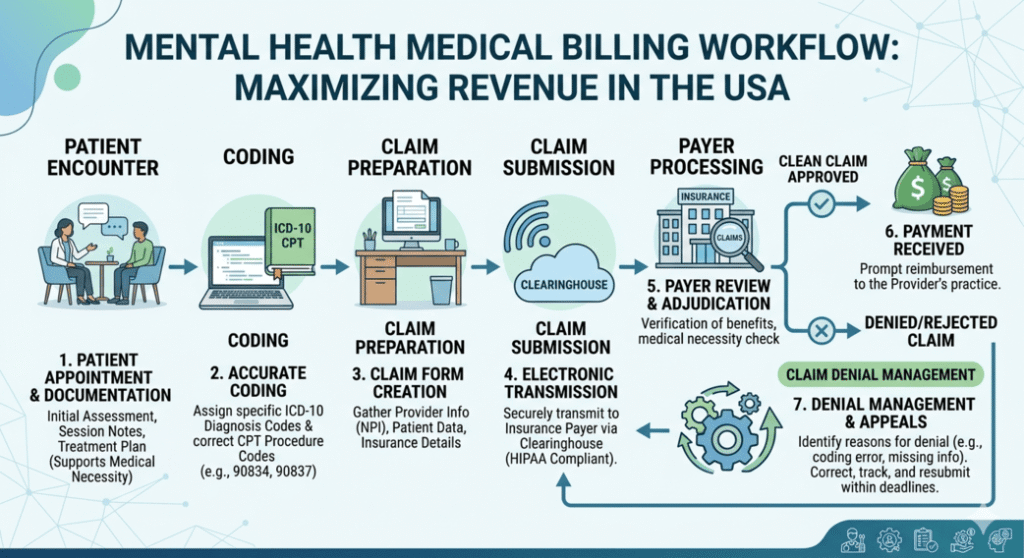

The healthcare landscape in the USA has shifted dramatically over the last few years, with mental health finally receiving the widespread recognition it deserves. However, as independent practices, psychiatric clinics, and behavioral health centers expand to meet this growing demand, they encounter a formidable roadblock: complex, highly specialized reimbursement systems. Navigating insurance claims for therapy, intensive outpatient programs, and psychiatric evaluations is vastly different from traditional medical billing. To keep doors open and focus entirely on patient care, providers are increasingly searching for the best mental health billing company to manage their financial operations.
Choosing a specialized partner is not just a matter of administrative convenience; it is a critical business decision. Mental health practices deal with unique challenges, such as tracking varying session lengths, managing strict prior authorization requirements, and handling frequent policy changes from commercial insurers and Medicaid. Attempting to manage these variables internally often leads to administrative burnout, high claim denial rates, and delayed payments. By partnering with an expert team that understands the nuances of behavioral health, practices can secure their financial stability while remaining compliant with ever-evolving federal and state regulations.
Why Mental Health Billing Requires Specialized Expertise
Many general medical billing companies treat behavioral health as a footnote, applying the same generic templates they use for family medicine or orthopedics. This approach is a recipe for revenue leakage. Mental health claims are heavily scrutinized by insurance adjusters, and a single misplaced modifier or a slight mismatch in documented session time can trigger an immediate denial.
The Nuances of Behavioral Health Coding
In mental health, coding is deeply tied to time, setting, and the specific interactive nature of the session. For instance, differentiating between a 45-minute psychotherapy session and a 60-minute session requires precise documentation. Furthermore, add-on codes for interactive complexity or crisis interventions complicate the process. A specialized billing partner brings deep knowledge of these specific code sets, ensuring that every service rendered is captured accurately and billed to its maximum legitimate value.
Overcoming the Prior Authorization Hurdle
Unlike routine physical checkups, many intensive mental health services—such as partial hospitalization programs (PHP) or repetitive transcranial magnetic stimulation (rTMS)—require stringent prior authorizations. Navigating these requirements demands consistent follow-up and an intimate understanding of individual payer policies. The right billing partner acts as a proactive shield, securing authorizations before treatment begins to avoid costly retro-active denials.
The Role of Comprehensive Revenue Cycle Management Services
A healthy practice relies on a continuous, optimized financial flow. This is where holistic revenue cycle management services come into play. Rather than simply submitting claims and hoping for the best, a comprehensive management strategy looks at the entire lifecycle of a patient account—from the moment an appointment is scheduled to the final collection of a self-pay balance.
An effective revenue cycle workflow involves several moving parts:
-
Eligibility Verification: Confirming insurance coverage, deductibles, and copays before the patient sits on the couch.
-
Daily Claim Submission: Cleaning and transmitting claims within 24 to 48 hours of service to keep cash flowing.
-
Denial Management: Actively tracking down why a claim was rejected, correcting the issue, and resubmitting it within tight appeal windows.
-
Patient Statements: Providing clear, easy-to-read invoices for patient responsibilities, which reduces confusion and improves collection rates.
When these components function as a unified machine, practices experience a drastic reduction in days in accounts receivable (AR), allowing clinicians to reinvest in better facilities, advanced training, or expanding their staff.
Streamlining Administrative Workflows: Coding and Credentialing
To truly optimize a practice’s financial health, billing cannot exist in a vacuum. It must be supported by accurate coding and up-to-date provider enrollment.
Precision with Medical Coding Services
The backbone of any clean claim is accurate coding. Utilizing dedicated medical coding services ensures that clinical notes are translated into the exact ICD-10 and CPT codes required by insurance companies. In mental health, where diagnoses can evolve and treatment plans are highly individualized, having certified coders review documentation minimizes the risk of accidental upcoding or undercoding—both of which can trigger audits or lead to lost revenue.
Expanding Your Network with Credentialing Services
For any mental health professional in the USA, being in-network with major insurance panels is one of the fastest ways to build a robust patient base. However, the insurance enrollment process is notoriously tedious, often taking several months of paperwork, background checks, and endless follow-ups.
Integrating professional credentialing services into your administrative strategy removes this burden entirely. Experts handle the primary source verification, CAQH profile updates, and contract negotiations, allowing new clinicians to start seeing insured patients and generating revenue without costly administrative delays.
Key Features to Look For in a Mental Health Billing Partner
When evaluating potential companies to handle your practice’s finances, you should look beyond the price tag. The cheapest option often results in the highest denial rates. Instead, look for a partner that offers a robust blend of technology, transparency, and specialized expertise.
1. HIPAA Compliance and Data Security
Mental health records contain some of the most sensitive personal data imaginable. Your billing partner must employ bank-grade encryption, secure servers, and strict internal protocols to ensure absolute HIPAA compliance. A data breach can destroy a practice’s reputation and result in catastrophic financial penalties.
2. Transparent, Real-Time Reporting
You should never be kept in the dark about your own practice’s financial standing. The best billing companies provide intuitive dashboards and regular, transparent reports that highlight key performance indicators (KPIs) such as clean claim rates, top denial reasons, and aging AR.
3. Dedicated Account Managers
When an urgent billing issue arises, you do not want to route through a generic call center. Look for a company that assigns a dedicated account manager to your practice—someone who knows your clinicians by name, understands your specific payer mix, and is readily available to jump on a call to solve complex problems.
Elevating Your Practice Financials
Outsourcing your administrative burden is ultimately about reclaiming your time and securing your practice’s future. By utilizing specialized medical billing and coding services, mental health professionals can eliminate the overhead costs associated with hiring, training, and retaining an in-house billing department. There are no worries about staff turnover, vacation days, or buying expensive billing software.
As you look to transition to an external partner, consider a company that brings all these elements under one roof. 247 Medical Billing Services stands out as a trusted industry leader, offering customized medical billing services, precise medical coding services, and holistic revenue cycle management services. Their dedicated teams work around the clock to handle everything from clean claim submissions to robust credentialing services, ensuring that your practice remains compliant, profitable, and focused on what truly matters: patient healing and mental well-being.
Frequently Asked Questions
1. What makes mental health billing different from regular medical billing?
Mental health billing relies heavily on time-based CPT codes, specific modifiers, and strict prior authorization rules for extended treatments. General medical billing typically deals with procedural or diagnostic codes that do not fluctuate based on session length or interactive complexity, making specialized knowledge essential for mental health practices.
2. How much do mental health billing services typically cost?
Most billing companies charge a percentage of the total revenue collected, typically ranging between 4% and 8% depending on the size of your practice, your claim volume, and the specific services required. Some companies may charge a flat fee per claim or a fixed monthly subscription.
3. Can a billing company help my practice get paneled with insurance companies?
Yes, many comprehensive billing providers offer specialized credentialing services. They manage the entire application and verification process to get your clinicians in-network with commercial insurance plans, Medicare, and Medicaid, saving you months of administrative paperwork.
4. How long does it take to transition to an outsourced billing company?
A standard onboarding process typically takes between 2 to 4 weeks. This period involves integrating software systems, establishing secure data pipelines, verifying provider credentials, and setting up workflows to ensure a seamless transition without interrupting your current cash flow.
5. Will I lose control over my practice’s financial data if I outsource?
Not at all. Reputable billing companies provide cloud-based software access and transparent, real-time reporting dashboards. You maintain full ownership of your data and can view the status of any claim, patient balance, or financial report whenever you choose.