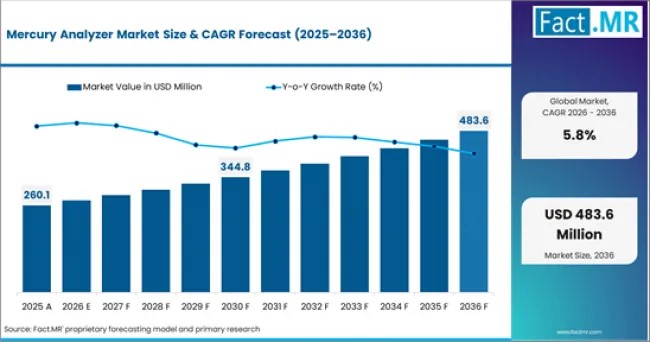

The global Mercury Analyzer Market is witnessing sustained growth as governments, environmental agencies, and industrial operators intensify mercury monitoring efforts to comply with increasingly stringent environmental regulations. According to recent Fact.MR analysis, the global mercury analyzer market was valued at USD 260.1 million in 2025 and is projected to expand at a CAGR of 5.8% to reach USD 483.6 million by 2036.
Get detailed market forecasts, competitive benchmarking, and pricing trends: https://www.factmr.com/connectus/sample?flag=S&rep_id=11591
Mercury analyzers play a critical role in detecting and quantifying mercury at trace and ultra-trace levels across environmental monitoring, food safety testing, industrial emissions compliance, pharmaceutical quality assurance, and mining remediation applications. The implementation of the Minamata Convention on Mercury, combined with tightening emission standards across North America, Europe, and Asia Pacific, continues to create strong procurement opportunities for advanced mercury monitoring systems.
Key Market Projections and Strategic Insights
- Market valuation expected to rise from USD 260.1 million in 2025 to USD 483.6 million by 2036
- Forecast CAGR of 5.8% during the assessment period
- Absolute dollar opportunity estimated at USD 208.4 million between 2026 and 2036
- Atomic Absorption Mercury Analyzers expected to account for 33.7% market share in 2026
- Environmental Monitoring to dominate application demand with 36.5% share
- Europe maintains the largest installed analyzer base globally
- India emerges as the fastest-growing country market with a projected 7.4% CAGR
Growing demand for continuous emission monitoring systems (CEMS), increasing food contamination testing requirements, and rising environmental remediation activities are creating new revenue streams for analyzer manufacturers and service providers.
Analyst Perspective
“The mercury analyzer market is being reshaped by tightening emission standards and expanding mercury testing requirements across environmental, food safety, pharmaceutical, and remediation applications. The transition from periodic sampling to real-time monitoring is creating a long-term replacement and upgrade cycle that will support market growth across both mature and emerging economies.”
Competitive Landscape and Market Share Analysis
The market remains moderately fragmented, with global analytical instrumentation leaders competing alongside specialized mercury detection technology providers.
Key companies operating in the market include:
- Thermo Fisher Scientific Inc.
- PerkinElmer Inc.
- Agilent Technologies Inc.
- Lumex Instruments
- Hitachi High-Tech Corporation
- Nippon Instruments
- Teledyne Leeman Labs
- ENVEA GmbH
- LECO Corporation
- Analytik Jena AG
- Mercury Instruments GmbH
- DURAG GROUP
- NIC Company
Leading players continue to strengthen their positions through technology innovation, regulatory method validation, service contracts, consumables programs, and AI-enabled predictive maintenance capabilities.
Production vs. Consumption Economy Analysis
Production activities remain concentrated in technologically advanced manufacturing hubs across North America, Europe, and Japan, where leading analytical instrumentation companies maintain R&D and manufacturing facilities.
On the consumption side, demand is expanding rapidly across Asia Pacific due to increasing industrialization, stricter environmental enforcement, and growing laboratory infrastructure investments. India and China are becoming major consumption centers as governments scale mercury monitoring programs and industrial facilities deploy continuous emissions monitoring systems.
Supply Chain and Value Chain Insights
The mercury analyzer value chain spans component suppliers, sensor manufacturers, instrument assemblers, calibration service providers, software developers, distributors, and end users.
Key supply chain priorities include:
- Secure sourcing of precision optical and sensor components
- Compliance with global environmental monitoring standards
- Expansion of calibration and maintenance networks
- Integration of cloud-based monitoring and reporting platforms
- Development of aftermarket service and consumables revenue streams
Manufacturers are increasingly investing in localized support networks to reduce downtime and improve lifecycle performance for customers.
Strategic Procurement Intelligence
Procurement decisions are increasingly driven by:
- Regulatory compliance requirements
- Detection sensitivity and accuracy
- Total cost of ownership
- Calibration efficiency
- Service support availability
- Data integration capabilities
Environmental agencies, utilities, industrial operators, and testing laboratories are prioritizing analyzer platforms that support automated reporting and continuous monitoring mandates.
Unlock the Complete Industry Analysis: https://www.factmr.com/report/mercury-analyzer-market
Country Opportunity Assessment
India – Fastest Growing Market
India is forecast to expand at a 7.4% CAGR through 2036. Growing implementation of Minamata Convention requirements, expanding coal-fired power generation monitoring, and increasing food contamination testing are supporting robust analyzer demand.
China
China is expected to grow at 6.9% CAGR, supported by ultra-low emission retrofit programs and expanding environmental compliance enforcement.
United States
The U.S. market continues to benefit from EPA Mercury and Air Toxics Standards (MATS) enforcement, contaminated site remediation programs, and laboratory modernization initiatives.
Technology and Innovation Outlook
Technology innovation remains a key competitive differentiator within the mercury analyzer industry. Major developments include:
- AI-assisted data interpretation
- Predictive maintenance systems
- Cloud-enabled compliance reporting
- Portable field-deployable analyzers
- Enhanced atomic fluorescence detection technologies
- Integrated continuous emission monitoring platforms
Manufacturers are increasingly introducing intelligent monitoring solutions that reduce operator intervention while improving analytical precision and compliance reporting capabilities.
To View Related Report:
Sound Reception System Market https://www.factmr.com/report/1433/sound-reception-system-market
Shotcrete Sprayer Market https://www.factmr.com/report/1434/shotcrete-sprayer-market
Outdoor Warning Sirens Market https://www.factmr.com/report/1435/outdoor-warning-sirens-market
Oil Drain Valves Market https://www.factmr.com/report/1436/oil-drain-valves-market