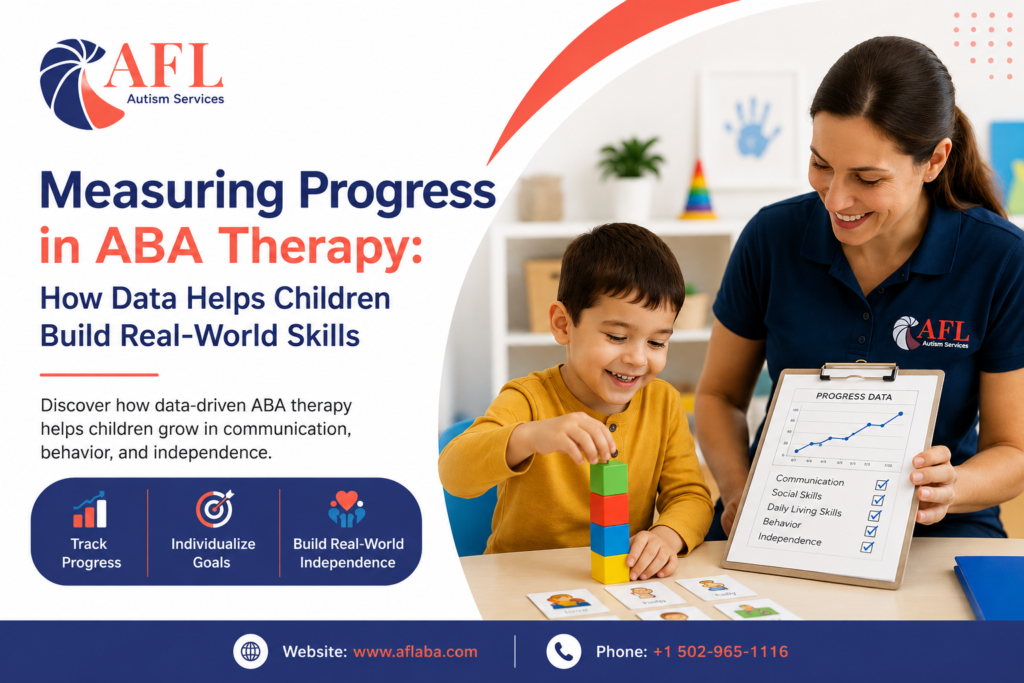

If you’re a parent whose child is in ABA therapy, you’ve probably asked yourself this question more than once: Is this actually working?
It’s a fair question, and an important one. ABA therapy often involves long-term commitment, weekly sessions, and a lot of trust placed in a treatment team. Parents want to see real, lasting changes, not just hope that things are improving. The good news is that ABA therapy doesn’t rely on guesswork. It relies on data.
Every session, every skill taught, and every behavior addressed is tracked, measured, and reviewed. This is what separates ABA therapy from approaches based purely on intuition. Behavior analysts use this information to make clinical decisions, adjust goals, and confirm that a child is moving toward meaningful, real-world independence.
This article breaks down how progress is measured in ABA therapy, what that progress actually looks like, and how parents can stay involved in a process that’s ultimately about helping their child thrive.
Why Measuring Progress Is Essential in ABA Therapy
ABA therapy isn’t one-size-fits-all. Two children with autism can have completely different strengths, challenges, and goals. That’s why measuring progress matters so much: it keeps therapy individualized instead of generic.
Individualized treatment. A treatment plan built around accurate data reflects what a specific child needs, not what worked for someone else.
Evidence-based care. ABA is grounded in behavioral science. Data collection is what makes therapy evidence-based rather than just well-intentioned.
Every child’s path looks different. Some children make fast gains in communication but need more time with social skills. Others may move quickly through self-care goals but need a slower pace with emotional regulation. Data accounts for these differences instead of forcing every child through the same timeline.
What Does Progress Mean in ABA Therapy?
Progress in ABA therapy is often misunderstood as simply reducing tantrums or difficult behaviors. While behavior reduction can be part of treatment, real progress is much broader. It touches nearly every area of a child’s daily life.
Communication Development
This might mean a nonverbal child learning to request items using picture cards, or a verbal child learning to form longer sentences instead of single words. Many families also pair ABA goals with speech therapy to support this growth.
Social Interaction
Progress here could look like a child learning to take turns during play, respond to their name, or initiate a greeting with a peer.
Daily Living Skills
Tasks like brushing teeth, getting dressed, or following a morning routine independently all fall under this category, often built through home and community-based ABA therapy.
Emotional Regulation
This includes learning to recognize frustration before it escalates, or using a calming strategy instead of melting down.
Independence
The long-term goal of ABA therapy is helping a child function with greater independence at home, in school, and in the community.
Real progress usually shows up across several of these areas at once, even if growth in one area is more noticeable than another.
How BCBAs Collect Data During Therapy
Behind every therapy session, a Board Certified Behavior Analyst (BCBA) is using structured methods to track how a child is responding. This is where ABA data collection becomes the backbone of effective treatment.
Skill Acquisition Data
This tracks how well a child is learning new skills, such as identifying colors, following two-step instructions, or answering questions appropriately.
Behavior Frequency Recording
This measures how often a specific behavior occurs, such as the number of times a child asks for a break instead of acting out.
Duration and Latency Tracking
Duration measures how long a behavior lasts (like a tantrum), while latency measures how long it takes a child to respond after being asked to do something.
Prompt Levels
Therapists track how much assistance a child needs to complete a task, whether that’s full physical guidance, a verbal reminder, or no help at all. As prompts decrease, independence increases.
Generalization Across Different Environments
A skill isn’t fully learned until a child can use it outside the therapy room. BCBAs track whether skills transfer to home, school, or community settings.
Each of these methods gives a clearer, more honest picture of growth than simply asking, “How did today go?”
Turning Data into Better Therapy Decisions
Collecting data is only useful if it leads to action. This is where measuring ABA therapy success really shows its value.
Identifying successful strategies. If a particular teaching method is producing fast, consistent results, the data confirms it’s worth continuing.
Recognizing when goals need adjustment. If progress has stalled, a BCBA can pinpoint why and revise the approach.
Preventing plateau. Without data, a stalled skill might go unnoticed for weeks. With data, it’s caught early.
Updating treatment plans. As a child grows and learns, goals evolve. Data ensures these updates are based on real performance, not assumptions.
Individualized decision-making. Every adjustment is tailored specifically to the child in front of the therapist, not a generic template, as part of personalized ABA therapy.
This is the heart of personalized ABA therapy. The plan is never static. It shifts based on what the data shows.
Examples of Real Progress Families May Notice
Sometimes progress is subtle day to day but becomes obvious when you look back over weeks or months.
Communication Example
A child who once pointed or grabbed for what they wanted begins using simple words or a communication device to make requests.
Daily Routine Example
A child who needed full assistance getting dressed in the morning starts buttoning their own shirt with just a verbal reminder.
School Readiness Example
A child becomes able to sit through a 15-minute group activity, something they couldn’t tolerate for more than two minutes before. Our ABA Therapy Resource Hub offers more guidance on school readiness milestones.
Social Skills Example
A child who avoided peers begins to tolerate, and eventually enjoy, short periods of shared play.
Independent Living Example
A child learns to wash their hands fully on their own, from start to finish, without a parent standing over them.
These moments may seem small individually, but together they represent real movement toward greater independence.
How Parents Can Support Progress at Home
ABA therapy works best when it doesn’t stop at the end of a session. Parents play a major role in reinforcing what’s being taught. Our guide on how parents can support ABA therapy at home covers this in more depth.
Reinforcing therapy goals. Practicing the same skills at home helps a child generalize what they’re learning.
Tracking observations. Jotting down small wins or challenges gives the BCBA useful real-world context.
Communicating with the BCBA. Regular updates from parents help shape and adjust treatment goals.
Maintaining consistency. Following through with strategies recommended by the therapy team, even outside of sessions, supports faster progress.
Celebrating small achievements. Recognizing progress, even minor steps, builds motivation for the child and reassures parents that growth is happening. Explore more on our Parent Resources page.
Common Misunderstandings About ABA Therapy Progress
Many parents come into ABA therapy with expectations that don’t always match how learning actually happens.
Progress isn’t always linear. A child may move forward for weeks, then plateau briefly before another breakthrough. This is normal, not a sign of failure.
Children learn at different speeds. Comparing one child’s progress to another’s isn’t useful. Each child has a different starting point and different needs.
Therapy goals change over time. As skills are mastered, new goals naturally replace old ones. This is a sign of growth, not instability.
Data matters more than opinions. A “good day” or “bad day” can be misleading. Data collected consistently over time tells a more accurate story than how one session felt.
Frequently Asked Questions
- How long does it take to see progress in ABA therapy?
This varies by child, but many families begin noticing small changes within the first few months, with more significant progress over six months to a year. - What if my child’s progress seems slow?
Slow progress doesn’t mean therapy isn’t working. BCBAs use data to identify what’s working and adjust strategies as needed. - Why does my child’s BCBA keep changing the treatment plan?
Treatment plans are updated based on data showing what skills have been mastered and what new goals make sense next. - Can I see the data being collected on my child?
Yes. Most ABA providers share progress reports and discuss data with parents regularly. - Is reducing problem behavior the main goal of ABA therapy?
No. While behavior reduction can be part of treatment, the larger goal is building functional skills like communication, social interaction, and independence.
Conclusion
ABA therapy progress isn’t something families have to guess about. Behind every session is a structured system of ABA data collection that tracks communication growth, social development, daily living skills, and independence. This data-driven approach allows BCBAs to make informed decisions, adjust goals, and create therapy plans built specifically around each child’s needs.
For parents, staying engaged in this process, understanding the data, asking questions, and reinforcing skills at home, can make a meaningful difference in how effectively a child progresses.
If you’re looking for evidence-based ABA therapy that focuses on measurable progress and personalized treatment, Adapt For Life – AFL Autism Services is here to help. Our experienced team uses data-driven strategies to build individualized therapy plans that support communication, behavior, social development, and daily living skills. Visit aflaba.com or call +1 502-965-1116, or get started today.