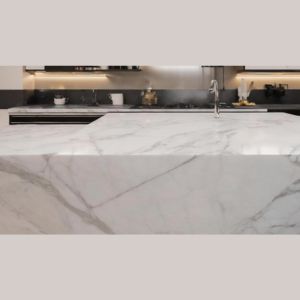

Marble and quartzite get confused for one another more often than any other pair of stone worktops. They can look strikingly similar on a showroom sample, both prized for that soft, veined elegance that photographs beautifully.
But live with them for a year and the differences become impossible to ignore. If you’re weighing up a marble worktop against a quartzite worktop, here’s what actually separates them.
Where They Come From?
A marble worktop starts life as limestone, transformed under heat and pressure into the classic veined stone we recognise from centuries of architecture and interior design. Quartzite forms differently; it begins as sandstone and fuses under extreme heat and pressure until the quartz grains bond together into something remarkably tough. They’re both natural, both metamorphic, and both genuinely beautiful, but the chemistry underneath is where the story changes.
Hardness and Everyday Resilience
This is the crux of the marble worktop versus quartzite worktop debate. Marble sits at around 3-4 on the Mohs hardness scale soft enough that a kitchen knife dragged across it, or a heavy pan set down carelessly, can leave a mark over time. Quartzite is dramatically tougher, closer in hardness to granite, and shrugs off scratches that would trouble marble.
Porosity follows the same pattern. Marble is genuinely porous, meaning liquids like coffee, wine and citrus juice can soak in if left too long, and sealing is recommended as often as every six months to keep it protected. Quartzite has very low porosity by comparison, so while sealing is still worthwhile, you can typically get away with an annual routine rather than a twice-yearly one.
Heat and Staining
Quartzite has the edge here too. It can tolerate far higher heat than marble before you’d see any damage, which makes it the more forgiving choice for a household that cooks often and moves pans around the worktop without thinking twice.
Marble is more vulnerable to etching, that dull, cloudy mark you get when something acidic sits on the surface a moment too long. It’s not a dealbreaker if you’re careful, but it is a genuine daily consideration.
Price and availability
Here’s where people are often surprised:
- Quartzite worktops are usually the pricier of the two, largely because of scarcity; quartzite deposits are rarer and often quarried in remote or high-altitude locations, which pushes up cost. Marble, meanwhile, spans a wide range.
- A classic option like Carrara marble can actually be one of the more affordable natural stone choices, while a rare or highly patterned marble can rival quartzite at the top end.
Don’t assume one is automatically the budget option; get quotes on the specific slab you’ve fallen for.
Which Suits Your Kitchen?
If your kitchen sees heavy daily use (regular cooking, kids, entertaining, spills that don’t always get wiped up straight away), a quartzite worktop is the more practical natural stone choice. If you want the timeless, unmistakable look of veined marble and you’re happy to build sealing into your routine, a marble worktop remains one of the most beautiful surfaces you can put in a home.
Whichever direction you lean, always view the actual slab before it’s cut, since both marble and quartzite carry natural variation that a small sample simply can’t convey. At Koliqi, we supply and fit both marble and quartzite worktops across the UK, and we’ll happily talk you through which specific slabs in our range handle daily kitchen life best, rather than just which ones look good under showroom lighting. A kitchen worktop is a decade-plus decision; it’s worth getting the honest picture before you commit.
Marble is more vulnerable to etching, that dull, cloudy mark you get when something acidic sits on the surface a moment too long. It’s not a dealbreaker if you’re careful, but it is a genuine daily consideration.