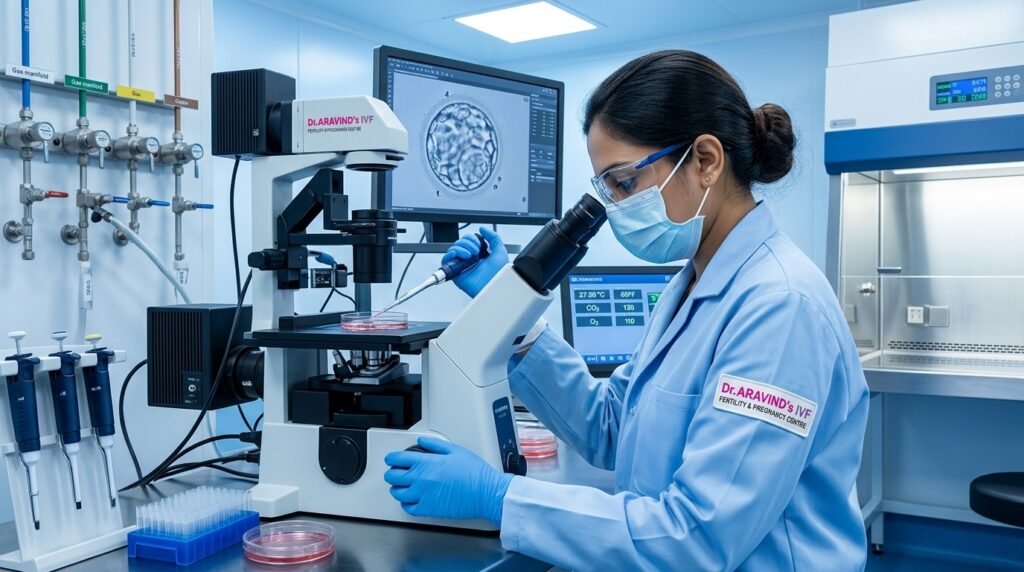

Who Is an Embryologist?
When couples think about IVF, they often picture the fertility specialist who plans the treatment and performs procedures. But there is another professional who plays a crucial role behind the scenes – the embryologist.
An embryologist is a trained laboratory professional who works with eggs, sperm, and embryos during assisted reproductive treatment.
From the moment eggs are collected until embryos are prepared for transfer or freezing, the embryology team is involved in several delicate stages of the IVF process.
For couples exploring IVF Centres in Palakkad, understanding the role of an embryologist can help explain why the laboratory is such an important part of fertility treatment.
What Happens to the Eggs After Retrieval?
Once the eggs are retrieved from the ovaries, they are immediately transferred to the embryology laboratory.
The embryologist examines the collected material under a microscope and identifies the eggs.
Not every follicle contains an egg, and not every retrieved egg is necessarily mature.
The embryology team evaluates the retrieved eggs to identify those that are suitable for fertilization.
This is one of the first important steps where laboratory expertise becomes part of the IVF journey.
How Does Fertilization Take Place?
Once mature eggs are identified, the next step is fertilization.
Depending on the couple’s fertility factors, the laboratory team may use conventional IVF or ICSI.
In conventional IVF, prepared sperm are placed with the eggs in controlled laboratory conditions, allowing fertilization to occur naturally.
With ICSI, an embryologist selects an individual sperm and injects it directly into a mature egg.
The choice of technique depends on factors such as sperm quality, previous fertilization outcomes, and the treatment plan recommended by the fertility specialist.
What Does an Embryologist Do During ICSI?
ICSI requires a high level of precision.
The embryologist uses specialized equipment to hold the egg in position and carefully inject a selected sperm into it.
The procedure requires steady handling and technical expertise because eggs are extremely delicate.
After injection, the eggs are returned to controlled culture conditions and monitored for signs of fertilization.
The embryologist then records the results and communicates relevant findings to the clinical team.
What Is Embryo Culture?
After successful fertilization, the fertilized eggs begin developing into embryos.
This stage is known as embryo culture.
The embryos remain in specialized laboratory conditions where their development can be monitored over several days.
The embryology team observes changes in embryo development and documents their progress.
The goal is to maintain appropriate conditions while allowing the embryos to develop naturally within the laboratory environment.
Embryo development can vary significantly between patients.
Some embryos may continue developing normally, while others may stop developing at different stages.
This is a natural part of the IVF process and does not necessarily indicate that anything was done incorrectly.
How Are Embryos Evaluated?
Embryologists monitor embryo development using established assessment methods.
Depending on the stage of development, they may evaluate features such as:
- Cell division
- Cell number
- Degree of fragmentation
- Developmental pattern
- Blastocyst formation
- Inner cell mass
- Trophectoderm appearance
Embryo assessment helps the fertility team identify embryos that may be suitable for transfer or freezing.
However, visual assessment cannot identify every genetic or biological characteristic of an embryo.
An embryo that appears healthy under a microscope may still have chromosomal abnormalities.
This is why embryo grading should not be interpreted as a guarantee of implantation or pregnancy.
What Is Embryo Grading?
Embryo grading is a system used by embryologists to describe embryo development and appearance.
At the blastocyst stage, embryos may be assessed according to their developmental expansion and the appearance of specific cell groups.
The grading system helps embryologists and fertility specialists communicate about embryo quality and make informed decisions regarding transfer or freezing.
However, embryo grade is only one factor among many.
The woman’s age, uterine health, sperm factors, and other biological conditions also influence the chances of pregnancy.
Does the Embryologist Decide Which Embryo Will Be Transferred?
The embryologist plays an important role in assessing and reporting embryo development, but embryo transfer decisions are generally made as part of a collaborative clinical process.
The fertility specialist and embryology team consider the available embryos, the patient’s medical situation, previous treatment history, and the clinic’s embryo transfer strategy.
The goal is to identify the most appropriate embryo for transfer based on the available information.
Patients should feel comfortable asking their fertility team how embryo selection decisions are made.
What Happens When Embryos Are Frozen?
Not every suitable embryo needs to be transferred immediately.
If additional embryos are considered suitable for future use, they may be frozen using a technique called vitrification.
The embryology team prepares embryos for freezing and stores them in specialized cryogenic systems.
When a frozen embryo transfer is planned, the embryologist also manages the thawing process.
The embryo is carefully assessed after warming to determine whether it has survived the process appropriately before transfer.
Why Is Communication Between Doctor and Embryologist Important?
IVF involves both medical and laboratory decisions.
The fertility specialist manages ovarian stimulation, monitoring, egg retrieval, and embryo transfer.
The embryologist manages the laboratory stages involving eggs, sperm, fertilization, embryo development, and freezing.
These parts of treatment need to work together.
For example, the number of mature eggs retrieved may influence the fertilization strategy. The fertilization outcome may help determine how the remaining stages of treatment are planned.
A Best IVF specialist in Kerala should therefore work closely with the embryology team to ensure that clinical and laboratory decisions are coordinated.
What Happens If Fertilization Does Not Occur?
Sometimes, fertilization may not happen even when mature eggs and sperm are available.
This can be emotionally difficult for couples.
The fertility team may review the laboratory results to understand what happened.
Depending on the circumstances, factors such as egg maturity, sperm quality, or fertilization technique may be considered.
In a future treatment cycle, the clinical team may discuss whether a different fertilization approach, such as ICSI, could be appropriate.
The next step should be based on the specific findings rather than automatically repeating the same approach.
Does an Embryologist Influence IVF Success?
Embryologists are an important part of IVF treatment, but pregnancy is influenced by many factors beyond the laboratory.
These include:
- Woman’s age
- Egg quality
- Sperm quality
- Embryo development
- Uterine health
- Endometrial receptivity
- Underlying fertility conditions
The embryology team’s work supports the fertilization and embryo development stages, but no professional or laboratory can guarantee a successful pregnancy.
Why Embryology Is an Important Part of IVF Care
An IVF cycle involves much more than the medical procedures patients see during clinic visits. Once eggs are retrieved, the embryology team becomes closely involved in the next stages of treatment.
From identifying mature eggs and performing fertilization to monitoring embryo culture, assessing development, and managing embryo freezing, embryologists contribute to several critical steps of assisted reproduction.
If you are comparing IVF Centres in Palakkad, it is worth understanding not only the fertility specialists but also the role of the embryology team supporting your treatment. At Dr. Aravind’s IVF Fertility & Pregnancy Centre, couples can discuss how the medical and laboratory teams work together throughout the IVF process.
Knowing who is involved at each stage can make the treatment journey easier to understand and help couples ask more meaningful questions before beginning IVF.
Book Your Appointment at Dr. Aravind’s IVF Fertility & Pregnancy Centre:
https://www.draravindsivf.com/book-your-appointment
Contact Us
Dr. Aravind’s IVF Fertility & Pregnancy Centre
Premier Tower, Coimbatore Road, Kalvakulam, Mankavu, Palakkad – 678013, Kerala
Phone: +91 90 2012 2012
Email: info@draravindsivf.com
Frequently Asked Questions
What is the role of an embryologist in IVF?
An embryologist handles eggs, sperm, and embryos in the IVF laboratory. Their work may include fertilization, ICSI, embryo culture, embryo assessment, and cryopreservation.
Does the embryologist perform egg retrieval?
No. Egg retrieval is performed by the fertility doctor or qualified medical specialist. The embryologist receives and examines the eggs once they arrive in the laboratory.
Who performs ICSI?
ICSI is performed by a trained embryologist in the IVF laboratory using specialised equipment.
What happens during embryo culture?
After fertilisation, embryos are maintained in controlled laboratory conditions and monitored as they develop over several days.
Can embryologists guarantee which embryo will result in pregnancy?
No. Embryologists can assess embryo development and appearance, but implantation and pregnancy depend on many biological factors.