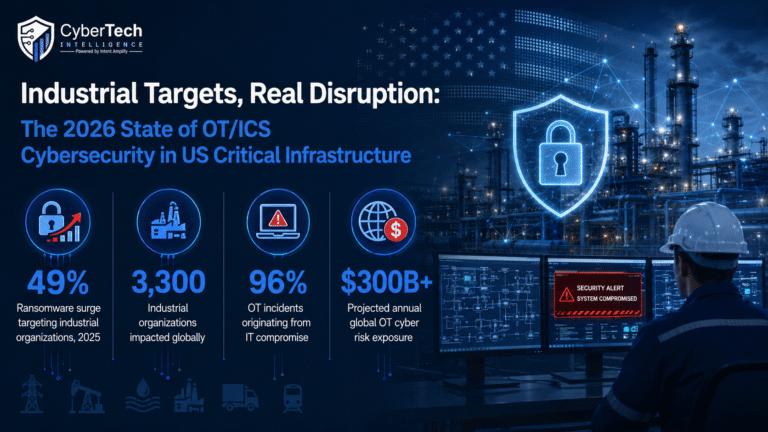

Operational Technology (OT) and Industrial Control Systems (ICS) form the backbone of America’s critical infrastructure. From power generation and water treatment facilities to manufacturing plants, transportation networks, and energy grids, these systems keep essential services running every day. However, as digital transformation accelerates and IT/OT environments become increasingly interconnected, critical infrastructure organizations are facing a new era of cyber risk.
The latest research reveals a troubling reality: cyber threats targeting industrial environments are becoming more frequent, more sophisticated, and more capable of causing real-world operational disruption. Attackers are no longer focused solely on stealing data. They are actively targeting the systems that control physical processes, creating risks that extend beyond financial losses to include operational downtime, public safety concerns, regulatory consequences, and national security implications.
The 2026 OT/ICS Cybersecurity landscape demonstrates how adversaries have evolved their tactics. Modern threat actors are mapping entire industrial control environments, exploiting vulnerabilities across interconnected networks, and leveraging IT compromises as a gateway into OT systems. Research indicates that a significant majority of OT security incidents originate from IT-level intrusions, highlighting the growing danger posed by IT/OT convergence.
Critical infrastructure operators are also struggling with a rapidly expanding attack surface. Legacy industrial assets designed decades ago remain essential to operations but often lack modern security capabilities such as strong authentication, encryption, and continuous monitoring. As exploit timelines continue to shrink, organizations face increasing challenges in maintaining visibility, prioritizing vulnerabilities, and responding effectively to incidents before operational disruption occurs.
The report highlights several alarming trends shaping the OT/ICS threat landscape:
- Rising volumes of high-severity vulnerabilities affecting critical industrial systems.
- Increased ransomware activity targeting operational environments.
- Nation-state actors actively pursuing access to critical infrastructure networks.
- Growing exploitation of IT/OT convergence points.
- Significant monitoring and visibility gaps across industrial environments.
- Persistent risks associated with aging infrastructure and long asset lifecycles.
At the same time, organizations are facing mounting pressure from regulators, insurers, stakeholders, and government agencies to strengthen cyber resilience. Traditional perimeter-based security strategies are proving insufficient against adversaries capable of moving laterally across complex environments and targeting operational processes directly. Cybersecurity can no longer be viewed as a standalone IT function—it has become a critical component of business continuity, operational reliability, and strategic risk management.
The research also reveals a concerning readiness gap. Many organizations lack comprehensive OT monitoring, formal incident response plans, and mature cyber resilience programs. Without real-time visibility into industrial networks, security teams may struggle to detect attacks, investigate incidents, and contain threats before physical consequences occur. Meanwhile, threat actors continue to exploit these gaps with increasing speed and precision.
Despite these challenges, the report provides a roadmap for strengthening critical infrastructure security. Key recommendations include implementing continuous OT network monitoring, improving asset visibility, hardening IT/OT boundaries, enhancing incident response preparedness, adopting Zero Trust principles, and elevating OT cybersecurity to a board-level business priority. Organizations that embrace these measures will be better positioned to manage risk, improve resilience, and defend against emerging cyber threats.
For CISOs, security leaders, OT engineers, risk managers, policymakers, and executive decision-makers, understanding the evolving OT/ICS threat landscape has never been more important. The future of critical infrastructure security depends on the ability to anticipate threats, close visibility gaps, and build resilient defenses capable of protecting both digital and physical operations.
Key Insights You’ll Discover
- The latest threat trends impacting U.S. critical infrastructure.
- Why vulnerability growth is outpacing defender capacity.
- How nation-state actors are targeting industrial environments.
- The risks created by legacy infrastructure and IT/OT convergence.
- Critical monitoring and visibility gaps affecting OT security.
- Practical recommendations for improving cyber resilience and operational continuity.
- Strategic priorities for security leaders navigating the 2026 threat landscape.
Read the Full Research Report
Gain exclusive insights into the state of OT/ICS cybersecurity, emerging threats targeting critical infrastructure, and the actions organizations must take to strengthen their defenses against modern cyber adversaries.
Critical infrastructure is under increasing pressure from cyber threats that can impact operations, safety, and national security. Stay ahead of evolving risks with data-driven insights, expert analysis, and actionable recommendations from the latest OT/ICS Cybersecurity Research Report.
Read the full report: https://tinyurl.com/3w4k887s
Contact Us
1846 E Innovation Park Dr, Suite 100, Oro Valley, AZ 85755
Phone: +1 (845) 347-8894, +91 77760 9266