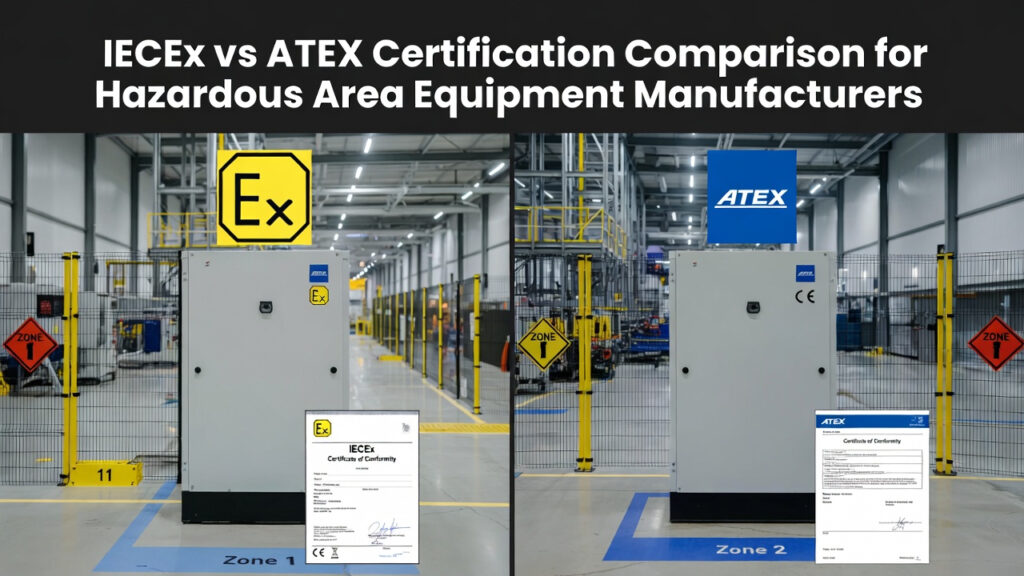

The explosion protection landscape presents professionals and companies in the UAE and GCC region with a fundamental choice: pursue IECEx or ATEX certification? While both schemes aim to ensure safety in hazardous areas, their recognition, application, and relevance differ significantly depending on where you work and which markets you serve. Understanding these distinctions enables informed decisions that align with your career goals or organizational compliance needs.
Understanding the Foundational Differences
ATEX originated as a European Union directive, specifically designed to regulate equipment and protective systems intended for use in potentially explosive atmospheres across EU member states. The name derives from the French “ATmosphères EXplosibles,” and it became mandatory throughout Europe in the early 2000s. ATEX operates as regional legislation, meaning its legal force applies within EU borders.
IECEx, conversely, represents a truly international certification scheme administered by the International Electrotechnical Commission. Rather than regional legislation, IECEx provides a voluntary framework adopted by member countries worldwide. Its foundation rests on international standards—particularly the IEC 60079 series—that countries can incorporate into their national regulations.
This fundamental distinction shapes everything else. ATEX carries legal weight automatically throughout the EU because it’s legislation. IECEx certification gains authority when individual countries recognize it within their regulatory frameworks, which increasingly happens globally but isn’t automatic.
For professionals and companies in the UAE and GCC region, this distinction becomes immediately relevant. The GCC nations aren’t EU members, so ATEX holds no inherent legal authority. However, many GCC projects—particularly those managed by European engineering firms or involving European equipment manufacturers—specify ATEX requirements due to organizational familiarity and established supply chains.
Recognition and Legal Scope in the GCC Market
UAE regulations increasingly reference IEC standards, creating natural alignment with IECEx certification. The UAE Civil Defense and various free zone authorities recognize IECEx as meeting their hazardous area safety requirements. Saudi Arabia similarly aligns its technical regulations with IEC standards through SASO (Saudi Standards, Metrology and Quality Organization).
Qatar, Kuwait, Oman, and Bahrain follow comparable paths, incorporating IEC 60079 standards into their national codes. This regulatory landscape means that IECEx certification directly satisfies official requirements throughout the GCC region.
ATEX, meanwhile, holds no direct legal standing in GCC countries. However, its market presence remains significant for several practical reasons. Many multinational corporations operating in the GCC maintain European headquarters and apply their global standards consistently across regions. If a company’s internal safety management system specifies ATEX compliance, their GCC projects inherit those requirements regardless of local regulations.
European equipment manufacturers often pursue ATEX certification because it’s legally mandatory for selling within the EU—their largest market. When this equipment reaches GCC projects, it arrives with ATEX certification rather than IECEx. Project specifications then reference ATEX simply because that’s what the available equipment carries.
End clients in the GCC sometimes specify ATEX based on consultant recommendations, past project precedents, or perceived quality associations with European standards. This specification persists despite IECEx potentially being more appropriate for the regional context.
The practical reality creates a hybrid environment where understanding both schemes provides maximum flexibility and employability in the GCC market.
Personnel Certification: A Critical Distinction
Perhaps the most significant difference for individual professionals lies in personnel certification availability. IECEx operates a comprehensive Certificate of Personnel Competency (CoPC) scheme that certifies individuals as competent to install, maintain, inspect, or repair explosion-protected equipment.
ATEX, as equipment-focused legislation, doesn’t provide equivalent personnel certification. While various organizations offer “ATEX training” courses, these don’t result in internationally recognized personnel certificates comparable to IECEx CoPC. You might receive a course completion certificate proving you attended training, but this lacks the formal assessment and international registry that IECEx provides.
This distinction matters enormously for maintenance engineers, technicians, and inspection personnel in the GCC. When project specifications require certified personnel—increasingly common on major facilities—IECEx CoPC provides the recognized credential. ATEX training certificates alone won’t satisfy these requirements.
Some European countries have national personnel certification schemes aligned with ATEX principles, but these remain nationally recognized rather than international. The UK’s CompEx scheme, for example, enjoys respect throughout former British Commonwealth countries but lacks the truly global recognition that IECEx CoPC achieves.
For GCC-based professionals, this makes IECEx CoPC the clear choice for personnel certification. Even on projects specifying ATEX equipment, certified personnel requirements typically default to IECEx CoPC because no ATEX personnel certification alternative exists.
Equipment Certification Considerations
Equipment certification presents different considerations. Manufacturers pursuing global markets increasingly obtain both ATEX and IECEx certification for their products, recognizing that European customers require ATEX while international markets favor IECEx.
The technical standards underlying both schemes—IEC 60079 series and corresponding EN (European Norm) standards—maintain substantial alignment. Equipment designed and tested to one standard generally complies with the other, though certification processes differ.
For GCC projects procuring equipment, acceptance of either certification depends on contract specifications. Major projects often specify equivalency, accepting equipment certified under ATEX, IECEx, or equivalent national schemes. This flexibility recognizes market realities and avoids unnecessarily restricting equipment options.
However, when projects explicitly specify IECEx certification, ATEX-only equipment requires additional justification or equivalency demonstration. Conversely, IECEx-certified equipment generally faces easy acceptance on projects specifying ATEX, particularly when technical standards alignment is demonstrated.
Practical Decision Flowchart
For Individual Professionals:
If you’re pursuing personnel certification to advance your career in the GCC region, choose IECEx CoPC without hesitation. It provides internationally recognized credentials, satisfies regional regulatory requirements, and increasingly represents the expected standard across major GCC projects.
Supplement your IECEx certification with ATEX awareness training if you frequently work on European-managed projects or with European contractors. This combination provides comprehensive knowledge while maintaining formal certification where it matters most.
For Equipment Manufacturers:
If your primary market is Europe, ATEX certification remains mandatory. For equipment destined for GCC and broader international markets, pursue IECEx certification either instead of or in addition to ATEX, depending on your market strategy.
The trend favors dual certification—ATEX for European access, IECEx for global reach. While this increases initial certification costs, it maximizes market access and positions your products competitively across regions.
For Project Managers and Contractors:
Specify IECEx certification as primary, with ATEX accepted as equivalent for equipment procurement. This approach aligns with regional regulations while maintaining flexibility for European-sourced equipment.
For personnel requirements, specify IECEx CoPC explicitly, as this provides verifiable, internationally recognized competency certification that ATEX training certificates cannot match.
The Convergence Trend
The long-term trajectory points toward increasing convergence between ATEX and IECEx. European committee work increasingly coordinates with IEC standard development, reducing technical differences. Some predict eventual full alignment, though timeline uncertainty remains.
For the GCC market specifically, IECEx momentum continues building as regional regulators explicitly adopt IEC standards and more professionals pursue CoPC certification. This doesn’t diminish ATEX’s role entirely—European engineering influence ensures continued ATEX presence—but establishes IECEx as the primary standard for regional compliance and career development.
Making the right certification choice requires understanding your specific context—geographic focus, target employers, project types, and career trajectory. For most professionals and organizations operating in the UAE and GCC region, however, IECEx certification provides the clearest path to compliance, recognition, and career advancement in the regional explosion protection field.