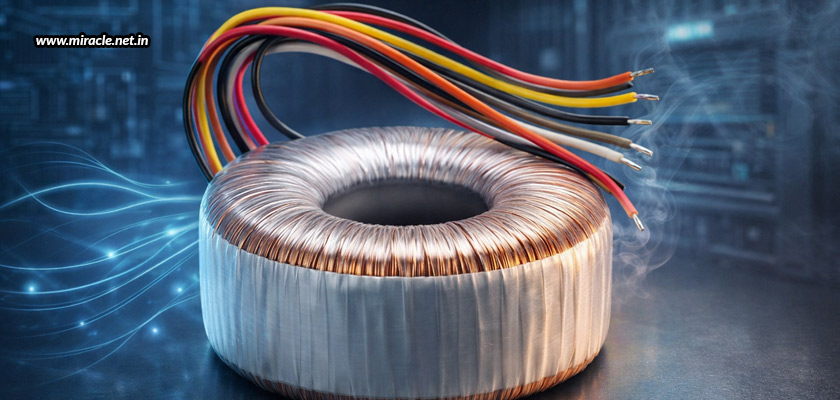

Power efficiency and thermal performance are critical in modern electronic systems, as inefficient components waste energy and generate excess heat, affecting reliability and lifespan. Transformers play a key role in this, and toroidal transformers stand out for their high efficiency and superior thermal behaviour. Their unique design reduces energy losses, improves magnetic performance, and limits heat generation, making them ideal for compact and demanding applications. This blog explains how toroidal transformers achieve these benefits by examining their design, loss reduction, and thermal characteristics, along with their practical advantages in real-world systems. Leading manufacturers like Miracle Electronics are leveraging advanced toroidal transformer in India designs to deliver high-efficiency and thermally optimized solutions for modern applications.
Understanding efficiency and thermal performance in transformers
Transformer efficiency is defined as the ratio of output power to input power. Losses that reduce efficiency mainly include core losses caused by hysteresis and eddy currents in the core material, copper losses due to resistance in the windings, and stray losses resulting from leakage flux and magnetic coupling.
Thermal performance refers to how well a transformer manages the heat generated by these losses. Poor thermal performance can lead to reduced lifespan, insulation degradation, risk of failure in continuous-duty applications, and increased maintenance requirements.
Improving efficiency directly reduces heat generation, making both factors closely interconnected.
Optimized core design reduces energy losses
One of the primary reasons toroidal transformers are more efficient is their closed magnetic core design. They have a circular core with no air gaps, which ensures smooth uninterrupted magnetic flux flow, lower reluctance in the magnetic path, and reduced hysteresis losses. The uniform distribution of magnetic flux in the toroidal core helps minimize localized eddy currents, further reducing core losses. The result is lesser energy wasted, reduced heat generation, and improved overall efficiency.
Shorter winding length reduces copper losses
Electrical resistance in the windings of a transformer result in copper losses. But, toroidal transformers are designed in a way that naturally minimizes these losses. Since their windings are evenly distributed around the circular core, the average length of each turn is shorter, and current flows more efficiently with reduced resistance in the windings. The compact winding arrangement allows for higher current-carrying capacity and reduced losses, which directly contribute to higher efficiency, reduced heat buildup, and improved load handling capacity.
Superior magnetic coupling minimizes stray losses
Magnetic coupling between the primary and secondary windings plays a key role in transformer efficiency. In toroidal transformers, the windings are closely coupled around the entire core, efficiently transferring magnetic flux between the windings, and minimizing leakage inductance. This results in lesser energy being lost to the surrounding components, with reduced stray losses and lower EMI. This efficient energy transfer improves both performance and thermal stability.
Lower magnetizing current improves efficiency
Magnetizing current is the current required to energize the transformer core. Toroidal transformers require lower magnetizing current because of high permeability core materials and an efficient magnetic path, which results in reduced no-load losses, lower energy consumption during idle conditions, and improved efficiency in standby or lightly loaded systems. This is particularly beneficial in applications where transformers operate continuously.
Reduced heat generation at the source
In toroidal transformers, there are lower core losses that reduce heat in the core, reduced copper losses that minimize winding temperature rise, and efficient energy transfer that prevents localized heating. All of this results in lower internal temperature rise and stable performance in compact enclosures, which reduces the need for external cooling systems.
Compact design supports thermal efficiency
Toroidal transformers are smaller and lighter for the same power rating, as compared to other transformers, which also contributes to thermal performance. The compact size allows better airflow in enclosures and enables optimized placement away from heat-sensitive components. Moreover, they are easier to combine with heat sinks or ventilation systems, and are suitable for sealed or semi-enclosed systems. In compact systems, efficient thermal management is essential, and toroidal transformers support this requirement effectively.
Improved heat dissipation
In addition to generating less heat, toroidal transformers are also effective at dissipating the heat they do produce. Their circular geometry ensures even distribution of heat across the core and windings, with zero localized hotspots. Their shape provides a relatively large surface area for natural convection and passive cooling, resulting in lower operating temperatures, reduced thermal stress on insulation materials, and thus enhanced reliability.
Reduced need for cooling infrastructure
Because of their high efficiency and low heat generation, toroidal transformers often require minimal cooling support. In many applications, natural air cooling is sufficient, and no fans or forced cooling systems are required. there is thus lower system complexity, lower power consumption, and reduced maintenance required. This makes toroidal transformers ideal for systems where reliability and simplicity are priorities.
Enhanced lifespan through thermal stability
Heat is one of the primary factors affecting transformer lifespan. The lower operating temperatures of toroidal transformers results in slower insulation aging, reduced risk of thermal breakdown, and improved long-term stability. Toroidal transformers maintain stable electrical characteristics and consistent efficiency over time. This is especially important in continuous-duty applications such as industrial equipment and power systems.
Toroidal transformers present a distinct advantage in enhancing both power efficiency and thermal performance. Their enclosed magnetic core, effective winding configuration, and excellent magnetic coupling greatly minimize energy losses. Consequently, they produce less heat and function at lower temperatures than traditional transformer designs. These features not only boost system performance but also improve reliability, decrease cooling needs, and prolong equipment lifespan. In a time when energy efficiency and compact design are of growing significance, toroidal transformers offer a practical and efficient solution for contemporary electrical and electronic systems. For engineers and designers aiming to optimize performance while reducing thermal issues, toroidal transformers continue to be a wise and dependable option.