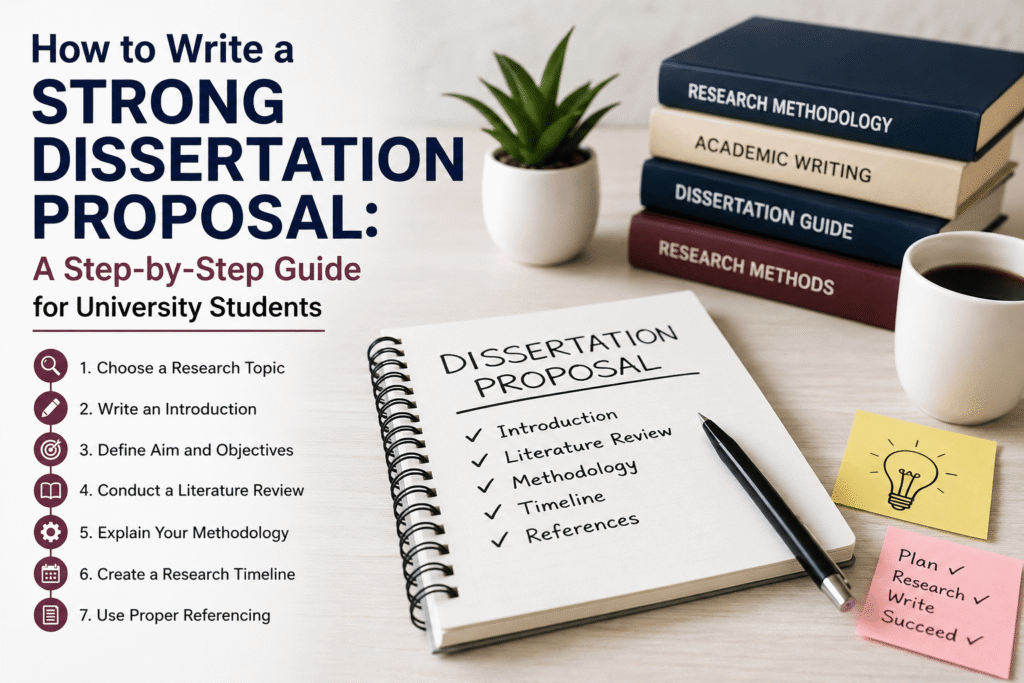

Writing a dissertation proposal is one of the most important milestones in a university student’s academic journey. Before you begin writing your dissertation, your proposal serves as a blueprint that outlines your research topic, objectives, methodology, and the significance of your study. A well-prepared proposal not only increases your chances of approval but also provides a clear direction for your research.
If you’re unsure how to write an effective dissertation proposal, this step-by-step guide will help you understand each section and prepare a proposal that meets academic standards.
What Is a Dissertation Proposal?
A dissertation proposal is a formal document that explains what you plan to research, why the topic is important, and how you intend to conduct your study. It allows your supervisor or academic committee to evaluate whether your research is feasible, relevant, and worth pursuing.
Although proposal requirements may vary between universities, most include similar sections such as the introduction, literature review, research methodology, objectives, and references.
Step 1: Select a Research Topic
The first step is choosing a topic that genuinely interests you. Since you’ll spend weeks or even months researching and writing, selecting an engaging subject will help you stay motivated throughout the project.
Your topic should be:
- Relevant to your academic discipline
- Specific rather than too broad
- Supported by sufficient academic literature
- Practical to complete within your available time
A focused topic makes the rest of the proposal much easier to develop.
Step 2: Write a Strong Introduction
The introduction provides readers with background information about your chosen topic. It should explain the research problem, why it matters, and what you hope to achieve.
A good introduction answers questions such as:
- What is the problem?
- Why is this topic important?
- What gap exists in current research?
- Why should this study be conducted?
Keep the introduction concise while clearly explaining the purpose of your research.
Step 3: Define Your Research Aim and Objectives
Your research aim explains the overall purpose of your study, while your objectives describe the specific tasks you will complete to achieve that aim.
For example:
Research Aim
To investigate the impact of digital marketing strategies on small business growth.
Research Objectives
- Examine popular digital marketing channels.
- Evaluate customer engagement strategies.
- Analyse the relationship between digital marketing and business performance.
Well-defined objectives keep your research focused and measurable.
Step 4: Conduct a Literature Review
A literature review demonstrates your understanding of previous research related to your topic. Rather than simply summarising studies, critically evaluate different viewpoints and identify gaps that your research will address.
Use reliable academic sources such as:
- Peer-reviewed journals
- Books
- University publications
- Government reports
- Trusted research databases
A strong literature review shows that your study builds upon existing knowledge while contributing something valuable.
Step 5: Explain Your Research Methodology
The methodology section describes how you will conduct your research.
Include details such as:
- Whether your research is qualitative, quantitative, or mixed-method.
- How you will collect data.
- Who your participants are.
- How you will analyse the data.
- Ethical considerations for your study.
Providing a clear methodology demonstrates that your research is practical and achievable.
Step 6: Create a Research Timeline
Planning your research schedule helps you stay organised and complete your dissertation on time.
Your timeline might include:
- Topic approval
- Literature review
- Research design
- Data collection
- Data analysis
- Chapter writing
- Editing and proofreading
- Final submission
Breaking the project into smaller milestones makes the overall process much more manageable.
Step 7: Prepare Accurate References
Academic integrity is essential in every dissertation proposal. Cite every source correctly using your university’s preferred referencing style, whether APA, Harvard, MLA, or Chicago.
Incorrect referencing can lead to plagiarism issues, so always double-check your citations before submission.
Common Mistakes Students Should Avoid
Many students weaken their proposals by making avoidable mistakes. Some of the most common include:
- Selecting a topic that is too broad.
- Writing vague research objectives.
- Using outdated or unreliable sources.
- Providing a weak methodology.
- Ignoring university formatting guidelines.
- Failing to proofread the final proposal.
- Incorrect citations and references.
Taking the time to review your proposal carefully can significantly improve its quality.
Why Careful Planning Matters
A strong dissertation proposal does more than secure approval—it acts as a roadmap for your entire dissertation. When your research question, objectives, and methodology are clearly defined, the writing process becomes more structured and less stressful. Investing extra effort at the proposal stage often saves time later by reducing the need for major revisions.
Get Professional Dissertation Support
Writing a dissertation proposal for the first time can feel challenging, especially when you’re expected to meet strict academic standards. If you need guidance with topic selection, proposal writing, literature reviews, research methodology, editing, or proofreading, professional support can make the process much easier.
Learn more about expert dissertation help here:
https://assignprosolution.com/dissertation-help/
Final Thoughts
A well-written dissertation proposal is the foundation of a successful dissertation. By selecting a focused topic, conducting thorough research, defining clear objectives, and presenting a logical methodology, you’ll create a proposal that demonstrates your academic ability and prepares you for the research ahead.
Remember that successful dissertations don’t happen by chance—they begin with careful planning, consistent effort, and a strong proposal. Start early, stay organised, seek feedback from your supervisor, and revise your work thoroughly before submission. With the right preparation and commitment, you can create a dissertation proposal that sets the stage for academic success.