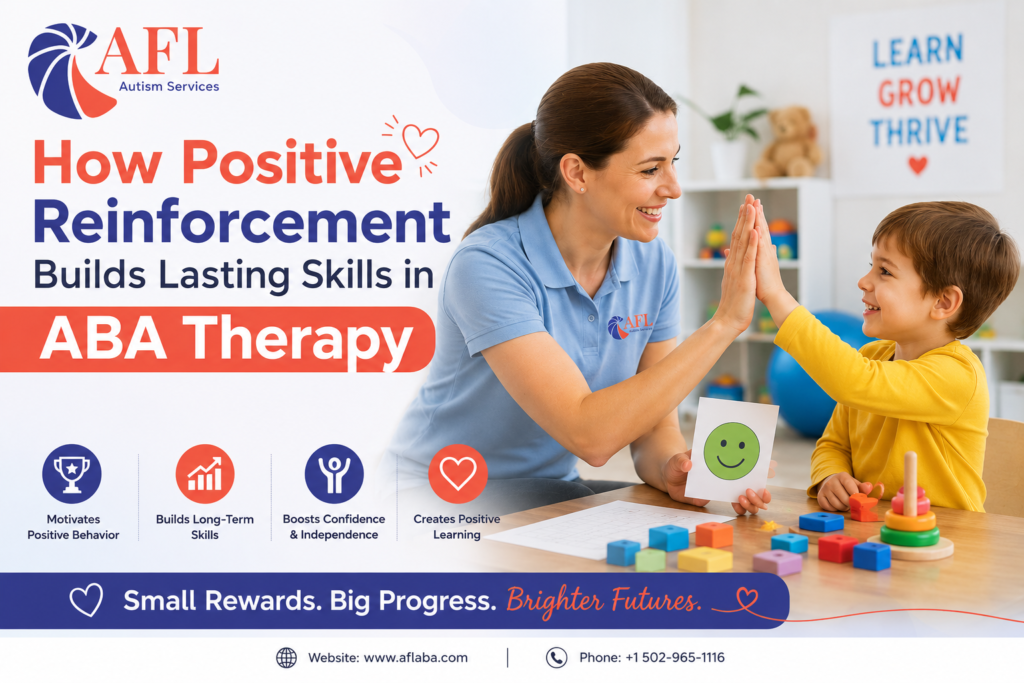

Every child learns best when their efforts are noticed and celebrated. A toddler taking first steps gets cheers from the whole family. A student solving a tough math problem gets praise from a teacher. Success that gets acknowledged tends to repeat itself, and that simple truth sits at the heart of one of the most powerful tools in ABA therapy: positive reinforcement.
For children with autism, positive reinforcement isn’t just encouragement. It’s a structured, evidence-based strategy that helps build communication, social, behavioral, and daily living skills in a way that feels rewarding rather than forced. Understanding how it works can help parents support their child’s progress both in therapy sessions and at home.
What Is Positive Reinforcement in ABA Therapy?
Positive reinforcement means adding something pleasant right after a desired behavior happens, which makes that behavior more likely to happen again. In ABA therapy, this could be praise after a child shares a toy, a favorite snack after completing a task, or extra playtime after following directions.
The goal is simple: increase behaviors that help a child grow, learn, and connect with others.
This is different from punishment, which tries to decrease unwanted behavior by introducing something unpleasant or removing something desired. ABA therapy leans heavily on reinforcement rather than punishment because research consistently shows that rewarding good behavior creates stronger, longer-lasting results than punishing unwanted behavior.
Modern ABA therapy is built around positive learning experiences. Children are far more likely to engage, try new skills, and tolerate challenges when therapy feels supportive rather than punitive. That’s why reinforcement, not correction, is the foundation of effective ABA.
Why Positive Reinforcement Is So Effective
Builds Motivation
When a behavior leads to something a child genuinely enjoys, they become more willing to try it again. A child who gets enthusiastic praise for making eye contact during a greeting is more likely to attempt that same behavior next time, simply because it felt good the first time.
Increases Skill Retention
Skills that are reinforced consistently tend to stick. Repetition paired with reward strengthens neural pathways associated with that behavior, which is part of why reinforcement-based learning tends to outperform rote drilling alone.
Improves Confidence
Every small win builds a child’s belief that they can succeed. A child who struggles with transitions but gets recognized for handling one calmly starts to see themselves as capable of managing change, not just told to.
Creates Positive Learning Experiences
Therapy sessions built around reinforcement feel encouraging rather than stressful. A child who associates therapy with praise, fun activities, and small rewards is more likely to stay engaged and look forward to sessions, which makes long-term progress far more achievable.
Types of Positive Reinforcement Used in ABA Therapy
Social Praise
This is often the simplest and most natural form of reinforcement. Examples include:
- Verbal encouragement like “Great job asking for that!”
- High-fives or fist bumps
- Specific, positive feedback such as “I love how you waited your turn”
Social praise works well because it mirrors how reinforcement happens in everyday life, at school, with friends, and within the family.
Activity-Based Reinforcement
Sometimes the most motivating reward is doing something a child loves. This might look like:
- A few minutes with a favorite game
- Extra time on a preferred activity
- Choosing the next task or game
Tangible Reinforcement
Physical rewards can be especially effective for younger children or those just beginning to build a new skill. Common examples include:
- Stickers
- Token systems that lead to a bigger reward
- Small, meaningful prizes
Natural Reinforcement
Over time, many skills become reinforcing on their own. A child who learns to ask for a toy and actually receives it experiences a natural reward built into the skill itself. This is often the long-term goal: behaviors that no longer need an external reward because the outcome itself is satisfying.
How BCBAs Identify Effective Reinforcers
Not every child responds to the same reward, which is why board-certified behavior analysts (BCBAs) spend real time figuring out what motivates each individual child.
This usually starts with a preference assessment, where a BCBA observes which toys, activities, snacks, or interactions a child naturally gravitates toward. From there, the therapist builds an individualized reinforcement plan tailored to that child’s interests and developmental needs, whether that’s delivered through Clinic-Based ABA Therapy or Home & Community-Based ABA Therapy.
Reinforcement isn’t a one-time decision. BCBAs monitor how a child responds over time and adjust the plan as preferences shift or as the child masters new skills. What worked last month may need to change next month, and that flexibility is part of what makes ABA therapy effective rather than formulaic.
Every child is different, and a reinforcement strategy that works beautifully for one child might do nothing for another. This individualized approach is one of the clearest examples of how ABA therapy adapts to the child rather than asking the child to adapt to a fixed program.
Real-Life Examples of Positive Reinforcement in Action
Communication Skills
A nonverbal child uses a picture card to request a snack instead of grabbing it. The therapist immediately hands over the snack along with enthusiastic praise. Over repeated trials, the child learns that communicating clearly leads to getting their needs met faster and more reliably than other behaviors might. For children who also show early communication delays, services like speech therapy often work alongside ABA to support this growth.
Daily Living Skills
A child who resists brushing their teeth starts the routine independently after a sticker chart is introduced, with a small reward after five consistent days. The behavior eventually becomes part of the daily routine, with or without the chart.
Social Skills
A child who typically plays alone initiates a simple interaction, like asking a peer to play. The therapist reinforces this with specific praise and a few extra minutes of the activity the child enjoys. Over time, initiating social contact becomes easier and more frequent.
Classroom Readiness
A child who struggles to sit still during instruction earns short breaks for following directions for set periods of time. As tolerance builds, the time between breaks increases, helping the child prepare for a typical classroom environment.
In each case, reinforcement isn’t just rewarding behavior. It’s teaching the child that the new skill leads to a meaningful, positive outcome.
Why Reinforcement Changes as Skills Improve
As a child masters a skill, the reinforcement plan around it should change too. This typically happens in a few ways:
Fading reinforcement means gradually reducing how often a reward is given as the behavior becomes more consistent, so the child isn’t dependent on constant external rewards.
Building independence is the larger goal behind fading. The aim is always for the child to perform a skill because it’s useful or rewarding on its own, not because a therapist is standing by with a reward every time.
Developing intrinsic motivation happens naturally for many skills. A child who learns to ask for help eventually finds that getting help feels good on its own, separate from any external reward.
Generalization across environments is the final piece. A skill that only shows up during therapy sessions isn’t fully learned. BCBAs work to make sure reinforced behaviors transfer to home, school, and community settings, which is part of why family involvement matters so much.
Common Misconceptions About Positive Reinforcement
“Positive reinforcement is just bribery.”
Bribery typically happens before a behavior, to stop something undesirable in the moment. Reinforcement happens after a desired behavior, and it’s part of a planned, consistent strategy designed to build skills over time. This distinction matters a lot during moments like handling tantrums in children, where it’s easy to confuse the two in the heat of the moment.
“Children become dependent on rewards.”
This is why fading reinforcement is so central to ABA therapy. The goal from day one is to move toward independence, not to keep a child reliant on rewards indefinitely.
“Reinforcement only works with young children.”
Reinforcement principles apply across ages. Teenagers and adults respond to reinforcement too, though what motivates them often looks different from what motivates a toddler.
“Reinforcement is the same for every child.”
As covered earlier, individualized reinforcement plans are central to ABA therapy. What works for one child may not work for another, and effective therapists adjust constantly.
How Parents Can Use Positive Reinforcement at Home
Reinforcement works best when it’s consistent across environments, which makes parent involvement essential. For a deeper look at this, our guide on how parents can support ABA therapy at home covers this in more detail. A few practical strategies:
Be consistent. Reinforce the same target behaviors the same way each time, at least while a skill is still developing.
Give immediate feedback. The closer the reward is to the behavior, the stronger the connection a child makes between the two.
Celebrate small successes. Progress in ABA therapy often happens in small steps. Recognizing those small wins keeps motivation high.
Build routines. Predictable routines make it easier to reinforce behaviors consistently, since both parent and child know what to expect.
Work closely with the BCBA. Ask what reinforcers are being used in therapy and how to apply similar strategies at home. Our parent resources and ABA Therapy Resource Hub are good starting points if you want to go further. Consistency between therapy and home life often accelerates progress.
Frequently Asked Questions
- What is the difference between reinforcement and rewards?
A reward is the item or experience given. Reinforcement is the process of using that reward, delivered consistently after a behavior, to increase how often that behavior happens. - How do therapists choose reinforcers?
BCBAs use preference assessments to observe what a child naturally enjoys, then build an individualized plan around those preferences, adjusting it as the child grows and develops. - Can positive reinforcement be used at home?
Yes, and it’s encouraged. Parents who reinforce the same skills targeted in therapy, using strategies guided by their child’s BCBA, often see faster, more consistent progress. - What happens if a reinforcer stops working?
Preferences change, especially in children. BCBAs regularly reassess what motivates a child and adjust the reinforcement plan so it stays effective. - Does positive reinforcement work for older children?
Yes. The types of reinforcers may shift toward things like privileges, social recognition, or independence, but the underlying principle works at any age.
Conclusion
Positive reinforcement is more than a therapy technique. It’s a way of helping children see their own progress as something worth celebrating. By rewarding communication, social interaction, daily living tasks, and behavioral growth, ABA therapy helps children build skills that last well beyond the therapy room.
Because every child responds differently, reinforcement strategies need to be personalized, monitored, and adjusted over time. With the right plan and consistent support from both therapists and family, children can build confidence, independence, and meaningful skills that carry into every part of their lives.
If you’re looking for evidence-based ABA therapy that uses positive reinforcement to help children develop communication, social, behavioral, and daily living skills, Adapt For Life – AFL Autism Services is here to help. Our experienced team creates personalized therapy plans designed to support meaningful progress and long-term success. Schedule a consultation or get started today, or call +1 502-965-1116 to learn more.