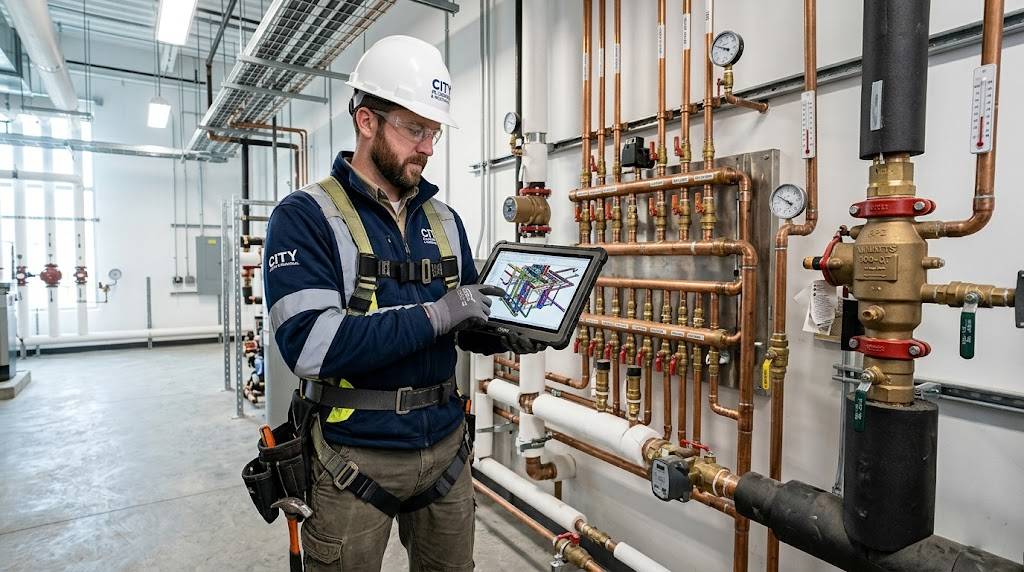

Cross connection control is one of the most consequential yet frequently misunderstood areas of plumbing compliance on commercial and institutional construction projects in the United States. When potable water systems connect improperly with non-potable sources, the resulting contamination risk is serious and in some cases irreversible. Plumbing contractors who understand how to identify, document, and eliminate cross connections are protecting public health, satisfying code authorities, and delivering installations that pass inspection the first time.
This article walks plumbing contractors, MEP engineers, general contractors, and BIM professionals through the practical standards, the code framework, and the modern coordination tools that make cross connection control manageable on today’s complex construction projects.
Understanding Cross Connections and Why They Matter
A cross connection is any physical link between a potable water supply and a source of contamination. That contamination source could be a chemical feed system, a reclaimed water line, a fire suppression system, a lawn irrigation loop, or a piece of process equipment. Under normal operating pressure, potable water flows outward and contamination stays isolated. But when pressure drops on the supply side due to a water main break, high demand, or a pump failure, backflow can occur. Contaminated water can be pulled into the potable supply and distributed through the building or into the municipal system.
The United States Environmental Protection Agency recognizes backflow from cross connections as a documented cause of drinking water contamination events. The consequences range from regulatory enforcement to public health incidents, and plumbing contractors who miss cross connection requirements during installation face liability that extends well beyond the construction phase.
The Code Framework Governing Cross Connection Control
Cross connection control in the United States is governed by a layered framework of model codes, state adoption, and local authority requirements. The primary model codes that address backflow prevention and cross connection control are the Uniform Plumbing Code (UPC), published by the International Association of Plumbing and Mechanical Officials, and the International Plumbing Code (IPC), published by the International Code Council.
Both codes reference the American Water Works Association standards on backflow prevention, particularly AWWA M14, which provides detailed guidance on cross connection control program administration, device selection, and testing requirements. Most state plumbing boards have adopted one of these model codes with local amendments, and many municipalities layer their own cross connection control ordinances on top of the state adoption.
Plumbing contractors must verify which code is in force in the project jurisdiction before design begins. This is not a step that can be deferred to the submittal phase. Device selection, installation requirements, and testing protocols vary between code editions and local amendments, and late-stage corrections to installed assemblies are expensive and disruptive.
Types of Backflow Prevention Assemblies and When to Apply Them
The code prescribes specific backflow prevention assemblies based on the degree of hazard associated with a given cross connection. Selecting the wrong device is a code violation even if a device is installed. Contractors need to understand the hierarchy of protection and apply it systematically across every connection in the potable water system.
Air Gap
An air gap is the highest level of protection available. It is a physical separation between the water supply outlet and the flood level rim of a receiving vessel. Air gaps are required where the hazard is severe, such as connections to boiler feed systems, chemical mixing tanks, and certain irrigation systems. They are simple, reliable, and require no mechanical maintenance, but they interrupt the continuity of a pressurized system and are not appropriate in every application.
Reduced Pressure Zone Assembly
The reduced pressure zone (RPZ) assembly is a testable mechanical device that protects against both back siphonage and backpressure in high-hazard applications. RPZ assemblies are required for connections to fire suppression systems with chemical additives, reclaimed water connections, medical gas panel connections, and other high-hazard applications. They require annual testing by a certified tester and must be installed with proper clearance for access and drainage.
Double Check Valve Assembly
The double check valve assembly (DCVA) is used for low-hazard cross connections where backpressure is a risk but the contamination potential is limited. Typical applications include lawn irrigation systems without chemical injection, fire suppression systems using potable water only, and connections to food service equipment. DCVAs are testable and require periodic inspection per code and local water utility requirements.
Pressure Vacuum Breaker and Atmospheric Vacuum Breaker
These devices protect against back siphonage only. Pressure vacuum breakers (PVB) are used on irrigation systems and hose bibs where the supply pressure does not fall below the device during operation. Atmospheric vacuum breakers (AVB) are simpler devices used in lower-risk scenarios and cannot be installed under continuous pressure. Both devices are non-testable assemblies with specific installation height requirements relative to the highest downstream outlet.
Using Plumbing Modeling and Coordination to Identify Cross Connections Before Construction
On complex commercial, healthcare, and institutional projects, identifying every potential cross connection from paper drawings alone is nearly impossible. Systems overlap, mechanical rooms are dense, and connections between trades are rarely captured comprehensively in traditional 2D documentation. This is where modern BIM workflows change the outcome for plumbing contractors.
Through dedicated plumbing modeling and coordination services, plumbing systems are built as intelligent 3D models that carry pipe material, service type, pressure zone, and connection data. When the potable water system, the reclaimed water system, the fire suppression system, and the mechanical systems are all modeled in the same federated environment, cross connection points become visible and documentable before a single pipe is installed.
This approach is especially valuable in healthcare facilities, laboratories, and food processing environments where the regulatory scrutiny of cross connection control is highest. The model becomes both a coordination tool and a compliance documentation resource that the plumbing contractor can present to the authority having jurisdiction (AHJ) during plan review.
How Clash Detection Supports Cross Connection Compliance
Clash detection is typically associated with spatial conflicts between ductwork, conduit, and piping. But in the context of cross connection control, clash detection serves a more specific compliance function. When plumbing systems are modeled with accurate service type data, a properly configured clash detection workflow can flag instances where potable and non-potable systems are routed in proximity without a documented backflow prevention device in the model.
Using a structured clash detection and coordination process, the plumbing contractor can run interference checks between the domestic water model and the reclaimed water, fire protection, and chemical feed models. The resulting clash reports identify locations where cross connection protection may be missing or where device placement conflicts with structural or mechanical clearance requirements.
This level of pre-construction analysis reduces the risk of failed inspections, required field modifications, and the documentation gaps that create problems during commissioning and occupancy. For plumbing contractors working under design-build contracts, it also provides a defensible record of the coordination effort that was performed before construction began.
BIM for Plumbing Contractors and the Documentation of Backflow Assemblies
One of the most practical applications of BIM for plumbing contractors in the context of cross connection control is the documentation and scheduling of backflow prevention assemblies. In a well-developed plumbing model, every RPZ, DCVA, PVB, and AVB can be tagged with its location, model number, installation date, required testing frequency, and the name of the certified tester responsible for annual inspection.
This data does not disappear when the project closes out. Owners and facilities managers can access the model to locate devices, schedule testing, and maintain the compliance records required by the local water utility and the AHJ. For plumbing contractors who offer this level of documentation as part of their delivery, it is a meaningful differentiator that supports long-term client relationships.
Contractors serving general contractors on large commercial projects will find that BIM-ready backflow assembly data supports the broader operations and maintenance handover package, which is increasingly a contract requirement on public and institutional projects.
Revit Modeling Service and Plumbing System Intelligence
The practical tool that most plumbing BIM workflows are built around is Autodesk Revit. A professional Revit modeling service delivers more than spatial coordination. It produces models where pipe systems are classified by service type, where device families carry manufacturer data and compliance parameters, and where the plumbing design intent is fully captured in a format that supports fabrication, installation, and commissioning.
For cross connection control specifically, Revit allows the plumbing contractor to model separate system types for domestic cold water, domestic hot water, reclaimed water, irrigation, fire suppression, and other services. When these systems are modeled with the correct system classification, Revit’s built-in analysis tools and third-party MEP analysis plugins can check for unprotected connections between systems of different classifications.
This capability is not limited to large firms. Plumbing contractors of all sizes can access Revit-based services through specialized BIM partners who focus on MEP 3D modeling and can develop plumbing models that are coordination-ready from the first submittal.
MEP Coordination and the Plumbing Contractor’s Role in Cross Connection Reviews
Cross connection control is not a solo discipline. On projects with complex mechanical, electrical, and plumbing systems, the connections that create cross connection risk often occur at the interface between plumbing and mechanical scope. Chilled water systems, steam condensate returns, boiler makeup water connections, and cooling tower makeup feeds all represent potential cross connections that must be evaluated, documented, and protected.
Participating actively in the MEP coordination process allows plumbing contractors to identify these interface points early and confirm that backflow prevention devices are included in the design before shop drawings are finalized. It also ensures that clearance requirements for testable assemblies are met, that drain provisions for RPZ assemblies are coordinated with the mechanical room drainage layout, and that access panels are located correctly for inspection and testing.
Plumbing contractors who wait until construction is underway to raise cross connection issues are putting themselves in the position of either installing noncompliant systems or absorbing the cost of field corrections. Early participation in MEP coordination through the BIM for plumbing contractors process eliminates that risk.
Practical Steps for Applying Cross Connection Standards on Every Project
Regardless of project size or delivery method, plumbing contractors can establish a consistent approach to cross connection control that satisfies code requirements and supports efficient inspection and closeout.
- Confirm the applicable plumbing code and local cross connection control ordinance before design begins
- Conduct a systematic hazard assessment for every point where the potable water system connects to any other system or equipment
- Select backflow prevention assemblies based on the documented degree of hazard at each connection, not on contractor preference or product availability
- Coordinate testable assembly locations with the MEP team to ensure proper clearance, drainage, and access panel placement
- Document every cross connection and its protection device in the plumbing model, including manufacturer data and testing requirements
- Submit the cross connection control plan to the AHJ during plan review and incorporate any required modifications before installation begins
- Ensure that commissioned systems are tested by a certified backflow tester before occupancy and that test reports are delivered to the owner and water utility
Conclusion
Cross connection control is a code requirement, a public health obligation, and an increasingly important differentiator for plumbing contractors who want to deliver projects that close out without compliance issues. By understanding the code framework, selecting the right backflow prevention assemblies, and using modern plumbing modeling and coordination workflows to identify and document cross connections before construction, contractors can build systems that protect occupants, satisfy inspectors, and provide facility managers with the documentation they need to maintain compliance throughout the life of the building.
The tools available to plumbing contractors today, from Revit-based modeling services to coordinated MEP clash detection workflows, make the process of cross connection control planning faster and more accurate than it has ever been. Contractors who adopt these practices are not just meeting code. They are raising the standard for what professional plumbing delivery looks like on US construction projects.