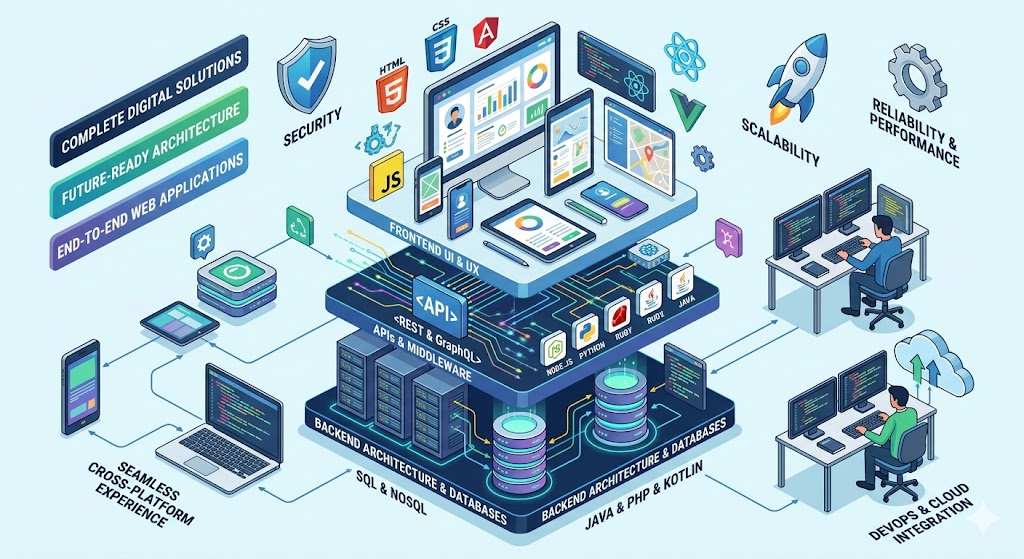

Modern businesses operate in an increasingly digital environment where customer expectations, operational efficiency, and data-driven decision-making determine long-term success. Traditional websites that simply display information are no longer sufficient for organizations aiming to stay competitive. Instead, businesses are investing in modern web applications that provide interactive experiences, automate workflows, improve collaboration, and support business growth. Whether serving customers through online portals, managing internal operations, or integrating multiple business systems, web applications have become essential assets for organizations of every size.
As cloud technologies, responsive frameworks, and secure development practices continue to evolve, businesses can deploy scalable applications that adapt to changing market demands without compromising performance. Companies across retail, healthcare, finance, manufacturing, education, and professional services increasingly rely on custom web applications to improve productivity and customer satisfaction. This article explores how modern web applications enhance business performance, examines practical use cases, discusses emerging industry trends, and provides actionable insights to help organizations maximize their digital investments.
How Modern Web Applications Drive Business Growth
Modern web applications go far beyond presenting static content. They create dynamic platforms where customers, employees, suppliers, and management interact in real time. Unlike traditional software that often requires installation and manual updates, web applications run through browsers and remain accessible across desktops, tablets, and smartphones. This flexibility improves accessibility while reducing maintenance costs.
Smarter Operations Through Automation
One of the greatest advantages of modern web applications lies in automation. Businesses can streamline repetitive tasks such as customer onboarding, invoice generation, appointment scheduling, inventory management, and reporting. Automation minimizes human error while allowing employees to focus on strategic activities that contribute greater value.
Modern applications also integrate seamlessly with enterprise systems, payment gateways, CRM platforms, ERP software, marketing tools, and cloud storage solutions. These integrations eliminate duplicate data entry and improve collaboration between departments. Managers gain access to centralized dashboards with real-time insights, enabling faster decisions based on accurate business data.
Additionally, advanced security features such as encrypted communication, role-based access control, multi-factor authentication, and automated backups help protect sensitive information while ensuring compliance with industry standards.
Benefits, Applications, or Key Insights
Organizations that embrace digital transformation often experience measurable improvements in productivity, customer engagement, and operational efficiency. Businesses investing in full stack application development services can build scalable platforms that combine responsive user interfaces, secure backend architecture, cloud infrastructure, and seamless third-party integrations within a unified development approach. This comprehensive strategy enables organizations to launch reliable applications that evolve alongside changing business requirements.
Modern web applications create value across multiple business functions, including customer service, sales, operations, finance, and marketing. Common advantages include:
- Faster business processes through workflow automation.
- Improved customer engagement with personalized experiences.
- Real-time analytics for informed business decisions.
- Better scalability to support business expansion.
- Stronger security with modern authentication and encryption.
Practical Examples and Best Practices
Consider an e-commerce company experiencing rapid growth during seasonal sales. A modern web application automatically updates inventory, processes secure payments, manages shipping integrations, and provides customers with real-time order tracking. Instead of manually coordinating every transaction, employees monitor operations through centralized dashboards, significantly improving efficiency.
Similarly, a healthcare provider can implement a secure patient portal where appointments, medical records, prescriptions, and billing information remain accessible in one location. Patients enjoy greater convenience while administrative teams reduce paperwork and scheduling conflicts.
Manufacturing companies also benefit by connecting production planning, warehouse management, supplier coordination, and quality control into one integrated platform. Managers receive live production updates, identify bottlenecks quickly, and make operational adjustments before delays affect customers.
To maximize results, businesses should prioritize user experience during development. Applications should load quickly, support mobile devices, maintain intuitive navigation, and undergo regular security testing. Continuous performance monitoring, user feedback analysis, and feature enhancements ensure applications remain valuable as business needs evolve.
Challenges, Trends, or Future Outlook
Although modern web applications deliver significant advantages, successful implementation requires thoughtful planning. Organizations often face challenges involving legacy system integration, cybersecurity risks, evolving compliance requirements, and user adoption. Poor planning may result in performance bottlenecks, scalability limitations, or costly redevelopment projects later.
- Define Clear Project Goals: Establish well-defined business objectives before development to ensure the web application aligns with organizational needs and delivers measurable results.
- Choose Scalable Technologies: Select modern, scalable technology stacks that support future business growth, high performance, and easy feature expansion.
- Perform Comprehensive Testing: Conduct rigorous functional, security, performance, and usability testing to identify and resolve issues before deployment.
- Maintain Regular Updates: Keep the application secure, optimized, and compatible with evolving technologies through continuous software updates and maintenance.
- Invest in Employee Training: Provide proper training to help employees confidently adopt new digital platforms and maximize productivity.
- Adopt Progressive Web Applications (PWAs): Leverage PWAs to deliver fast, reliable, and app-like user experiences without requiring users to download applications.
- Utilize Cloud-Native Architecture: Implement cloud-based infrastructure to improve scalability, reliability, flexibility, and disaster recovery capabilities.
- Embrace API-First Development: Integrate multiple business systems seamlessly using APIs, enabling faster expansion and improved operational efficiency.
- Incorporate Intelligent Technologies: Integrate AI-powered search, predictive analytics, personalized recommendations, voice interfaces, and advanced cybersecurity to enhance customer experiences and support smarter business decisions.
- Focus on Continuous Innovation: Treat web applications as evolving business assets by regularly introducing new features, optimizing performance, and adapting to changing customer expectations and market trends.
Businesses that continuously modernize their digital infrastructure will remain better positioned to respond to changing customer expectations, competitive pressures, and technological advancements. Rather than viewing web applications as one-time projects, successful organizations treat them as long-term business assets that evolve through continuous improvement and innovation.
Conclusion
Modern web applications have transformed the way organizations operate by improving efficiency, enhancing customer experiences, strengthening security, and supporting data-driven decision-making. Businesses that invest in scalable, user-friendly, and well-integrated digital platforms gain greater flexibility to adapt to changing market conditions while reducing operational complexity. Choosing experienced technology partners such as Vedx Solutions can help organizations build reliable web applications that align with business objectives and future growth plans. By combining thoughtful planning, modern technologies, continuous optimization, and a customer-focused approach, companies can create digital solutions that deliver measurable business value and establish a strong competitive advantage in today’s rapidly evolving marketplace.
Frequently Asked Questions (FAQs)
- What is a modern web application?
A modern web application is an interactive, browser-based software solution that enables users to perform tasks, access services, and manage information securely from multiple devices. - How do web applications improve business performance?
They automate repetitive processes, improve collaboration, enhance customer experiences, provide real-time insights, and increase overall operational efficiency. - Are modern web applications suitable for small businesses?
Yes. Small businesses benefit from improved productivity, lower operational costs, better customer engagement, and scalable solutions that support future growth. - How important is security in web application development?
Security is essential because it protects customer information, prevents cyber threats, supports regulatory compliance, and builds long-term business trust. - What should businesses consider before developing a web application?
Businesses should define clear objectives, understand user requirements, choose scalable technologies, prioritize security, and plan for continuous maintenance and future enhancements.