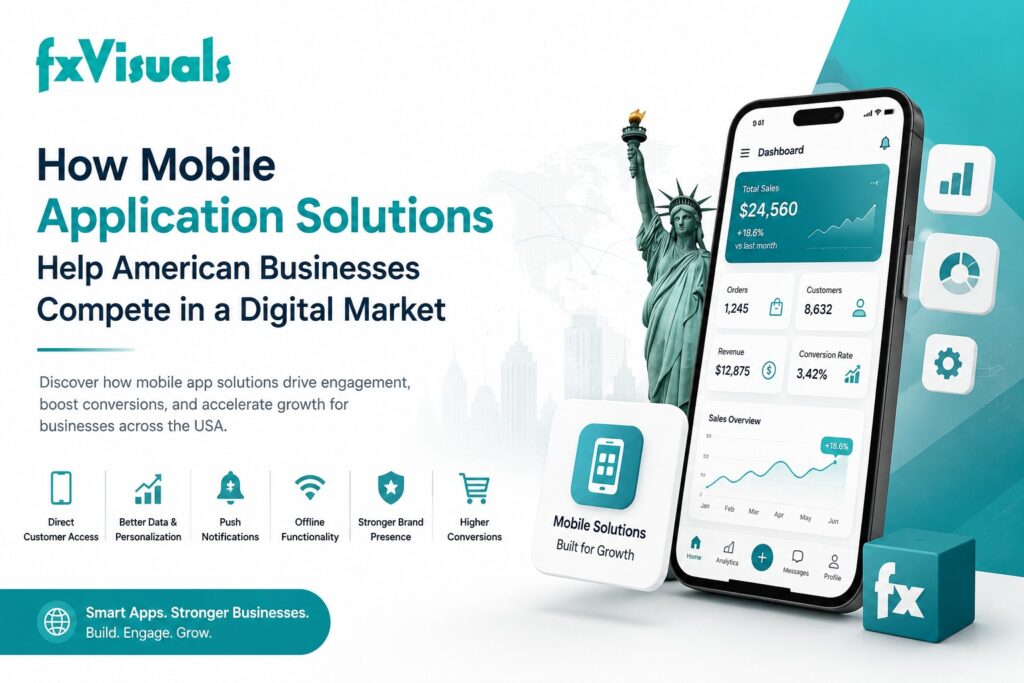

American consumers now spend most of their online time inside apps, not browsers. If your business doesn’t show up on their phone, you’re losing ground to a competitor who does. That’s the reality driving demand for mobile application solutions across every industry, from retail and healthcare to real estate and logistics.
This guide breaks down why mobile apps matter for US businesses right now, what makes a mobile app strategy actually work, and how to avoid the mistakes that sink most app projects before they ever launch.
Why Mobile Application Solutions Matter for American Businesses
The US mobile market is one of the most competitive in the world. Shoppers compare prices in-app while standing in a store. Patients book doctor visits from their phone. Diners order food before they’ve even left work. If a business doesn’t offer a smooth mobile experience, customers move to one that does, often within seconds.
Mobile application solutions give businesses a direct, always-on channel to their customers. Unlike a website that depends on someone remembering to visit, an app sits on a customer’s home screen, sends push notifications, and works even with a spotty connection. That level of access is why companies of every size, from local service providers to national retailers, are treating mobile app development as a core part of their growth strategy rather than a nice-to-have.
There’s also a competitive pressure angle. When your direct competitors launch apps and you don’t, you’re not just missing an opportunity, you’re actively losing market share to businesses that made the investment first.
What Are Mobile Application Solutions?
Mobile application solutions refer to the full range of services involved in planning, designing, building, testing, and maintaining a mobile app for iOS, Android, or both. This isn’t just writing code. A complete solution typically covers:
- Market and user research to define what the app needs to do
- UI/UX design tailored to mobile screens and touch interaction
- Backend development, APIs, and database architecture
- Native or cross-platform development
- Quality assurance and device testing
- App store submission and compliance
- Post-launch support, updates, and analytics
Businesses that only think about the “build” phase often get blindsided by everything else that goes into keeping an app running, secure, and relevant. That’s why working with a team that offers end-to-end mobile application solutions, rather than piecing together freelancers for each stage, tends to produce better long-term results.
Key Benefits of Investing in Mobile App Development
Direct Customer Access
Apps skip the noise of email inboxes and social feeds. A push notification about a flash sale or appointment reminder lands directly on a customer’s lock screen.
Better Customer Data and Personalization
Apps collect behavioral data (what users browse, how long they stay, what they buy) that lets businesses personalize offers and content in ways a generic website can’t match.
Stronger Brand Presence
An app icon on a customer’s home screen is a constant, low-effort reminder of your brand. That kind of visibility is hard to replicate through ads alone.
Offline Functionality
Native and hybrid apps can work without a live internet connection, which matters for field service teams, delivery drivers, or users in low-connectivity areas.
Competitive Differentiation
In crowded US markets like healthcare, real estate, and hospitality, a well-built app can be the deciding factor that separates a business from competitors offering only a website.
Revenue Growth
Faster checkout, in-app purchases, loyalty programs, and personalized recommendations all tend to increase conversion rates compared to mobile web experiences.
Real-World Use Cases Across Industries
Retail and E-commerce: In-app product recommendations, one-tap checkout, and loyalty rewards drive repeat purchases and reduce cart abandonment.
Healthcare: Patient portals, telehealth scheduling, and secure messaging between doctors and patients improve care access while cutting administrative overhead.
Real Estate: MLS and IDX-integrated apps let buyers search listings, schedule tours, and get instant notifications when new properties match their criteria.
Hospitality: Hotel and restaurant apps handle bookings, digital check-in, and personalized offers based on guest history.
Education: School and university apps manage fee collection, grade tracking, and parent-teacher communication in one place.
Logistics and Field Services: Route optimization, offline data capture, and real-time job updates keep mobile teams productive without constant office check-ins.
Best Practices for Building a Competitive Mobile App
Start with a clear user problem, not a feature list. The best apps solve one core problem well before expanding into extras.
Design for mobile-first interaction. Touch targets, thumb reach, and load speed matter more on mobile than desktop equivalents.
Prioritize security from day one. Especially for apps handling payments, health data, or personal information, security can’t be bolted on after launch.
Test across real devices, not just simulators. Screen sizes, OS versions, and hardware vary widely across the US market.
Plan for post-launch maintenance. OS updates, security patches, and user feedback loops are ongoing, not one-time tasks.
Optimize app store listings. Strong ASO (App Store Optimization) with the right keywords, screenshots, and reviews affects discoverability as much as the app’s actual quality.
Integrate analytics from the start. You can’t improve what you don’t measure. Track engagement, drop-off points, and conversion paths from launch day.
Common Mistakes Businesses Make with Mobile Apps
- Skipping user research and building based on internal assumptions instead of actual customer behavior
- Choosing the wrong development approach (native vs hybrid vs PWA) without weighing long-term costs
- Underestimating maintenance costs, treating the app as a one-time project instead of an ongoing product
- Ignoring app store guidelines, which leads to rejected submissions and launch delays
- Overloading the app with features instead of nailing the core use case first
- Neglecting performance testing, resulting in slow load times that drive users to uninstall
- Failing to plan a marketing strategy for app launch, assuming the app store alone will drive downloads
Avoiding these mistakes often comes down to working with an experienced mobile application solutions partner who has already seen where these projects tend to go wrong.
How to Choose the Right Mobile App Development Partner
Not every development team is equipped to handle the full scope of mobile application solutions. When evaluating a partner, look for:
- A portfolio of apps across multiple industries, not just one niche
- Experience with both native and cross-platform development
- A clear process for design, build, testing, and launch
- Transparent communication and a dedicated project contact
- Post-launch support and maintenance plans, not just a handoff at launch
Agencies like fxVisuals approach mobile application solutions as end-to-end partnerships, covering everything from custom mobile app development to ongoing support after launch. That kind of full-cycle involvement tends to produce apps that hold up long after the initial release, rather than needing a costly rebuild a year in.
If your business is also rethinking its broader digital presence, pairing mobile app development with professional website design and development and a solid search engine optimization strategy creates a more consistent experience across every channel your customers use to find you.
Final Thoughts
Mobile application solutions aren’t just a technical upgrade, they’re a direct response to how American consumers actually behave: on their phones, expecting fast, personalized, always-available service. Businesses that treat mobile app development as a strategic investment, backed by real user research and ongoing support, are the ones pulling ahead of competitors still relying on a website alone.
If you’re ready to explore what a mobile application solution could look like for your business, get in touch with the fxVisuals team for a free consultation, or request a quote to get a clear picture of scope, timeline, and cost for your project.
Frequently Asked Questions
What are mobile application solutions?
Mobile application solutions cover the full process of planning, designing, developing, testing, and maintaining a mobile app, including native, hybrid, and AI-based applications built for iOS and Android.
How long does it take to build a mobile app?
A basic app can take 8 to 12 weeks, while more complex apps with custom integrations, AI features, or multi-platform builds can take several months.
Should my business build a native app or a hybrid app?
It depends on your priorities. Native apps offer the best performance and deepest access to device features, while hybrid apps save cost and time by using a single codebase for both iOS and Android.
Do small businesses need a mobile app?
Not always immediately, but if customers frequently interact with your business on mobile (booking, ordering, browsing), an app or PWA can meaningfully improve retention and conversion compared to mobile web alone.
What’s the difference between mobile app development and mobile application solutions?
Mobile app development typically refers to the technical build phase, while mobile application solutions is the broader term covering strategy, design, development, testing, launch, and ongoing support.
How do businesses measure ROI from a mobile app?
Common metrics include user retention rate, session length, in-app conversion rate, customer acquisition cost through the app, and revenue generated through app-exclusive features or promotions.