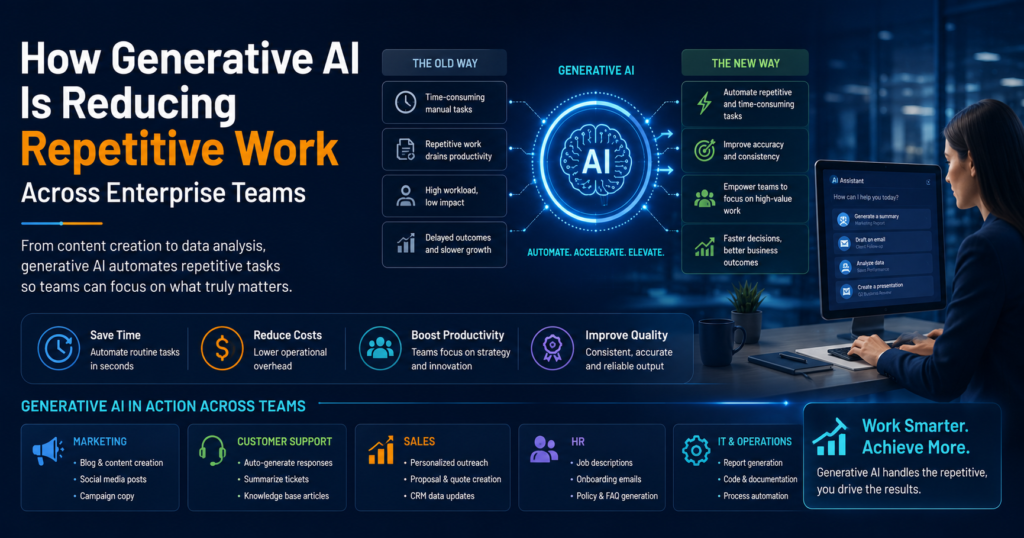

Salesforce research puts a hard number on a problem most support leaders already feel: 66% of customer service time is currently spent on non-customer-facing tasks, work that adds no value the customer ever sees. That pattern repeats across nearly every enterprise function. Sales reps spend roughly 70% of their week on admin instead of selling. Knowledge workers lose hours a week to email triage, status updates, and manual data entry that exists purely to keep systems in sync with each other.
Generative AI’s real enterprise value isn’t in flashy chatbots or one-off content generation. It’s in quietly absorbing the repetitive, low-judgment work that eats the majority of a knowledge worker’s week, freeing people for the work that actually requires their expertise. Done well, this is measurable: a Quarterly Journal of Economics field study of over 5,000 customer support agents found generative AI assistance raised productivity by 14% on average, with novice agents improving by as much as 34%. Done poorly, generative AI becomes just another tool employees have to manage on top of their existing workload, which is exactly why custom generative AI solutions, built around a specific team’s actual workflows rather than generic off-the-shelf prompts, are becoming the differentiator between organizations that capture this value and those that don’t.
Why Repetitive Work Is Holding Enterprise Teams Back
Repetitive work isn’t just tedious. It’s expensive in ways most organizations don’t measure directly:
- It consumes the majority of the workweek for roles that should be judgment-heavy. Sales, support, HR, and IT teams all report the same pattern: the highest-value activity (selling, resolving complex issues, strategic hiring decisions, solving hard technical problems) gets squeezed into a minority of available hours.
- It burns out skilled employees on unskilled tasks. Asking an experienced analyst to manually reformat reports or a senior support rep to answer the same FAQ for the hundredth time wastes exactly the expertise the organization is paying for.
- It scales badly. Manual processes that work at 50 tickets a day break down at 500, forcing headcount growth that tracks volume growth linearly instead of letting the organization grow output without growing cost at the same rate.
- It’s inconsistent. Manual, repetitive tasks performed by different people on different days produce different quality, which shows up downstream as customer complaints, compliance gaps, or onboarding delays no one can trace back to a root cause.
How Generative AI Is Changing Everyday Business Operations
Generative AI’s shift in enterprise operations isn’t about replacing entire job functions. It’s about absorbing the parts of a role that don’t require human judgment, so the parts that do get more attention. Microsoft’s 2026 Work Trend Index, surveying 20,000 knowledge workers, found 66% say AI has let them spend more time on high-value work, and 58% say they’re producing output they couldn’t have produced a year ago.
The Federal Reserve Bank of St. Louis puts a number on the average time recovered: generative AI users save roughly 5.4% of their weekly work hours, about 2.2 hours in a standard 40-hour week. That number understates the ceiling, though. Daily, heavy users of well-integrated AI tools report saving four or more hours a week, since the gains compound the more a tool is woven into actual daily workflow rather than used occasionally for isolated tasks.
Tasks That Generative AI Can Automate Across Departments
Content Creation
Drafting first versions of reports, marketing copy, internal documentation, and routine correspondence is one of the clearest wins. The human role shifts from originating every draft to reviewing and refining one, which is a fundamentally faster task.
Customer Support
AI-assisted ticket triage, suggested response drafting, and knowledge-base retrieval let support teams resolve more tickets without expanding headcount proportionally. Gains concentrate heavily among newer agents: the same QJE research found novice support agents improved productivity by 34%, while experienced agents saw far smaller gains, since they already carried much of that knowledge in their heads.
Sales and CRM
Generative AI drafts personalized outreach based on account context, summarizes call notes directly into CRM fields, and flags deals showing risk signals, cutting into the roughly 70% of a rep’s week that currently goes to non-selling activity.
HR and Employee Onboarding
Generating first-draft job descriptions, answering routine policy questions, and auto-populating onboarding paperwork and training schedules reduces the manual coordination load that typically falls on a small HR team supporting a much larger headcount.
IT and Internal Operations
AI-assisted ticket categorization, first-pass troubleshooting suggestions, and auto-generated documentation for routine fixes reduce the volume of low-complexity tickets that otherwise consume a disproportionate share of an IT team’s time.
Business Benefits of AI-Driven Workflow Automation
- Time recovered scales with adoption depth. Organizations that redesign workflows around AI rather than bolting AI onto existing processes see meaningfully larger returns. McKinsey found workflow redesign is the single factor most correlated with EBIT impact from AI, yet only 21% of adopters have actually done it, which is exactly why most pilots underdeliver.
- Consistency improves. AI-assisted first drafts and responses reduce the variance that comes from different people handling the same task differently.
- Faster onboarding and ramp time for new employees, since AI-assisted workflows carry more institutional knowledge in the tool itself rather than solely in senior employees’ heads.
- Better capacity utilization. Recovered hours get redirected to work that actually grows the business, rather than simply cutting headcount, which is the pattern most organizations report choosing.
- Reduced burnout on repetitive tasks, which shows up in retention numbers over time even though it rarely gets tracked as a direct AI ROI metric.
Common Challenges and Considerations Before AI Adoption
The gap between AI’s proven task-level gains and disappointing enterprise-level results is well documented, and it’s worth taking seriously before any rollout. MIT NANDA’s 2025 State of AI in Business report found only 5% of enterprise generative AI pilots reach measurable profit-and-loss impact, with the rest stalling in what researchers call pilot purgatory. The most common reasons include:
- Generic tools applied to specific workflows. Off-the-shelf AI assistants that don’t retain context or adapt to a team’s actual process tend to plateau quickly, since they can’t learn the nuances that make a workflow specific to one organization.
- Poor output quality creating hidden costs. Stanford and BetterUp researchers documented a phenomenon they call “workslop,” AI-generated content that’s low-effort or low-quality enough that a colleague has to spend nearly two hours per incident deciphering, correcting, or redoing it. That correction time can quietly erase the time savings the AI was supposed to deliver.
- No workflow redesign. Layering AI on top of an unchanged process rarely produces the gains organizations expect; the value comes from rethinking the process itself around what AI can now do.
- Underestimating the ramp-up period. Meaningful productivity gains typically take longer to materialize than leadership expects, often a matter of weeks, not days, as employees learn to trust and properly use new tools.
- Skipping governance and review structures. Deploying generative AI without clear guardrails on when human review is required creates quality and compliance risk that erodes trust in the tool faster than any efficiency gain can offset.
How Custom Generative AI Solutions Deliver Better Business Outcomes
Generic AI tools are built to be broadly useful, which means they’re rarely deeply useful for any one organization’s specific processes. A custom generative AI solution is built around the actual data, systems, and workflow logic a team already uses, which closes exactly the gap MIT NANDA’s research identifies as the core reason most pilots stall: the top barrier isn’t model quality, it’s that most enterprise tools don’t retain feedback, adapt to context, or improve with use.
A custom solution built for a specific department, say, one that integrates directly with an existing CRM, support ticketing system, or HR platform, can:
- Pull real context from internal systems rather than requiring employees to manually paste information into a generic chat interface.
- Apply company-specific formatting, tone, and compliance rules automatically, rather than requiring manual correction on every output.
- Learn from feedback loops specific to that workflow, improving over time instead of remaining static.
- Integrate directly into existing tools, so adoption doesn’t require employees to change how they already work, which is consistently the biggest driver of actual usage versus a tool that gets tried once and abandoned.
Organizations that buy from or build with specialized implementation partners rather than attempting fully generic, self-service deployment report succeeding at meaningfully higher rates, largely because the workflow-specific tuning that separates a working pilot from a stalled one requires expertise most internal teams haven’t built yet.
Real-World Enterprise Use Cases
- Customer support teams deploying AI-assisted response drafting integrated directly with their ticketing system see faster resolution times, with the largest gains concentrated among newer agents who benefit most from AI surfacing institutional knowledge they haven’t built up yet.
- Sales organizations using AI that pulls live CRM and account data into personalized outreach drafts recover meaningful selling time from what was previously spent on manual research and note-taking.
- HR teams at fast-growing companies use custom AI tools integrated with their applicant tracking and onboarding systems to handle first-draft job postings, policy Q&A, and onboarding document generation, reducing the coordination burden on a support function that rarely scales headcount at the same pace as the rest of the company.
- IT service desks use AI-assisted ticket triage tied directly into their ticketing platform to auto-categorize and suggest resolutions for routine issues, freeing technical staff to focus on the complex tickets that actually require their expertise.
Preparing Your Organization for AI-Powered Workflows
- Map the actual workflow before choosing a tool. Understanding exactly where time currently goes is the only reliable way to target AI at the highest-impact repetitive tasks rather than the most visible ones.
- Set a realistic ramp-up expectation. Meaningful productivity gains typically take weeks, not days, and treating week one results as the final verdict leads to premature abandonment of tools that would have worked.
- Build in human review where it matters. Not every output needs sign-off, but high-stakes outputs, customer-facing communication, compliance documentation, should have a clear review step defined from day one.
- Choose integration depth over feature breadth. A tool that connects deeply to the systems a team already uses will get adopted; a powerful tool that requires switching context to a separate interface usually won’t.
- Redesign the workflow, don’t just add a tool to it. The organizations capturing the largest gains are the ones that rebuilt the process around what AI now makes possible, not the ones that bolted a chatbot onto an unchanged process.
Conclusion
The organizations winning with generative AI aren’t the ones chasing the flashiest use case. They’re the ones treating AI as infrastructure for absorbing the repetitive work that’s been quietly consuming the majority of their teams’ time for years, and building or buying tools specific enough to their actual workflows to deliver on that promise. The data on generic pilots is sobering: most stall before they ever reach measurable business impact. But the data on well-integrated, workflow-specific deployments is just as clear in the other direction. Custom generative AI solutions built around a team’s real systems and processes are what separate organizations quietly recovering hours a week per employee from the ones stuck explaining why last year’s AI initiative never delivered the ROI it promised.