
Every parent has had that moment. Your child melts down, throws something, or shuts down completely, and you’re left wondering why. It can feel random. It almost never is.
Behavior is communication. A child who screams when asked to clean up, or who repeats the same hand movement for minutes at a time, is telling you something, even if they don’t have the words for it yet. The challenge for parents and therapists alike is figuring out what that “something” actually is.
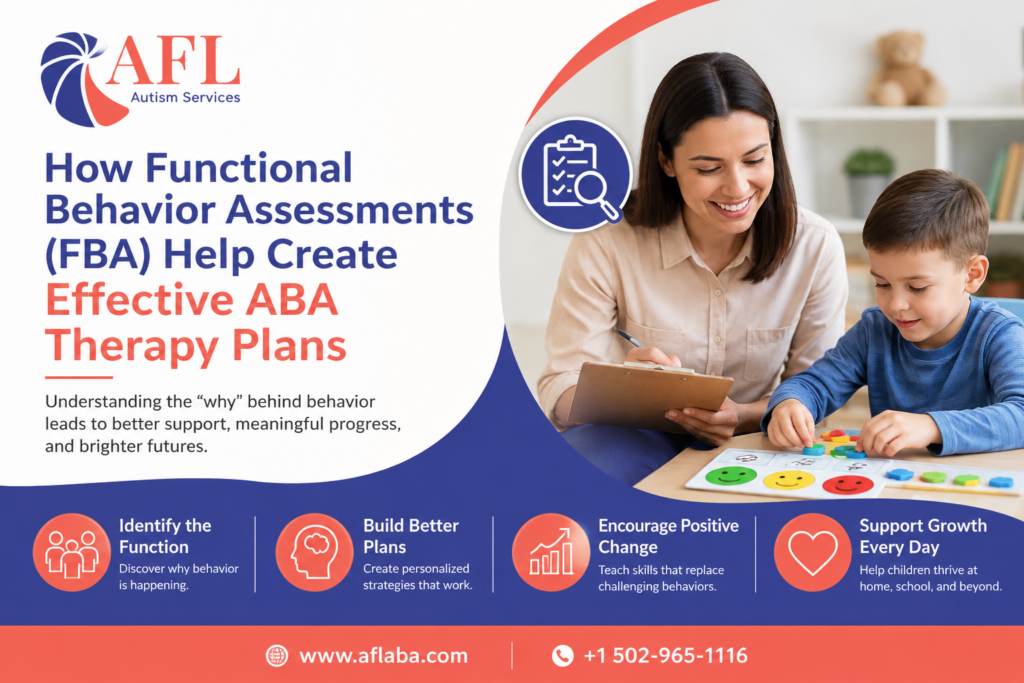
That’s where a Functional Behavior Assessment comes in. It’s the process that turns confusing behavior into useful information, and it’s the foundation that good ABA therapy plans are built on.
What Is a Functional Behavior Assessment (FBA)?
A Functional Behavior Assessment, or FBA, is a structured way of figuring out why a behavior is happening. Not just what the behavior looks like, but what’s driving it.
Most people’s first instinct when a child acts out is to try to stop the behavior. Take away the tablet. Give a time-out. Say “no” more firmly. The problem is that these responses treat the symptom, not the cause. If a child is hitting because he can’t ask for a break from a hard task, punishing the hitting won’t teach him how to ask for that break. The hitting might stop for a day and come back worse next week.
An FBA flips the approach. Instead of asking “how do we make this stop,” it asks “what is this behavior doing for the child.” Once you know that, you can teach a better way to get the same need met.
This is also why FBAs matter so much for E-E-A-T in the autism therapy world: they’re not guesswork. They rely on direct observation, data, and trained clinical judgment, usually from a Board Certified Behavior Analyst (BCBA). It’s evidence-based, not a hunch.
Why Do Challenging Behaviors Happen?
Behavior analysts generally group the reasons behind behavior into four categories. Almost every challenging behavior fits into one of these, sometimes more than one.
Seeking Attention
Some behaviors exist because they reliably get a reaction from other people, even if the reaction is negative.
Example: A seven-year-old starts making loud noises every time his mom is on the phone. It’s not that he enjoys annoying her. He’s learned that the noise gets her to stop her call and look at him. The attention, good or bad, is the reward.
Escaping or Avoiding Tasks
A behavior that helps a child get out of something they don’t want to do.
Example: During a worksheet activity at school, a child starts crying and pushing the paper away. The teacher, trying to calm him down, ends up shortening the assignment. Without meaning to, she’s just taught him that crying gets him out of work.
Access to Tangible Items
This is about wanting an object or activity, and using behavior to get it.
Example: A child grabs another kid’s toy and screams when it’s taken back. The behavior isn’t about the other child at all. It’s about wanting that specific toy, right now.
Sensory or Automatic Reinforcement
Some behaviors feel good or regulating to the child regardless of who’s around or what’s happening.
Example: A child rocks back and forth or flaps his hands when he’s excited or overwhelmed. There’s no audience needed and no item involved. The behavior itself is the reinforcement.
How BCBAs Conduct a Functional Behavior Assessment
A real FBA isn’t a quick checklist. It’s a process that usually takes place over several sessions and pulls information from multiple sources.
Direct Observation
The BCBA watches the child in the settings where the behavior actually happens, whether that’s at home, school, or during therapy. They’re not just counting how often something occurs. They’re watching what happens right before and right after.
Parent and Caregiver Interviews
Parents see things no one else does. A BCBA will ask detailed questions: When does this happen most? What have you already tried? Does it happen more when he’s tired, hungry, or in certain rooms? These conversations often surface patterns parents hadn’t connected before.
Teacher Collaboration
If the behavior shows up at school, teacher input is critical. A behavior that looks one way at home can look completely different in a classroom with twenty other kids and a fixed schedule.
ABC Data Collection (Antecedent, Behavior, Consequence)
This is the core data tool of an FBA. For every instance of the behavior, the team records:
- The Antecedent: what happened right before
- The Behavior: exactly what the child did
- The Consequence: what happened right after
Over time, this builds a clear picture. If “Consequence” keeps showing the same outcome, like the child getting sent home or getting a preferred snack, that’s a strong clue about the behavior’s function.
Identifying Behavior Patterns
Once enough data is collected, the BCBA looks for trends. Maybe the behavior spikes during transitions. Maybe it only happens with one specific teacher. Maybe it’s tied to hunger or fatigue. These patterns are what shape the actual therapy plan.
How FBA Results Create Better ABA Therapy Plans
Once the function of a behavior is clear, everything downstream becomes more targeted.
Prioritizing treatment goals. Instead of trying to address ten behaviors at once, the team can focus first on the ones that are most disruptive or most likely to escalate, and tackle them in a logical order.
Teaching replacement behaviors. This is one of the most important outcomes of an FBA. If a child hits to escape a task, therapy might teach him to hand over a “break” card instead. He still gets the escape, just through a behavior that works better for everyone.
Reducing challenging behaviors. When the underlying need is being met in an appropriate way, the original behavior naturally has less reason to occur.
Improving communication. Many challenging behaviors fade once a child has a reliable way to express needs, whether that’s through words, signs, or a communication device.
Supporting independence. Over time, kids who can communicate their needs and tolerate frustration appropriately need less direct intervention and can function more independently across settings.
Real-Life Examples of Functional Behavior Assessments
Example 1: A child throws materials during homework.
On the surface, this looks like defiance. But ABC data shows the throwing always happens right after a hard math problem, and it always ends with a break from homework. The function is escape. The plan: teach the child to ask for a short break, then return to the work with support.
Example 2: A child cries in crowded environments.
This could be mistaken for attention-seeking, but observation shows it happens even when no one is nearby to respond, and it’s worse in loud, bright spaces. The function is sensory. The plan: build in noise-canceling headphones and gradual exposure to busy environments, paired with coping strategies.
Example 3: A child repeatedly requests the same toy.
This looks like a simple preference, but data shows the requesting turns into a meltdown when refused, and it spikes when the child hasn’t had much one-on-one play time that day. The function may be tangible access combined with attention. The plan: scheduled play time and a clear, consistent way to request and wait for turns.
In each case, the surface behavior looked similar to other common issues. The function, uncovered through the FBA, completely changed the strategy.
Common Misconceptions About FBA
Myth: FBA is only for severe behaviors.
Not true. Even mild, everyday challenges, like trouble with transitions or minor tantrums, benefit from understanding their function. Catching patterns early often prevents bigger problems later.
Myth: FBA is the same as a diagnosis.
An FBA doesn’t diagnose autism or any other condition. It’s a behavioral tool used after a diagnosis (or alongside one) to understand specific behaviors, regardless of the underlying diagnosis.
Myth: FBA is only done once.
Behavior changes as kids grow and as circumstances change. Most BCBAs revisit and update the assessment regularly to make sure the therapy plan still fits.
Myth: Parents are not involved.
Parents are actually one of the most important sources of information in an FBA. Their observations from home often reveal patterns that wouldn’t show up anywhere else.
Why Family Participation Makes FBA More Effective
The FBA process works best when parents are active partners, not just bystanders.
Parents notice things therapists can’t always observe directly, like how a child behaves right before bed, or what happens on days with no school. Sharing these details with the BCBA fills in gaps that observation alone would miss.
Home routines matter too. If a strategy works at therapy but isn’t reinforced at home, progress slows down. Consistency across environments, home, school, and therapy, is what makes new skills stick.
Open communication with the BCBA also means adjustments happen faster. If a replacement behavior isn’t working at home, the team can tweak the plan instead of sticking with something that isn’t helping. And when parents reinforce replacement behaviors consistently, like praising a child for asking for a break instead of throwing something, those new skills become habits much faster.
Frequently Asked Questions
- Who performs an FBA?
Typically a Board Certified Behavior Analyst (BCBA), sometimes supported by trained behavior technicians who help collect observation data. - How long does an FBA take?
It varies, but most assessments take anywhere from a few sessions to a couple of weeks, depending on how often the behavior occurs and how many settings need to be observed. - Is an FBA required before ABA therapy?
Not always for every goal, but it’s standard practice when a child has specific challenging behaviors that need to be addressed, since it ensures the therapy plan actually targets the right cause. - How often are FBAs updated?
Many BCBAs review and update them periodically, especially after major changes like a new school year, a new environment, or noticeable shifts in behavior. - What happens after the assessment?
The findings are used to build or revise a Behavior Intervention Plan, which outlines specific strategies, replacement behaviors, and goals tailored to the child.
Conclusion
Challenging behavior can feel overwhelming, especially when it seems to come out of nowhere. A Functional Behavior Assessment takes the guesswork out of the equation. By identifying the real reason behind a behavior, whether it’s attention, escape, access, or sensory need, an FBA allows a child’s ABA therapy plan to address the actual cause, not just the surface action.
This is what separates a generic behavior plan from one that truly works. When therapy is built on solid, individualized data, progress tends to be faster, more consistent, and more meaningful for the whole family.
If your child displays challenging behaviors or you’re considering ABA therapy, Adapt For Life – AFL Autism Services provides comprehensive Functional Behavior Assessments and personalized ABA therapy programs tailored to each child’s unique needs. Visit aflaba.com or call +1 502-965-1116 to learn more about how our experienced team can support your family’s journey.