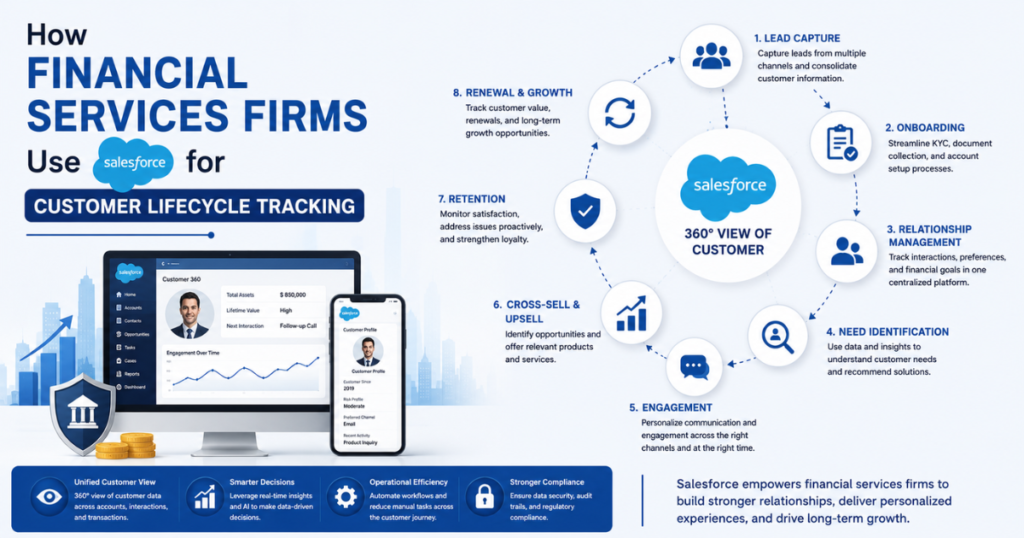

Financial services firms operate in one of the most regulated and data-heavy environments in modern industry. Every customer interaction carries compliance weight, risk implications, and revenue potential. Because of this, customer lifecycle tracking is no longer a back-office function; it sits at the center of business operations.
Recent industry data highlights how strongly financial institutions rely on CRM systems. According to Gartner, global spending on CRM software in financial services continued to grow steadily in 2025, driven by demand for unified customer data and regulatory reporting. IDC also reported that over 70% of large financial institutions now use a CRM platform as a core system of engagement, not just a sales tool. In parallel, Salesforce itself reported more than 150,000 customers globally across industries in FY2026, reflecting widespread enterprise adoption of structured customer management platforms.
These numbers point to a clear trend: financial services firms increasingly depend on platforms like Salesforce to manage the full customer lifecycle, from acquisition to retention and long-term relationship management.
But the real question is not whether Salesforce is used. The real question is how it changes lifecycle tracking inside banks, insurance companies, and investment firms.
Why Customer Lifecycle Tracking Matters in Financial Services
Customer lifecycle tracking in financial services goes far beyond traditional CRM use cases. A single customer may interact with multiple business units over time, including retail banking, credit, investments, insurance, and wealth advisory services.
Without a unified system, these interactions remain fragmented.
This fragmentation creates real operational problems:
- Advisors lack visibility into customer portfolios across products
- Risk teams miss early signals of financial distress
- Sales teams approach customers without full relationship context
- Compliance audits take longer due to scattered records
In financial services, missing context is not just inefficient—it can create regulatory exposure.
Salesforce addresses this challenge by creating a continuous view of the customer journey across all touchpoints.
Customer Onboarding: The First Stage of Lifecycle Tracking
The lifecycle begins with onboarding, and this stage sets the foundation for all future interactions.
Financial institutions typically handle onboarding through multiple systems—KYC verification tools, document management platforms, credit assessment engines, and internal approval workflows. Salesforce acts as the coordination layer across these systems.
During onboarding, firms use Salesforce to track:
- identity verification progress
- document submission status
- risk scoring updates
- account approval workflows
- product eligibility decisions
Instead of relying on manual updates, teams work with real-time status visibility.
This reduces onboarding delays, but more importantly, it creates a structured customer profile from day one. That profile becomes the foundation for all lifecycle tracking activities that follow.
Relationship Management and Cross-Channel Visibility
Once a customer enters the system, financial firms focus on maintaining a complete view of interactions across departments.
Salesforce aggregates data from multiple touchpoints such as mobile banking apps, branch visits, call centers, and advisory meetings. This integration ensures that every interaction updates the same customer record.
A relationship manager can view:
- account balances and transaction behavior
- investment portfolio performance
- loan repayment history
- service requests and complaints
- engagement history across channels
This visibility changes how financial conversations take place.
Instead of working with partial information, advisors operate with full context. That leads to more accurate recommendations and better timing for financial products such as loans, insurance upgrades, or investment rebalancing.
Risk Monitoring and Early Warning Signals
One of the most important uses of Salesforce in financial services is risk tracking across the customer lifecycle.
Risk does not remain static. It evolves based on behavior patterns such as missed payments, sudden withdrawal activity, or changes in credit usage.
Salesforce enables firms to track these signals by integrating with core banking systems and external data sources.
Typical risk indicators tracked include:
- delayed EMI payments
- credit utilization spikes
- reduced account activity
- abnormal transaction patterns
- changes in income-linked behavior
When these signals appear, Salesforce can trigger alerts to relationship managers or risk teams.
This does not replace core banking risk systems. Instead, it adds a customer-level context layer that helps teams respond earlier.
Customer Engagement Across Product Lifecycle
Financial services firms rarely sell a single product. A customer may start with a savings account and later adopt loans, insurance, credit cards, or investment products.
Salesforce helps track this multi-product lifecycle in a structured way.
Each product interaction becomes part of the customer’s lifecycle profile. Over time, firms can identify patterns such as:
- customers likely to upgrade to premium banking
- clients eligible for wealth management services
- users showing interest in credit expansion
- policyholders due for renewal or cross-sell offers
This is where lifecycle tracking becomes commercially valuable.
Instead of running disconnected campaigns, firms can base engagement on actual behavioral data.
Compliance and Audit Readiness
Regulatory compliance remains one of the strongest drivers of CRM adoption in financial services.
Regulators require institutions to maintain complete records of customer interactions, approvals, risk decisions, and communication history.
Salesforce supports this requirement by maintaining a structured audit trail across the entire lifecycle.
Every action is recorded, including:
- changes in customer profiles
- approval workflows
- communication logs
- policy updates
- product modifications
This reduces audit preparation time significantly and improves transparency during regulatory reviews.
In highly regulated markets, this capability often becomes as important as revenue tracking.
Real-World Enterprise Example: HSBC
A well-known example of Salesforce adoption in financial services comes from HSBC. The bank implemented Salesforce to unify customer data across multiple business units and improve relationship management across retail and commercial banking segments.
Before implementation, customer information existed in separate systems across regions. This created inconsistencies in customer engagement and made it difficult for relationship managers to understand the full customer journey.
After Salesforce integration, HSBC created a centralized customer view that connected data from multiple banking systems.
The bank reported improvements in:
- relationship manager efficiency
- cross-product visibility
- customer engagement consistency
- data access speed across regions
The key outcome was not just better reporting. It was better lifecycle continuity across fragmented banking systems.
This example reflects a broader industry trend where large financial institutions move toward unified customer intelligence systems instead of siloed databases.
Role of Salesforce in Investment and Wealth Management
In investment and wealth management firms, lifecycle tracking becomes even more complex because customer goals evolve over time.
Salesforce helps advisors track:
- portfolio allocation changes
- risk appetite adjustments
- long-term financial goals
- advisory meeting history
- market-driven behavior shifts
This enables more personalized financial planning.
Instead of static customer profiles, advisors work with dynamic lifecycle models that update based on real-time data.
This improves advisory accuracy and strengthens long-term client relationships.
Integration With Core Banking and IoT-Driven Financial Data
Modern financial institutions increasingly integrate Salesforce with core banking systems, payment gateways, and even IoT-enabled financial products.
For example, connected insurance devices in automotive or health insurance ecosystems generate real-time usage data. When integrated with Salesforce, this data helps insurers track customer behavior more accurately.
A telematics-based insurance model may use driving behavior data to adjust premiums or recommend safer driving programs. Salesforce acts as the customer-facing intelligence layer that organizes this data into actionable lifecycle insights.
This combination of financial systems and IoT data creates a more continuous and responsive customer lifecycle model.
Importance of Custom Development in Financial CRM Systems
Financial institutions rarely use Salesforce in its default configuration. Most require significant customization due to regulatory complexity, product diversity, and operational scale.
This is where a specialized Salesforce Development company becomes important. These teams design system architectures that align with banking workflows, compliance rules, and multi-product lifecycle structures.
Common customizations include:
- multi-entity customer data models
- regulatory compliance workflows
- risk scoring integrations
- custom advisor dashboards
- automated lifecycle triggers
- secure API connections with core banking systems
Without structured customization, lifecycle tracking often becomes incomplete or fragmented.
In parallel, Salesforce Development Services support ongoing optimization by maintaining integrations, improving automation logic, and adapting systems to evolving regulatory requirements.
ROI and Business Impact in Financial Services
The impact of Salesforce on lifecycle tracking is measurable, especially in large institutions.
Common improvements include:
- faster onboarding cycle times
- higher cross-sell conversion rates
- improved customer retention
- reduced compliance processing time
- better advisor productivity
- increased product adoption rates
For example, even a modest improvement in cross-sell conversion within a large retail banking portfolio can generate significant revenue expansion due to scale.
Similarly, reducing onboarding time by a few days improves customer satisfaction and increases early-stage engagement rates, which often correlate with long-term profitability.
In financial services, small efficiency gains often translate into large financial outcomes because of the size and complexity of customer portfolios.
Final Thoughts
Salesforce has become an important system for customer lifecycle tracking in financial services, not because it replaces core banking platforms, but because it connects fragmented systems into a unified customer view.
From onboarding to advisory engagement, risk monitoring to compliance reporting, Salesforce supports a continuous understanding of customer behavior across the entire relationship lifecycle.
However, the effectiveness of lifecycle tracking depends heavily on implementation quality, system integration, and ongoing governance. Financial institutions that treat Salesforce as a long-term operational system—rather than just a CRM tool—achieve stronger results in customer engagement and revenue performance.
A capable Salesforce Development company helps institutions design lifecycle models that align with regulatory and operational requirements, while Salesforce Development Services ensure those systems remain scalable, secure, and adaptive as financial ecosystems evolve.
In a sector where trust, accuracy, and timing define success, lifecycle visibility is no longer optional—it is a core operational requirement.