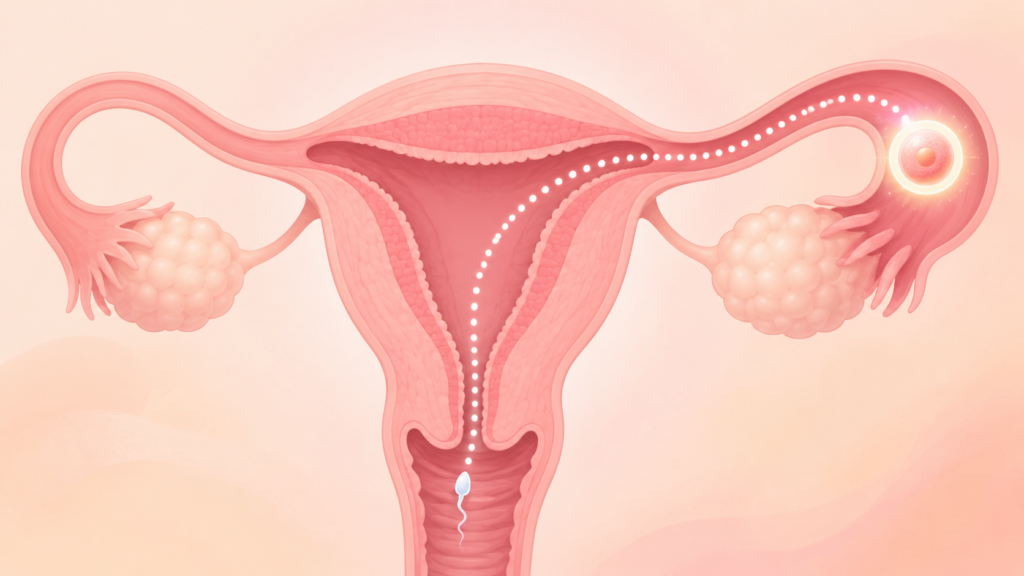

Conception looks simple in a diagram — a single sperm traveling up to meet an egg — but it’s actually the result of remarkable timing and a long, competitive journey. The illustration above captures the key moment: sperm entering through the cervix, swimming up through the uterus, and reaching the fallopian tube where a freshly released egg is waiting. Understanding each step of this process helps explain not only how pregnancy begins, but also why timing matters so much when you’re trying to conceive.
It starts with ovulation
Every cycle, the ovaries prepare a group of follicles, and usually one matures and releases an egg. This is ovulation. The egg leaves the ovary and is swept into the nearby fallopian tube by finger-like structures called fimbriae — the feathery edges you can see at the ends of the tubes in the illustration.
Once released, the egg has a short window of viability: roughly 12 to 24 hours. If it isn’t fertilized in that time, it dissolves and is shed with the next period. This narrow window is why knowing when you ovulate is so valuable, and why tools like the ovulation calculator at nanacircle.com can make a real difference for couples trying to conceive.
The sperm’s journey
When sperm are deposited in the vagina, only a fraction of the millions present will begin the journey upward. They pass through the cervix, into the uterus, and then must choose the correct fallopian tube — the one containing the egg. The dotted path in the illustration traces exactly this route: from the cervix, up through the uterine cavity, and into the tube.
It’s a demanding trip. The female reproductive tract filters out weaker or abnormally shaped sperm along the way, and only a small number of the strongest swimmers reach the egg. Crucially, sperm are hardy travelers: they can survive inside the reproductive tract for up to five days. This is why pregnancy is possible from intercourse that happens before ovulation, not just on the day itself.
The fertile window
Combining the lifespan of sperm with the lifespan of the egg gives you the fertile window — roughly six days each cycle. It includes the five days leading up to ovulation plus ovulation day itself. Intercourse during this window gives sperm the best chance of being present and ready when the egg is released.
Because cycles vary from person to person, pinpointing this window isn’t always obvious. Tracking your cycle length, ovulation signs, and period dates helps you predict it more accurately. The free period and ovulation calculators at nanacircle.com are designed to estimate your most fertile days based on your own cycle, taking some of the guesswork out of timing.
Fertilization
When a sperm finally reaches the egg, fertilization usually takes place in the widest section of the fallopian tube, called the ampulla. The sperm must break through the egg’s outer layers — and once one succeeds, the egg immediately changes its surface to block any others from entering. From that point on, the genetic material of both cells combines to form a single cell called a zygote.
This is the true beginning of a new pregnancy, though it’s invisible and happens days before any test could detect it.
From fertilized egg to implantation
Fertilization isn’t the end of the journey. The zygote begins dividing as it slowly travels down the fallopian tube toward the uterus, a trip that takes about six to ten days. By the time it reaches the uterine lining, it has developed into a cluster of cells called a blastocyst.
The blastocyst then burrows into the thickened, nutrient-rich lining of the uterus in a process called implantation. Only after successful implantation does the body start producing the pregnancy hormone hCG — the hormone that home pregnancy tests detect. This is why testing too early often gives a false negative: the embryo simply hasn’t implanted and started signaling yet.
Why timing and tracking matter
For anyone trying to conceive, the takeaways from this process are practical:
- The egg’s window is short — about a day — so sperm need to already be present or arrive quickly.
- Sperm can wait — up to five days — which is why the days before ovulation matter as much as the day itself.
- Your fertile window is roughly six days, and identifying it is the single most useful thing you can do to improve your chances.
Knowing your own cycle is the foundation for all of this. Logging your periods, watching for ovulation signs, and using a reliable calculator helps you understand your unique pattern rather than relying on textbook averages. The cycle, ovulation, and pregnancy tools at nanacircle.com bring these together in one place, so you can move from tracking your fertile window to following a pregnancy week by week once conception happens.
A note on the bigger picture
While the mechanics of conception are the same for everyone, fertility itself depends on many factors — age, overall health, cycle regularity, and conditions affecting either partner. If you’ve been trying to conceive for a while without success, or if your cycles are very irregular, it’s worth speaking with a doctor or fertility specialist. Tracking tools are a helpful starting point, but they work best alongside professional guidance.
This article is for general educational purposes and is not a substitute for medical advice. For concerns about fertility or your reproductive health, consult a qualified healthcare provider.