
As online education and corporate learning continue to grow, ensuring the integrity of online assessments has become a top priority. Whether you’re a university, a corporate training provider, or an organization using a Learning Management System (LMS), protecting exams from cheating is essential for maintaining credibility and learner trust.
This is where AI Online Exam Proctoring has transformed digital assessments. By combining artificial intelligence with advanced monitoring technologies, AI-powered proctoring helps create a secure testing environment without requiring a human invigilator. It enables educational institutions and businesses to conduct fair, reliable, and scalable online exams while improving the overall learner experience.
In this article, we’ll explore how AI Online Exam Proctoring strengthens LMS security, its key benefits, and why it’s becoming an essential feature for modern learning platforms.
What Is AI Online Exam Proctoring?
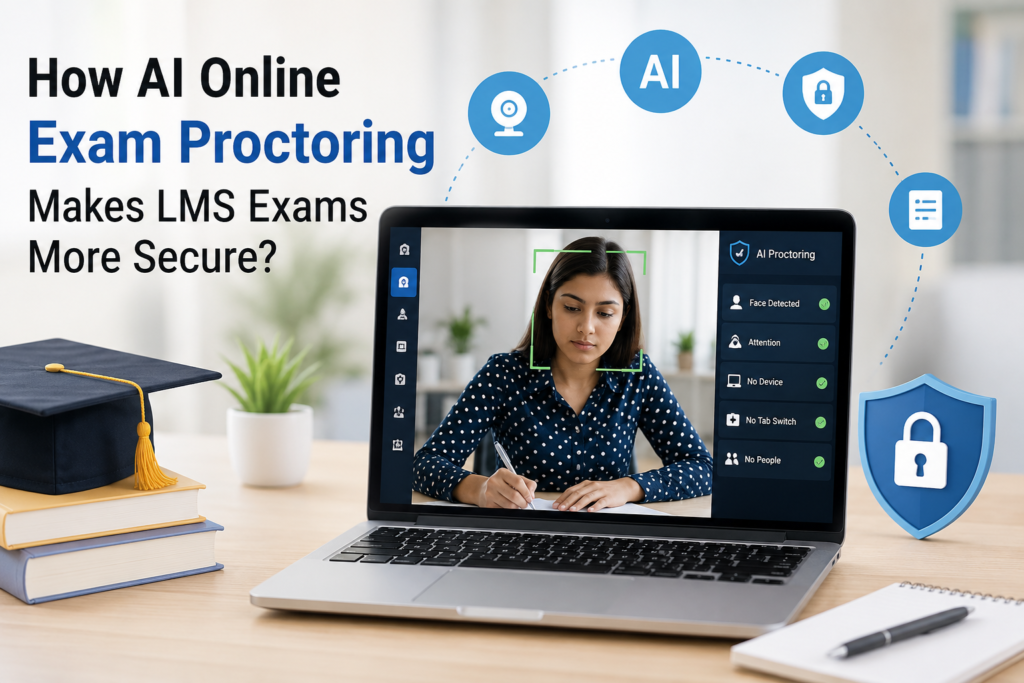
AI Online Exam Proctoring is an automated technology that monitors candidates during online examinations using artificial intelligence. It analyzes live video, audio, screen activity, browser behavior, and facial recognition to identify suspicious activities that could indicate academic dishonesty.
Unlike traditional exam supervision, AI proctoring can monitor multiple learners simultaneously, providing accurate insights and reducing the need for manual intervention. It works seamlessly with modern LMS platforms, allowing organizations to conduct secure online assessments regardless of the learner’s location.
Why Secure Online Exams Matter?
Online learning has made education and employee training more accessible than ever. However, it has also introduced challenges such as impersonation, unauthorized resources, browser switching, and collaboration during exams.
Without proper security measures, online certifications lose their credibility, and organizations risk making decisions based on inaccurate assessment results. AI-powered proctoring addresses these challenges by ensuring every learner completes exams under fair and monitored conditions.
How AI Online Exam Proctoring Enhances LMS Security
1. Real-Time Candidate Identity Verification:
One of the biggest concerns during online examinations is confirming that the registered learner is the person taking the test.
AI Online Exam Proctoring uses facial recognition and identity verification before and during the examination. Continuous identity checks help prevent impersonation and ensure assessment authenticity.
2. Continuous Behavior Monitoring:
Artificial intelligence monitors learner behavior throughout the exam session. It detects unusual movements, frequent eye shifts, multiple faces, background conversations, or attempts to leave the testing area.
Instead of relying solely on human observation, AI generates detailed reports that help instructors review flagged incidents quickly and objectively.
3. Browser and Screen Activity Detection:
Many AI proctoring solutions restrict browser navigation or detect attempts to switch tabs, open unauthorized applications, or access external websites during exams.
This significantly reduces opportunities for cheating while maintaining a smooth user experience.
4. Automated Flagging of Suspicious Activities:
Rather than interrupting learners unnecessarily, AI systems automatically record suspicious events and assign risk scores based on predefined rules.
LMS administrators can review these reports after the exam, saving valuable time while ensuring consistent evaluation.
Integration with Modern Learning Management Systems
One of the biggest advantages of AI Online Exam Proctoring is its ability to integrate with existing LMS environments.
Organizations using LMS Administration Services can configure AI proctoring tools within their learning ecosystem without disrupting existing workflows. From exam scheduling to automated grading and reporting, everything remains centralized within the LMS.
This seamless integration improves efficiency while maintaining high assessment standards.
Benefits for Educational Institutions
Educational institutions increasingly rely on digital assessments for admissions, certifications, and semester examinations.
AI Online Exam Proctoring offers several advantages:
- Reduces academic dishonesty
- Supports remote examinations
- Improves examination credibility
- Saves administrative time
- Provides detailed audit reports
These benefits help institutions deliver reliable online education without compromising assessment quality.
Benefits for Businesses and Corporate Training
Organizations investing in employee learning also benefit from AI-powered exam security.
A robust LMS System For Business enables companies to deliver compliance training, certification programs, leadership development, and skill assessments across distributed teams.
When AI Online Exam Proctoring is integrated into corporate learning, businesses can:
- Verify employee certifications
- Prevent fraudulent assessments
- Maintain compliance standards
- Measure training effectiveness accurately
This creates greater confidence in employee qualifications and learning outcomes.
AI Proctoring Supports Online Training Platforms
Every modern Online Training Platform aims to provide flexible learning experiences while maintaining assessment integrity.
AI Online Exam Proctoring enables organizations to deliver secure examinations without requiring physical testing centers. Learners can complete exams from home or any approved location while administrators maintain complete visibility into the examination process.
This flexibility improves learner satisfaction while reducing operational costs.
Powering the Next Generation of Learning Platforms
Today’s next Learning Platform Software is evolving beyond simple course management. Modern LMS solutions combine AI, automation, analytics, personalized learning, and secure assessment technologies into one integrated ecosystem.
AI-powered proctoring plays an important role in this evolution by enabling:
- Intelligent exam monitoring
- Automated reporting
- Scalable assessment management
These capabilities help organizations deliver high-quality learning experiences while maintaining strong security standards.
Supporting Remote Workforce Training
With hybrid and remote work becoming standard across industries, organizations increasingly rely on Remote Training Software to educate employees worldwide.
Remote training often concludes with knowledge assessments and certification exams. AI Online Exam Proctoring ensures these assessments remain trustworthy regardless of participant location.
Employees benefit from flexible learning schedules, while organizations gain confidence that certifications accurately reflect employee knowledge and skills.
Best Practices for Implementing AI Online Exam Proctoring
To maximize the effectiveness of AI-powered exam monitoring, organizations should:
- Inform learners about proctoring policies before exams.
- Use secure authentication methods.
- Configure AI sensitivity levels based on exam requirements.
- Review flagged incidents instead of relying solely on automation.
- Regularly update LMS security settings.
Following these best practices creates a transparent and secure assessment experience for everyone involved.
Conclusion
As online learning continues to expand, secure digital assessments are no longer optional—they are essential. AI Online Exam Proctoring provides an intelligent, scalable, and reliable solution for protecting exam integrity while reducing administrative workload.
Whether integrated into LMS Administration Services, an LMS System For Business, an Online Training Platform, next Learning Platform Software, or Remote Training Software, AI-powered proctoring helps organizations conduct fair assessments, strengthen learner trust, and maintain the value of certifications.
By combining automation, intelligent monitoring, and seamless LMS integration, AI Online Exam Proctoring is shaping the future of secure online education and corporate training. Organizations that embrace this technology today will be better prepared to deliver trusted learning experiences in an increasingly digital world.